Turn off the hectic East-West Highway at Chandrauta, bump up a short dirt road, and you reach the equally busy Basic Health Services Hospital in Shivraj Municipality, Kapilvastu District. Small groups of people gather around its two single-storey buildings — some line up, others fan themselves in the morning heat.
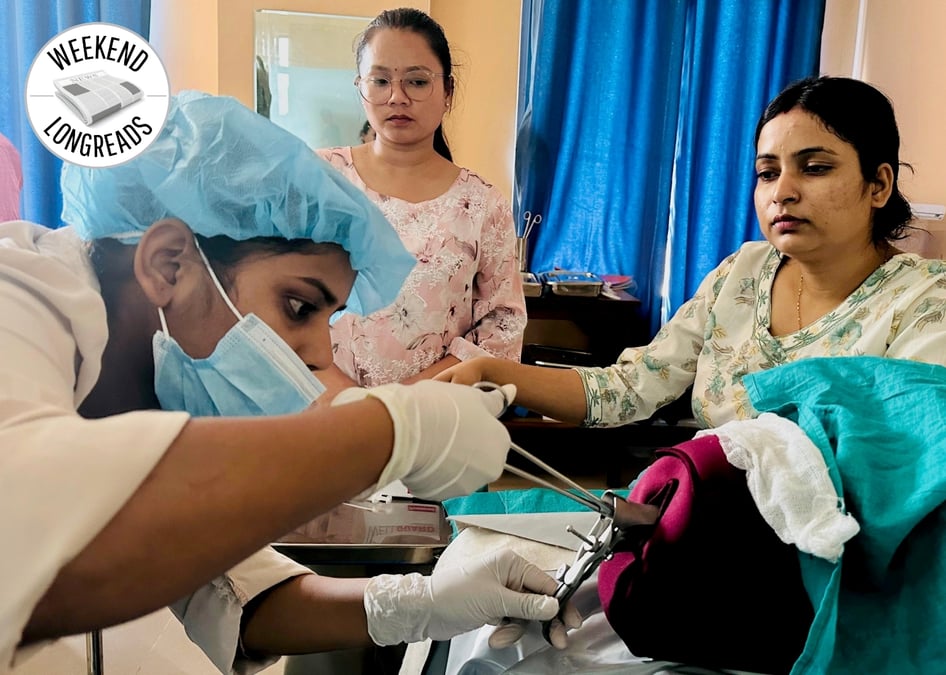
To the left is a new, smaller building. The main room is unfinished and boxes of supplies are scattered on the floor, but other areas are being used. At one end, a pharmacist sits at a window serving a line of people outside. In an office at the other end, a nurse at a desk talks to a pregnant woman during a pre-delivery (antenatal care, or ANC) visit.
“This Smart Integrated Clinic will be a one-stop shop for mother and child healthcare,” says Hospital Director Birendra Kumar Mishra. Financed by the municipality and equipped by UNICEF, the clinic will focus on vaccinating children in the hospital’s catchment area of nearly 100,000 people.
To date only about 70% of kids in the area get vaccinated due to low awareness or hesitation among locals, or because many born at the hospital are from families who live elsewhere.
“Many families from outside can’t afford to wait until the next vaccination day; the Smart Clinic will offer inoculations daily so they won’t have to,” says Mishra, sitting in his office with the ceiling fan whirring. Its records will be linked to a Government of Nepal information system, so if a mother or child misses an appointment they can be traced and contacted, he adds.
In an email, UNICEF credits proactive local leaders and a strong willingness to invest in innovation for the Smart Clinic, which is soon supposed to start delivering other services like nutritional counselling by female community health volunteers (FCHVs).
But like much of maternal and newborn health (MNH) in Kapilvastu, in Lumbini Province, and across Nepal, news at the Basic Hospital is not all positive.
About a month later in the same office, Dr Amit Pandey is explaining the recent death of a pregnant woman. Close to her delivery date, she arrived at the hospital with high blood pressure (known as pre-eclampsia) and severe anaemia.
Doctors referred her to the provincial hospital in Butwal, but her family took her home instead. Eight days later she returned, unconscious. Again, doctors referred her to Butwal but the family again returned home.
The next day she hadn’t improved so the family decided to follow the doctors’ advice but the woman, a mother of three, died on the way to the facility. “They are very poor,” said Pandey. “We referred the case but they didn’t want to go to a higher centre — they were worried about the cost. We even offered them a free ambulance but they didn’t take it.”
Ironically, two days earlier the Director of the Lumbini Province Health Directorate singled out the referral system as a weakness in the province’s healthcare.
“Our referral mechanisms are very poor,” said Roshan Lal Chaudhary in an interview in Taulihawa. “For example, we lack facilities in Kapilvastu, so from Kapilvastu Hospital a referral would be made to Butwal. We prepare the papers, but they don’t go. Sometimes it’s a financial issue. It could also be because they lack confidence speaking or they don’t know anyone there.”
Asked if Lumbini Province will meet the 2030 target for maternal mortality in the United Nations Sustainable Development Goals (SDGs), “it will be difficult,” said Chaudhary.
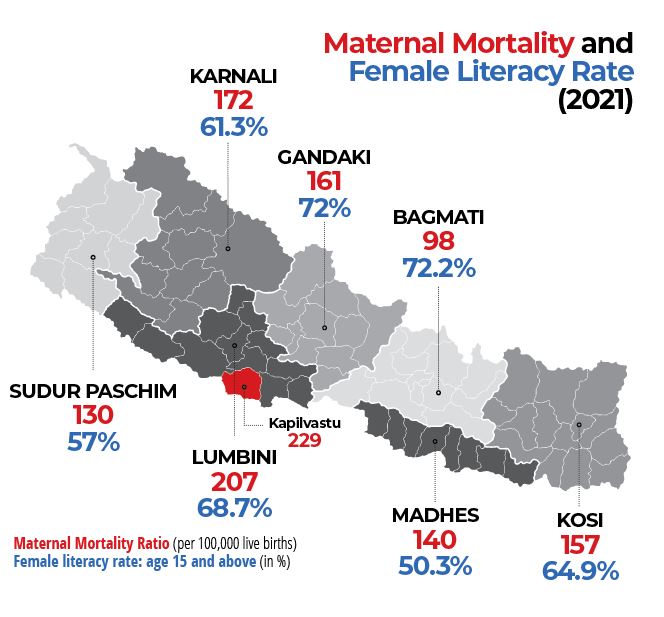
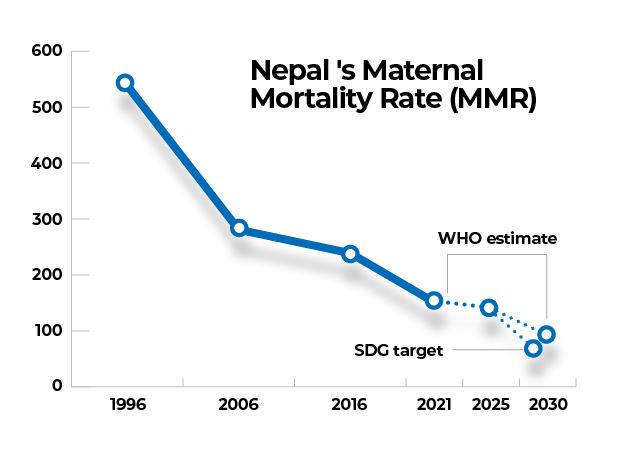
The Report on Maternal Mortality, part of the 2021 census, put Nepal’s maternal mortality ratio (MMR) at 151 deaths per 100,000 live births. Lumbini was the highest among provinces: 207 (see map). Kapilvastu’s MMR was 229.
In February 2025, the World Health Organization (WHO) estimated the national MMR had dipped to 142. Between 2016 and 2023 it fell 5.8% yearly, added the report. If that trend is maintained, WHO predicts that Nepal’s MMR will reach 93 by 2030, missing the SDG target of 70.
Early triumph
In 1996, Nepal’s MMR was 539 but by 2016 it had dropped to 239 and the country was celebrated globally for reducing maternal deaths. While progress has slowed, multiple efforts are being made by Nepal’s health community, including all three levels of government, to regain momentum to meet the SDGs target.
But inadequate funding from the central government and the sudden cut earlier this year of millions of dollars injected annually by USAID have made that climb steeper.
Kapilvastu followed the national trend — it made a huge improvement and then momentum braked. Home deliveries, which are riskier because they usually occur without skilled medical staff, dropped from 2,256 in 2019-20 to 284 in 2024-25, according to local non-government organisation (NGO) Kalika Self-Reliance Social Centre.
But with larger marginalised communities, whose members are less educated and more conservative, and frequent movement across the border with India, the challenge in Kapilvastu is greater. For example, between 2020-21 and 2022-23 the number of deliveries attended by a skilled birth attendant fell from 60% to 54%, according to the health directorate’s annual report. Births in health facilities dipped from 60% to 58% in the same period.
Lack of awareness seems to be on the lips of everyone asked to explain Kapilvastu’s maternal and child health issues. At Ganeshpur health post in Bijaynagar Rural Municipality, in-charge Gautam Roy is hoping that replacing 10 of 12 FCHVs, who retired, will spark greater awareness-raising but he says the scope for gain is limited by the community.
“We have fewer home deliveries now—just one or two a month compared to five when I arrived five years ago—but some local people are not well educated so they don’t follow our advice,” says Roy, sitting behind the desk in his office.
“They don’t make a plan, so when a woman has to go for delivery they don’t call the transport on time. In other cases, they don’t know the date of delivery, even though the health post calls them regularly to remind them,” he adds.
The situation varies from municipality to municipality and even from ward to ward. In Buddhabhumi Municipality, six wards had zero home deliveries in the previous year, the other four will reach the target this year, says Mayor Keshav Shrestha. One of those wards is Muslim majority, he adds, sitting on a couch facing a steady stream of service seekers coming through the office door.
Now in his second term in office, Shrestha says it’s clear why his government is investing in maternal and child health: “If we don’t look after these basic needs, then the community will not be developed for the future.”
Marginalised communities
The Madheshi and Muslim communities are often singled out for avoiding healthcare services. “In those communities the literacy rate is a little lower and the decision-making power of women is less,” said Chaudhary.
For example, Muslim women are the least likely group in Nepal to deliver in a health facility (67%); most common are Brahmin/Chhetri women (87%), found the 2022 Nepal Demographic Health Survey.
Muslims make up 18% of Kapilvastu’s people.
At the Basic Hospital, director Mishra says Muslims don’t necessarily lack awareness — some community members believe that their religion bars the use of certain services.
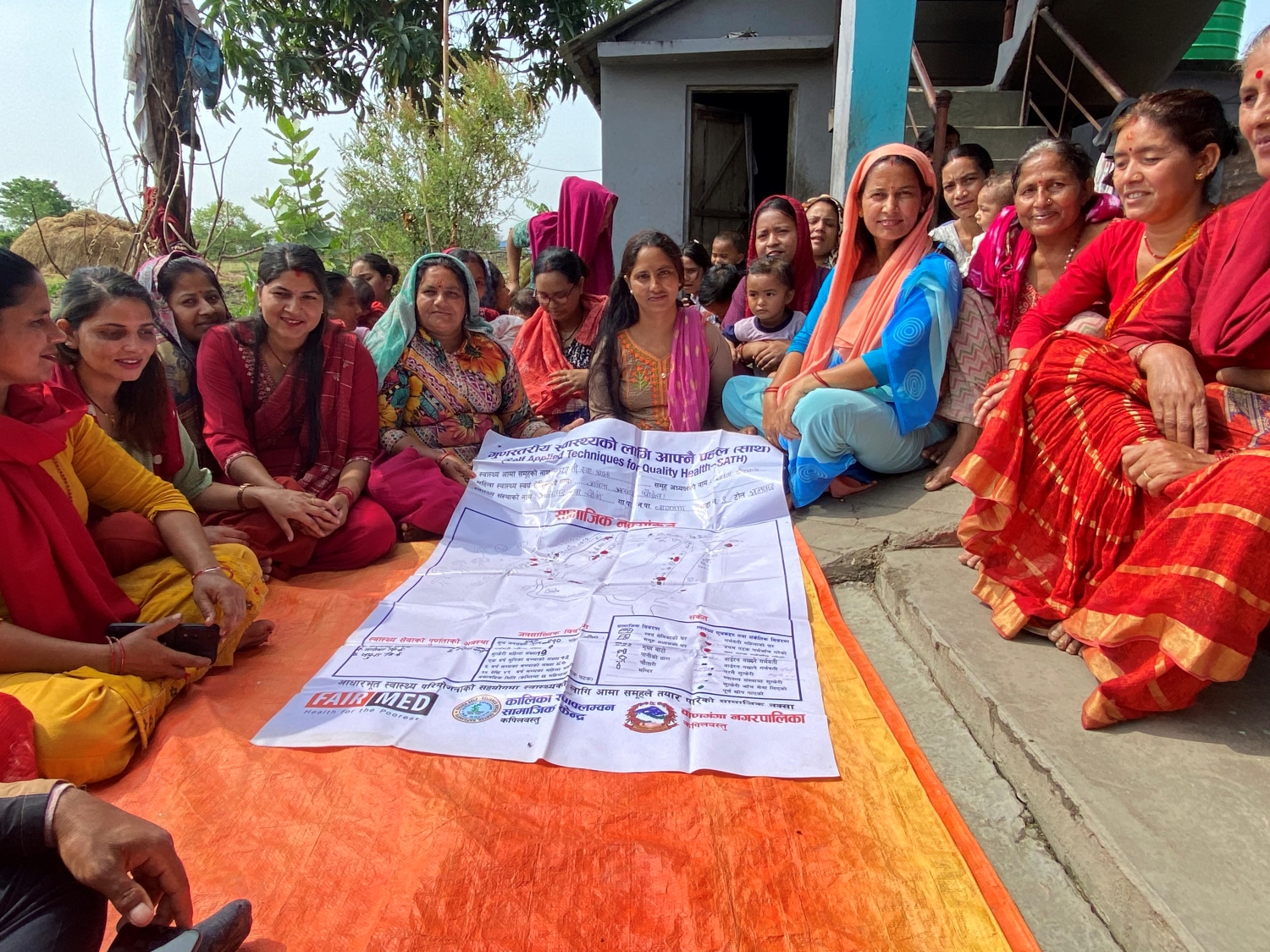
The INGO Fairmed has worked on MNH in Kapilvastu since 2011. Country Coordinator Nirmala Sharma says her team worked directly with Muslim religious leaders. “We developed a trust with them… those who got sensitized went to their mosques and sensitized people. Still, they can’t guarantee that 100% of people will comply.”
Teacher Niyaz Ahmad says that he has been encouraging family planning within the Muslim community since 2016. “I tell them, ‘planning starts before marriage. You have to choose your wife, your partner for life. After that, when do you want to have a child’?” he says in an interview at a local madrasa.
“After your first child, you must wait a minimum of two years to have your second. Otherwise, your child could have health problems, your wife could have health problems. It could be three years, four years — it depends on your wife’s health, your baby’s health.
The point is not to limit family size but to plan, says the teacher, founder of Madrasa Jamia Matalul Uloom Alsalafia, in Mayadevi Rural Municipality. “You can have one child, or three, or two but you have to make a plan.”
“These ideas are found in Islam, in the Quran, in the Prophet’s sayings,” adds Ahmad, who works within a programme known as Khusahal Pariwar, managed by the UN Population Fund (UNFPA) via a local NGO.
In Shivraj Municipality the use of family planning has risen 45% in the past 4 years, says UNFPA. Maternal and child health statistics have also improved, says the agency. For example, the number of women making four ANC visits rose 66% and facility deliveries jumped 101%.
Khushal Pariwar concepts have also been included in the class 8 health education curriculum and endorsed by the Madrasa Board of Lumbini Province and the National Madrasa Association, says the UN agency.