Nepal made significant gains in maternal and neonatal healthcare in the last 25 years, but the gains have stalled and the country may not meet global targets.
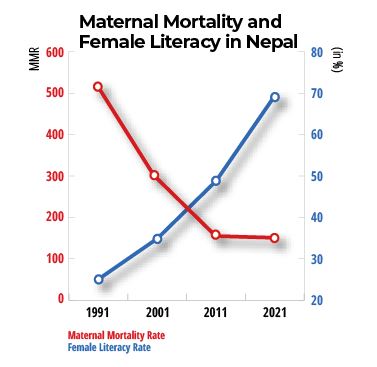
The national maternal mortality rate (MMR) dropped from 536 per 100,000 live births in 1996 to 151 by 2021. This progress was driven by improvements in healthcare infrastructure, the work of female health volunteers, improvements in perinatal care and a significant increase in hospital deliveries.
The National Safe Motherhood Program, Ama Surakshya initiative and the Female Community Health Volunteers (FCHV) have contributed to progress in reducing MMR and increasing institutional deliveries.
But the World Health Organisation (WHO) 2025 report puts Nepal’s MMR at 142 per 100,000 live births, which means it has flatlined for the past four years.
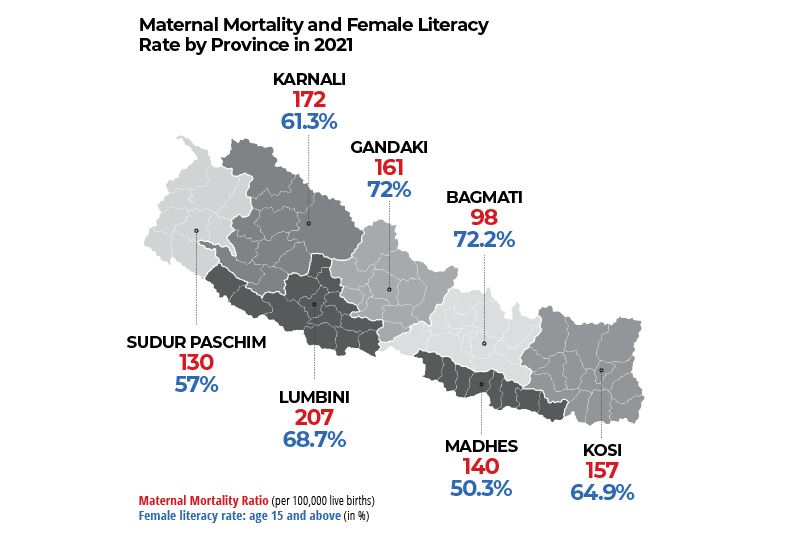
The national MMR average hides regional disparities, with maternal deaths remaining high in Lumbini (207) and Karnali (172). Despite Lumbini having a relatively higher female literacy, the province has low institutional deliveries and poor hospital care. Similarly, there are wide disparities among ethnic communities and socio-economic groups.
“Societal norms, education for girls, and gender rights play a critical role in shaping maternal and women's health outcomes,” explains public health expert Aruna Uprety. “Comprehensive awareness about sexual and reproductive health is essential, especially in rural areas where there is still a significant knowledge gap.”
Indeed, there is a direct inverse correlation between female literacy and child marriage with MMR across Nepal. The cause of maternal deaths, perinatal care including post-partum haemorrhage need particular focus.
Under Nepal’s national Sustainable Development Goals (SDGs) the target is to reduce MMR to 116 by 2030, against a global target of 70 per 100,000 live births.
The National Planning Commission has also set its own target to improve maternal health outcomes, but they are inconsistent— while one section of its 16th National Plan sets a MMR goal of 100 by 2029, another section of the same document presents a more ambitious goal of 85.
Such inconsistency even in target-setting creates confusion and undermines planning efforts, in monitoring, and fulfilment of maternal health goals — especially when existing health statistics are unreliable to begin with.
Read also: The slaughter of our daughters, Shristi Karki
“Conflicting targets and the lack of clarity at the highest levels of national planning create uncertainty for maternal health professionals, making it difficult to align their efforts and strategies,” says Laxmi Tamang, South East Asia Board Member of the International Confederation of Midwives (ICM).
Meanwhile, issues with budget deployment, and a lack of coordination between local and international agencies have also affected maternal and child health outcomes, which has been further exacerbated by the USAID funding freeze. The aid agency had allocated $72 million to reduce MMR and enhance access to healthcare in Nepal for this year.
Laws targeted towards sexual and reproductive health have played a significant role in improving maternal health outcomes in Nepal. Legalisation in 2002 brought down the number of unsafe abortions. Better access to reproductive health also reduced conditions including uterine prolapse.