
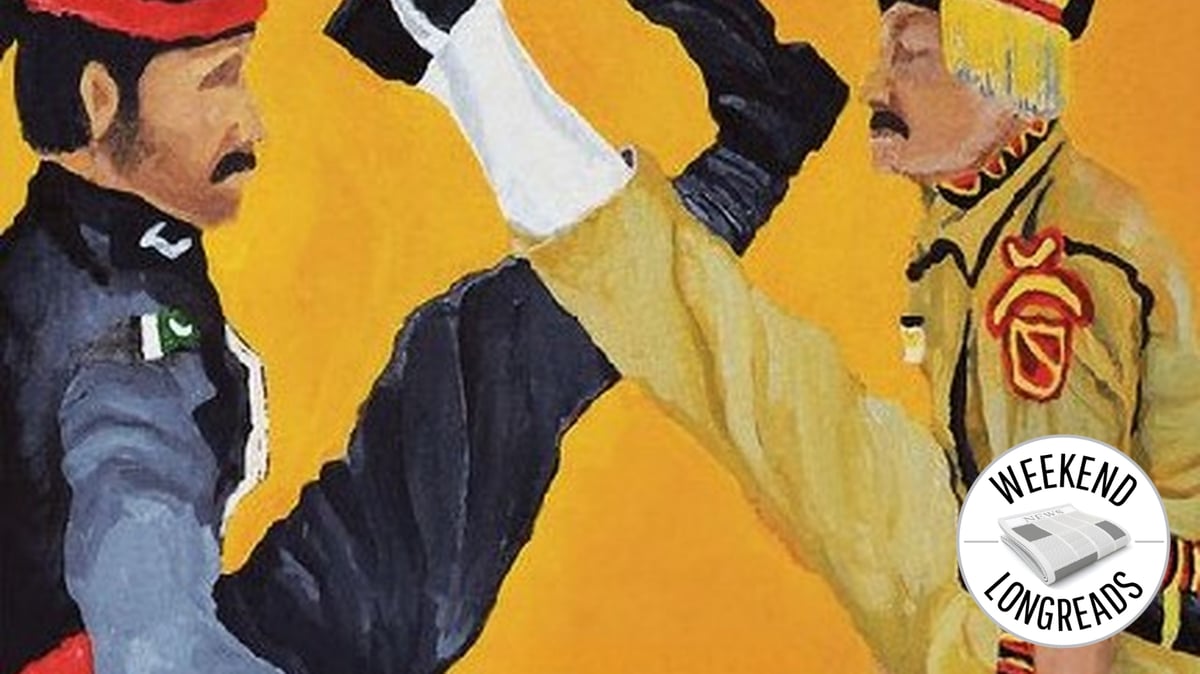
There are few performances in South Asia more elaborate, more physically strenuous, and more perplexingly admired than the daily parade of the Indo-Pakistani border forces at Wagah–Attari.
Tourists arrive hours in advance, vendors of tricolour souvenirs and green crescents ply their trade, and loudspeakers blare patriotic anthems across the expanse of a road bifurcated by a gate. As sunset nears, the atmosphere thickens, not with the sombre solemnity that borders usually evoke, but with the anticipatory buzz of a sporting event.
And then, as if summoned by the theatrical logic of the place, soldiers erupt into the parade ground, limbs swinging, chests thrust forward, boots slamming against asphalt as though the earth itself must be reminded of their presence.
The scene, captured in innumerable photographs, such as the one before us, has become an emblem of a curious tradition: an officially sanctioned performance of antagonism in which both India and Pakistan participate with remarkable enthusiasm.
One sees on the faces of the soldiers a fierce concentration, a form of militant pageantry that aims not at combat but at display. Their uniforms gleam; the plumes atop their caps arc dramatically skyward; their gestures are not merely amplified but exaggerated to the point of abstraction.
This is nationalism rendered as choreography, sovereignty expressed through the language of the body.
Yet behind the spectacle lies the unmistakable impression of something profoundly contradictory. The parade is an assertion of national virility, yet it is also a dance, a violent one, certainly, but a dance nonetheless.
It is a militaristic ritual that generates applause the way a circus might. And it is a carefully maintained illusion of enmity performed by actors who have rehearsed their roles daily, under the approving gaze of the states that employ them.
The result is a ritual at once absurd, ridiculous, and deeply revealing: a concentrated expression of the masculine imagination of the nation-state, and of the publics that find such imagination oddly comforting.
A theatre of colossal gestures
Most nations indulge in symbolic displays of military prowess, but few are as consciously theatrical as this. The raising of the flag at diplomatic premises, the changing of the guard at constitutional monuments—these are ceremonies steeped in tradition but restrained by decorum.
Wagah–Attari, by contrast, has abandoned restraint altogether. What remains is pure gesture: kicks so high they appear almost acrobatic, salutes so forceful they teeter on parody, marches so accelerated that they approach the limits of biomechanics.
If one were to imagine an anthropologist from another planet witnessing this ritual, one can almost predict the perplexed field notes: Two adjacent tribes meet daily to express hostility through stylised bodily movements. Their aggression substitutes for combat, yet the ritual is applauded by onlookers, suggesting that the conflict itself is symbolic, or perhaps therapeutic.
Indeed, the whole scene resembles a form of cathartic dissonance. The two nations, bound by a shared history, shared languages, interwoven cultures, have inherited a border that functions not simply as a territorial demarcation but as a repository of unresolved memory.
The parade attempts, each evening, to give physical shape to that memory. It is as if both sides seek, through a muscular choreography of kicks and stomps, to assert the sovereignty that history has always threatened to complicate.
Masculinity as national idiom
To discuss this ritual without foregrounding masculinity would be to miss its most conspicuous feature. The soldiers, with their towering plumed headgear and their hyperbolic gestures, perform a script of national virility. Their bodies become emblematic of state power, their gait heavy with meaning.
They do not simply walk; they storm forward. They do not merely turn; they whip around with the force of a centrifugal declaration. The parade offers an anatomy lesson in how nations imagine themselves: muscular, unflinching, unyielding.
This is masculinity not as identity but as ideology, an ideology in which control of the body mirrors control of the border. The soldiers are avatars of a vision in which the nation’s strength is measured by the height of a kick or the rigidity of a salute. In their movements, one senses a deeper anxiety, perhaps the fear that the nation is vulnerable, and therefore must be performed as invulnerable.
The irony is that both states participate willingly in this staging. It is not simply an Indian choreography or a Pakistani one; it is a duet of antagonism, a call-and-response of mirrored gestures. One soldier slams his boot; a soldier across the gate stands ready to match or exceed the gesture. The performance is symmetrical, as though the two nations were not adversaries but conspirators in a shared theatrical tradition.
The public as co-authors of the spectacle
What makes this ritual especially compelling is the audience. In the stands, spectators cheer, whistle, and chant slogans, investing themselves in a performative nationalism that lends the scene a sense of political intimacy.
Children wave flags, families record videos, and visitors from abroad observe with incredulity. The crowds do not remain passive; they amplify the event, lending it the effect of a communal festival.
It is not the hostility of war crowds, but the exhilaration of spectatorship, an exhilaration made possible by the knowledge that what unfolds before them is scripted, contained, and ultimately safe.
This complicity is revealing. It suggests that the ritual speaks to a psychological appetite: the desire to inhabit a narrative of national strength without bearing its consequences.
The parade allows citizens to imagine themselves as participants in a geopolitical drama while maintaining the comfortable distance of an audience. In this sense, the Wagah–Attari ceremony is a theatre of reassurance: a way for both nations to ritualise conflict without confronting its real costs.
The public’s admiration, so loudly voiced, is therefore not merely for the soldiers’ physical discipline but for the story the parade tells. It is a story in which the nation is bold, the enemy is predictable, and the border is a stage where identity is annually, weekly, daily reaffirmed. To cheer is to assent to the fiction.
The absurdity of official hostility
One cannot help noticing the paradox that this exuberant display of choreographed hostility is entirely official. Far from discouraging such theatrical militarism, the states endorse it. They regulate it, choreograph it, broadcast it, and invite citizens to revel in it.
In doing so, they reveal how deeply the apparatus of the state depends on spectacle. For all the rhetoric of danger and vigilance, this border, one of the most politically sensitive in the world, is transformed each evening into a carnival of muscular pantomime.
This contradiction is not accidental. The states understand that the ritual serves a political purpose: it manages hostility by domesticating it. Instead of the unpredictability of conflict, the nations opt for a predictable hostility, one that can be timed to the minute and choreographed to the centimetre. The border becomes a theatre of national mythmaking, not a site of existential threat.
The absurdity, then, is not in the soldiers’ gestures but in the logic that animates them: a logic that converts nationalism into a form of entertainment.
In a world where military conflict is devastating, the parade offers an illusion of control, an assurance that enmity can be expressed without violence. But illusions are fragile, and this one, for all its daily repetition, remains fundamentally theatrical.
A border turned mirror
At its core, the parade reveals the uncanny intimacy between the two nations. For all their political differences, India and Pakistan share an aesthetic vocabulary at Wagah–Attari.
Their soldiers dress similarly, march similarly, gesture similarly. The performance is less an encounter between enemies than a mirrored dance, in which each side reflects the other’s anxieties and aspirations. They are adversaries who understand each other too well.
The border, in this light, becomes a mirror: each nation sees itself reflected in the other’s parade. The soldiers confront not only an opposing force but a distorted version of their own national self-image. The hyper-masculine gestures and the exaggerated salutes reveal a shared grammar of sovereignty. The border becomes less a line of division than a site of mutual legibility.
This mirroring has a curious effect on the spectator. One begins to wonder whether the performance is adversarial at all. If the soldiers were to swap uniforms, would the ritual change? Would the public notice? Such questions underscore the extent to which the parade is a performance of difference constructed atop a deep layer of sameness.
Absurdity and the human condition
Seen from a philosophical perspective, the Wagah–Attari parade is not merely a nationalistic ritual but a commentary on the absurdity of the human condition. Here are two nations, born from the same historical trauma, reenacting that trauma through daily ceremonies of exaggerated hostility.
The repetition feels Sisyphean: no matter how often the soldiers stamp the ground, the border remains as contentious as ever. The parade changes nothing, yet it continues—precisely because it changes nothing. It is a ritual of stasis.
Albert Camus might have found in this ceremony an illustration of the absurd: humans inventing meanings to endure the existential void, nations inventing gestures to embody their anxieties. Yet the absurdity is not bleak; it is spectacular.
It is nationalism rendered as theatre, history rendered as performance. The parade is absurd precisely because it attempts to convert the unpredictability of geopolitics into a daily, choreographed certainty.
A creativity of nations gone awry
If one were to strip away the political context, the Wagah–Attari ceremony could almost be mistaken for modern performance art. Its exaggerated gestures, its strict symmetries, its audience participation, all resemble the avant-garde experiments of twentieth-century theatre.
But unlike performance art, which aims to disrupt the viewer’s assumptions, this ritual seeks to reinforce them. It is creativity bent toward conservatism: a spectacle that repeats rather than reimagines.
This creativity is nonetheless impressive in its own right. Few national performances elsewhere in the world show such choreographic discipline, such flamboyance, such sheer physical commitment.
And yet one is left wondering what might happen if the creativity devoted to manufacturing hostility were redirected toward imagining reconciliation. The theatre of the border could become a theatre of something radically different, if only the scripts were rewritten.
Conclusion: the paradox of admiration
Why, finally, does the public admire this ritual? Perhaps because it offers clarity in an increasingly ambiguous world. The parade presents nationalism in its simplest possible form: physical, evident, unambiguous.
It produces heroes whose heroism lies not in courage but in posture. It creates a story in which conflict is controlled, enmity is ritualised, and identity is performed rather than questioned.
And yet, hidden in the admiration is a tacit acceptance of the absurd. The parade’s masculinity is exaggerated to the point of self-parody; its nationalism is so theatrical that it reveals itself as a construction. Still, the crowd cheers. Officialdom applauds. Cameras flash. The ritual continues.
Perhaps this is the real message of the Wagah–Attari parade: that nations, like humans, are comforted by repetition, even when repetition borders on the ridiculous.
The ceremony endures not because it is serious, but because it is seriously staged. It is a performance in which soldiers become actors, borders become stages, and publics become audiences in search of reassurance.
And each evening, as the flags are lowered and the gates swing shut, one is left with the lingering impression of a theatre that never ends, a performance of power that conceals its own vulnerability, a masculinity that masks its own uncertainty, and a nationalism that depends, above all, on being seen.
Aftab Husain, PhD, is a Pakistan-born and Austria-based poet who writes in Urdu and English. He teaches South Asian Literature & Culture at Vienna University.