
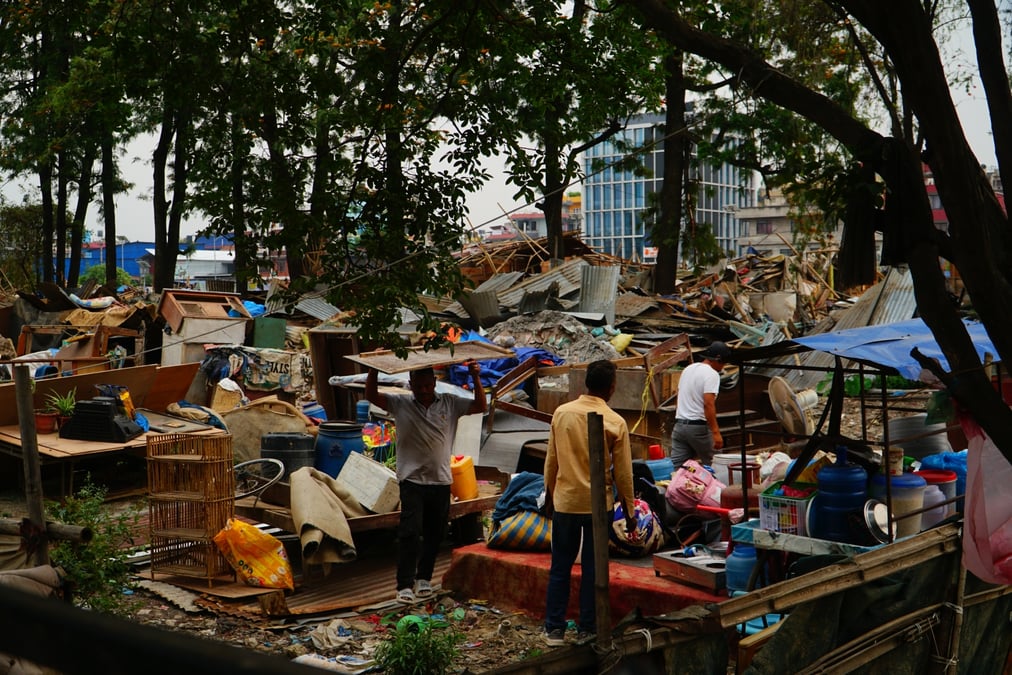
Barely a month into office, Prime Minister Balendra Shah flattened informal settlements in Kathmandu with bulldozers, sharply dividing Nepal’s cybersphere, the media, GenZ activists, and even his own ruling RSP.
The polarisation is most visible in the media. The mainstream press has relentlessly exposed the humanitarian tragedy of thousands of families losing their homes, schools and shrines being demolished, children and household pets out on rain-soaked streets.
Meanwhile, in the parallel universe of the social web there is widespread applause, and glee, at the prime minister’s decisive action to solve the squatter problem and make Nepal great again.
But fearing an electoral backlash from the negative news reports, the RSP secretariat this week asked the government in a mildly-worded statement not to bulldoze homes without first setting up a high-powered authority to identify the real landless. Prime Minister Shah had reportedly taken the decision to send in the bulldozers without formally informing his party or Cabinet.
The RSP seems more worried about how the visuals of the landless being made homeless will play out in the local elections next year. The party knows that its victory in the election was mainly because of ‘Balen’ and the online support he had from the diaspora, but it seems to have realised that the ones who stamped on the Bell in ballots are middle and lower-middle class people on the ground.
With clashes between squatter communities and riot police reported from Butwal, Pokhara and other parts of the country, the party in its statement also asked local governments not to use bulldozers.
The decision to remove informal settlements is laid out in the new government’s 100-point plan in Clauses 91 and 92 with a 100-day timeline for implementation. This has been a pet peeve of Balendra Shah even while he was mayor of Kathmandu, when his attempt to bulldoze squatter settlements was thwarted by the coalition of old parties.
There are an estimated 4 million landless and internal migrants without property titles across the country who have settled on public land along river banks, highways and government forests. Many were brought there by political parties to buttress vote banks, while the land mafia with political affiliation extracted rent from squatters.
Whatever the case, most families have lived in these informal settlements for generations in financially fragile situations, mostly doing day jobs in the city. They may have owned unproductive land in the mountains, but here with savings they added floors to their shanties, got electricity, paid taxes. Many of their children were born in the very homes that were bulldozed.
The RSP’s plan promises to digitally document all families to solve the problem once and for all by carefully mapping out and classifying land, as well as providing alternative means for genuine squatters in phases if they are eligible by income level or asset ownership. The clauses say the process will be fully transparent, and that a relevant ministry will directly monitor the coordination, follow-up, and implementation.
It all sounded good on paper. But the government gave little notice before sending in police with megaphones and batons, and even Nepal Army soldiers, to settlements at five in the morning before the bulldozers got there.
Supposedly reacting to the flood of shocking videos of families being thrown out into the streets, the Prime Minister took to social media this week to justify the evictions: ‘Have you forgotten, or do you still remember, the scenes every year when thousands of people living along Kathmandu’s riverbanks are forced to flee for their lives during floods…' He also said the settlements were creating a sanitation issue by making the river filthy.
In a further post, the Prime Minister stressed that squatters were being transferred voluntarily without using force, that the intention is not to displace citizens, and that adequate measures were taken to accommodate the families. He posted: ‘Don’t panic unnecessarily, and don’t spread unverified information.’
All this is little comfort to the 25,000 or so who were abruptly made homeless. Even critics of the evictions say those who were brought in by political parties with promises of land titles should be identified and removed, but add that there was a correct way to do this.
The prime minister and his advisers are convinced they are doing the right thing, mainly because of the massive support they have from social media accounts for removing urban blight and beautifying Kathmandu. Just like during the election campaign, the prime minister’s loyalists in Nepal and the diaspora have sprung into action to justify the move, viciously trolling anyone raising humanitarian concerns, accusing them of being supporters of the previous governments and engaging in ‘poverty porn’.
As mayor, Balendra Shah imposed his own vision to create a more liveable Kathmandu, one with no street vendors and squatters. Pushcart vegetable sellers mainly from the Tarai, and street merchants were beaten with sticks and expelled. Now prime minister, he appears to be continuing the crusade.
WAR ZONE
His supporters say the September protests were a lesson, and that only decisive and drastic street action can affect change in Nepal. These comments appear alongside critics posting drone images of razed neighbourhoods comparing them to war zones.
‘Balen’ supporters on social media also pounced on Human Rights Watch, Amnesty International and the International Committee of Jurists last week for their open letter to the prime minister that raised the alarm at the evictions, calling them a violation of human rights. Cyber lynch mobs were also unleashed on a statement by Nepali human rights activists, its signatories accused of being ‘dollar-funded’.
Besides individual ‘Balen’ supporters on social media, popular portals like Routine of Nepal Banda and 24 Ghanta Nepal have either sidestepped the humanitarian aspect of the evictions, or defended them. There is almost no mention of the two people who have died by suicide after their homes were destroyed, or of mothers breast-feeding babies amidst the ruins. In stark contrast, such heart-breaking stories of loss and sorrow appear daily in the mainstream press.
Supporters of Balendra Shah have compared him to the young Lee Kuan Yew who also became prime minister of Singapore at age 35 after separation with Malaysia. The message is that only ‘Balen’ with his methods can turn Nepal into Singapore, and there is significant support in the diaspora for that point of view.
This has further widened the gap between social media users who believe only such forceful action will save Nepal, and the perception that journalists in the mass media are puppets of the old parties parroting their propaganda.
On-site videos cover a wide range of viewpoints. Some are full of praise, pointing out the stucco houses with Corinthian columns that have been built on public land. Others are pressing for the arrest of politicians and bureaucrats who gave out land titles and building permits to squatters. Many more are distraught at having lost their home of decades and disillusioned with the RSP government.
Journalist and activist Narayan Wagle has been a vocal critic. The translation of his Setopati piece reads: ‘In such a short time since the election, we are falling so rapidly from the path of democracy that we have not even been able to find a handhold on this dangerous cliff.’ On the same site, Dalit activist Mitra Pariyar has compared the sight to the destruction of Gaza.
With the disapproval of the RSP’s methods on evictions and ruling by ordinance becoming louder, the prime minister called for reconvening Parliament on 11 May. The RSP may have support in the digital diaspora, but most Nepalis in Nepal have sent the message that they do not approve of such undemocratic behaviour.