
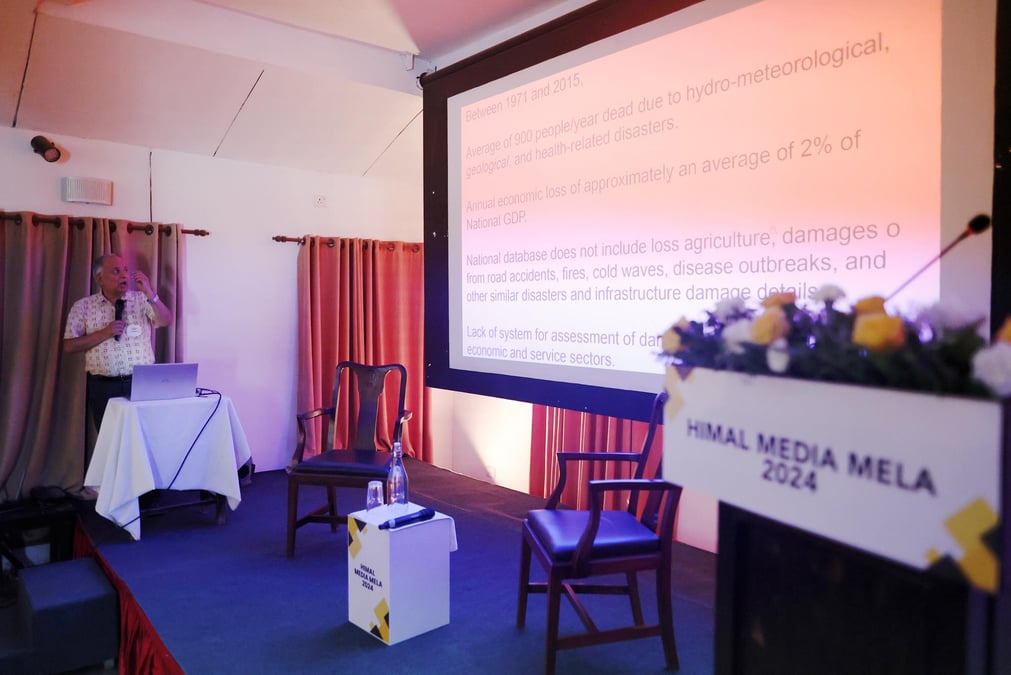
The third Himal Media Mela 2024 continued on Friday following the keynote speech from Mohamed Nasheed, climate activist, writer/journalist, and former president of the Maldives.
The day-long symposium included four workshops and two panel discussions ranging from possibilities of AI usage in newsrooms to threats faced by investigative journalists in environmental reporting, to climate finance.
In the first session of the day, Naresh Newar gave a workshop on AI in the Newsroom with a presentation about how media practitioners can responsibly use Large Language Models (LLM) and Generative AI to ease their workload.
“One main way AI can lighten the burden of journalists is by using it on small repetitive tasks that could lead to burnout,” said Newar, adding that newsrooms can use AI in such tasks as proofreading, transcription, review, and research.
“However, one must not claim AI-generated content as their own,” cautioned Newar.
The workshop also delved into the rapid advancement of AI technology, as well as its limitations. There was also discussion surrounding the ethics of AI use, and the need for newsrooms to be careful in identifying AI-generated content that might be posed as human-generated media.
Meanwhile, during the workshop on Data Mining to Tell Compelling Stories, data journalists Mohan Mainali and Arun Karki shed light on formulating stories from available data sources, and the importance of interactive data in storytelling.
“A single set of data can generate multiple stories and analyses,” said Arun Karki. “The key is to know how and where to look.”
Sharing his experiences while reporting for a three-part series published in Nepali Times analysing meteorological, hydrological and demographic data from eastern Nepal, Mohan Mainali emphasised on the importance of data visualisation.
“Like the expression, ‘show, don’t tell’ goes—it is the journalist’s responsibility to visualise and present data in the most easily apprehensible way for audiences,” said Mainali. “And although numbers by themselves do not have much to say, visualising those numbers reveals trends.”
The speakers also encouraged journalists to make the most out of open-source and freely available data while reporting on environmental issues, adding that climate-related data are more accessible than most.
“When media is under a financial crisis, data journalism lets journalists form a story without actually having to go to the field,” added Mainali.
Later in the day, water expert Ajaya Dixit during the workshop Media for Early Warning of Disasters discussed how Nepal can move to a disaster-resilient future. He highlighted that Nepal’s policies recognise that it is prone to multi-hazards, and must be prepared for them.
“The media must proactively communicate relevant messages before, during and after disasters, but attributing all environmental issues to climate change is not enough,” he said.
“Furthermore, no disaster is natural,” added Dixit, giving an example of how poorly built houses kill people, not earthquakes themselves. “Media coverage must stop referring to disasters as natural.
“We need to recognise the events within our borders—such as the soot from wildfires that are expediting the melting of the mountains— that contribute to the climate crisis,” remarked Rama Parajuli of the BBC.
Dixit also pointed to the need for collaboration between media practitioners, researchers, and development partners, and that knowledge and information need to be cross-validated.”
“Disaster, hazard, vulnerability, and risk are used interchangeably in Nepal. These terms need to be contextualised, disaggregated, and used appropriately,” he further added. “Reporting has to be based in science.”
The workshop Investigating Climate Finance led by economist Rashtraraj Bhandari of the Asian Development Bank was a crash course into climate finance, as well as jargon journalists must understand while reporting on climate finance.
The economist during his presentation emphasised the need for nations to generate their climate funds.
“Foreign grants and funding are never going to be enough to combat climate crises, and expecting external funding for them is more costly in the long-term— both economically and socially,” said Bhandari, “We as a country must identify what ‘green’ means for us, not what is dictated by grant-giving countries or projects.”
Bhandari also urged the journalists that storytelling should look beyond numbers. “Real stories are the ones that visualise the impact of crises,” he added.