
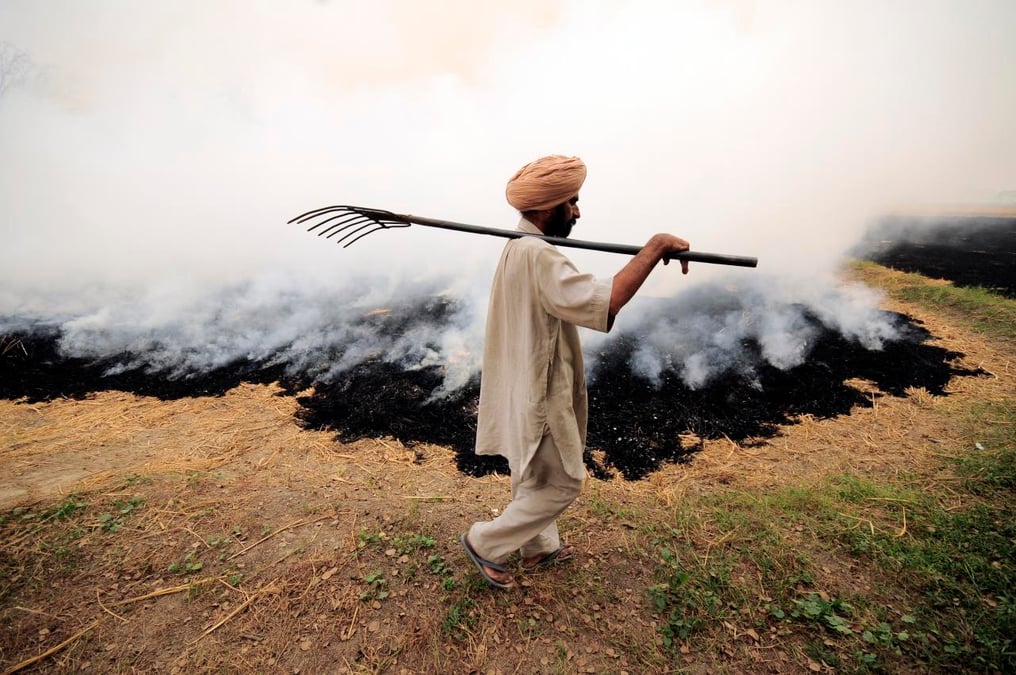
Stubble burning in northern India and Pakistan darkens the sky over the region every year in October. We cannot wait for next October to try to fix the problem — planning to resolve the problem should begin now.
Farmers even in the Nepal Tarai have started burning wheat harvest residue because of the shortage of farm hands, and this April the haze combined with wildfire smoke made people sick, blocked off mountain views forced flight cancellations.
Apart from Kathmandu Valley’s vehicular emissions, transboundary smoke blown in by prevailing winds from India accounts for much of the pollution in the country.
“The westerly wind cannot cross over the high Himalaya, and remains trapped on the southern side in Nepal, Bangladesh and India,” explains R L Verma, a transboundary air pollution expert at the Asian Institute of Technology (AIT) in Bangkok. "The pollution cannot disperse and is especially bad during winter due to inversion where it mixes with the fog.”
Prabhakar Shrestha, a research scientist at Bonn University, wrote in Nepali Times in 2021 that the long-term average of winter Aerosol Optical Depth (AOD) from December-February over the last 20 years in the region shows that winter haze extends throughout the Indo-Gangetic plains, with higher readings for eastern Bihar, West Bengal and Bangladesh, adjoining the Nepal Tarai.
"This alarming increase in winter AOD is due to an increase in crop-residue burning, rapid urbanisation, and industrialisation in the Indo-Gangetic belt," he stated.
There are now modelling studies that can trace emissions to their source which allow atmospheric scientists to pinpoint how much of certain particulate matter is coming from within Nepal, or from across the border. These models can also be used to predict future concentrations.
“Increasingly
which has empowered people to demand,” added Verma, who was in Kathmandu recently to train researchers here on air quality monitoring, forecasting and developing an emissions inventory.In the 1990s, air pollution levels in China were much worse than in India, but Beijing systematically improved AQI levels. A similar clean up campaign in northern India would have downwind benefits for Nepal as well.