
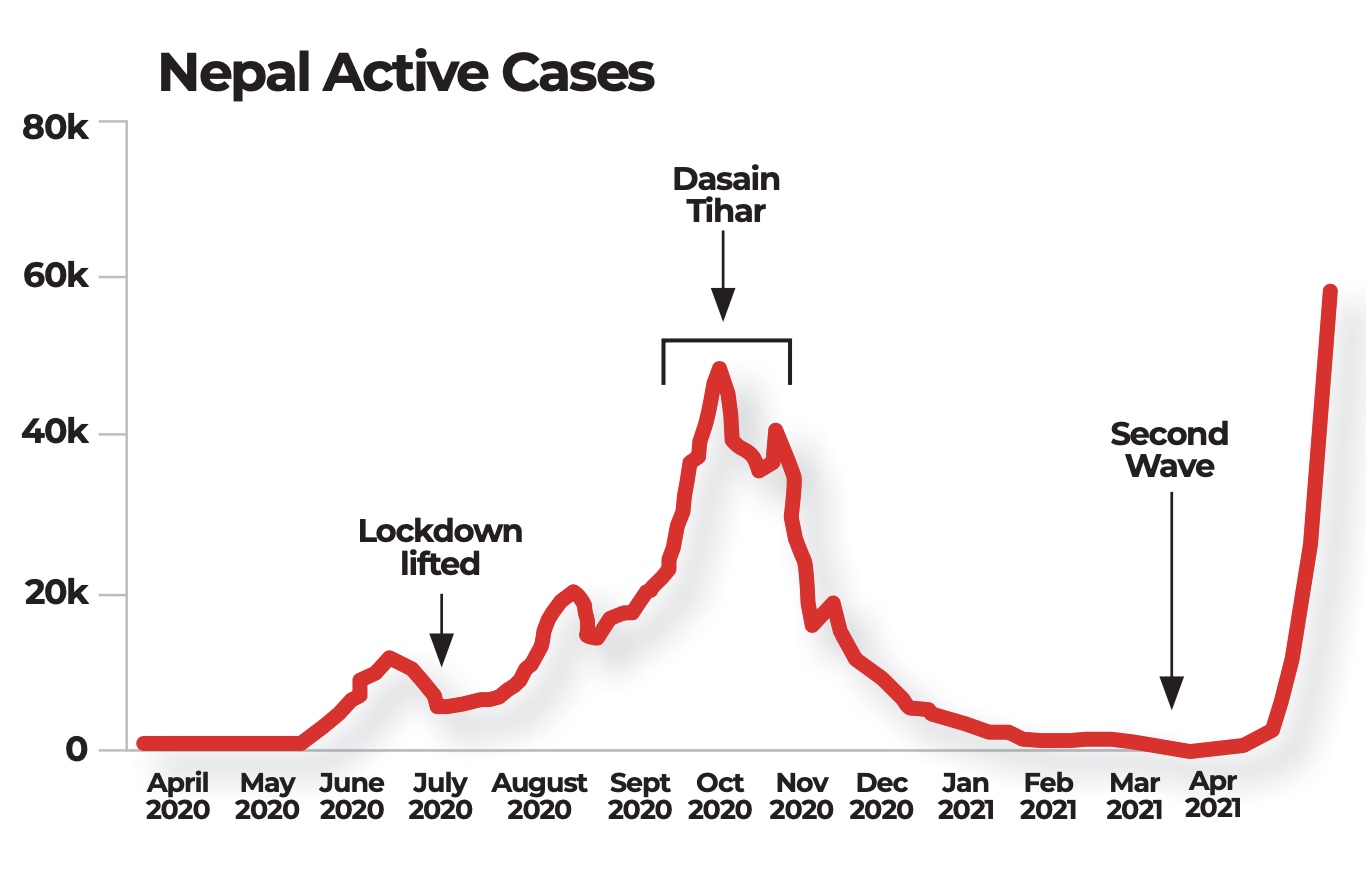
Nepal’s first wave of the coronavirus last year now looks like a ripple, and what the country is now witnessing is the main eruption.
A lot of the attention is on Kathmandu Valley because more than half the daily new Covid-19 cases are here. But it is the Tarai districts bordering India that have been ravaged first, just like last year, but on a much vaster scale.
Epidemiologists say what happens in India arrives in Nepal four weeks later, and the border cities precede Kathmandu by two weeks. Banke district, for example, which is the gateway to Nepal for most returnees from India, is the second most affected after Kathmandu, with 4,811 active cases.
Banke’s positivity rate is shocking: 210 of the 299 PCR tests at Nepalganj Medical College (NMC) in Kohalpur in 24 hours on Tuesday were positive -- 19 times higher than the rate a month earlier.
The doubling time for the infection at Bheri Hospital in Nepalganj is only eight days. The hospital did 1.6% of all the tests nationwide in the past two months, but had 5.35% of the new cases in that time.
One would have thought that the first wave would have prepared Banke and indeed Nepal for this one. But what is happening now is a tsunami.
Last year, when we caught up with Deputy Mayor Uma Thapa Magar of Nepalganj, she was trying to enforce mandatory quarantine on returnees from India, and trying to make sense of a virus that no one knew much about. The mixed directives or inadequate resources from the federal government did not help. Municipalities were left to fend for themselves.
“We were learning as we went along, this time we are dealing with a completely different virus," says Deputy Mayor Magar. "Last year the patient numbers were manageable, even with home isolation. This year, a high share of those who test positive need hospital beds with oxygen. If we cannot provide oxygen, we lose them. There is enough oxygen, but not enough cylinders."
The first wave was a dress rehearsal for the second one. Local leaders have learnt that the border is the chokepoint, and 70% of cases initially were among those with travel history. At the Indian border, health personnel are working in three shifts to screen inbound Nepalis with antigen tests. Those testing negative are kept in holding centres, then transported to home districts by local governments. Positive patients are kept in isolation in Nepalganj, or taken to their domiciles with the support of the Red Cross. These pre-established networks from the first wave have made the work smoother, but the sheer numbers have overwhelmed local capacity.