
Nepali Congress Joint General Secretary Mahalaxmi Upadhyay recalls how she missed a call from a journalist because she was attending an event.
When she called back later, the reporter replied to the Member of Parliament, “I couldn’t reach the party vice-president, so I called you.”
Another time, Upadhyay was meeting the press with other women in leadership to brief them on how underrepresented female politicians were in the news media. One editor said he listened to women: he always called up a politician’s wife for inside information.
Chanda Chaudhary, an MP from the Loktantrik Samajwadi Party, recalls a well-regarded tv anchor telling her without a hint of regret that there were no women politicians worth inviting to his talk show.
Binda Pandey of the UML sees Nepali politics as a revolving door of ageing politicians — mostly male, and some female who behave like men — who are always given office as if there were no one else in the party who deserved it.
Read also: The power to have a say in her-story, Shristi Karki
Nepal’s women politicians have had enough. They feel so strongly about being excluded that they have banded together across party lines to share these experiences with the media. They have been galvanised into action by their parties once more trying to short-circuit affirmative action policies in the Constitution allowing greater women’s representation in provincial and federal elections on 20 November.
Women politicians are on the list, but they are not given tickets to stand for direct elections and are confined to proportional representation registers.
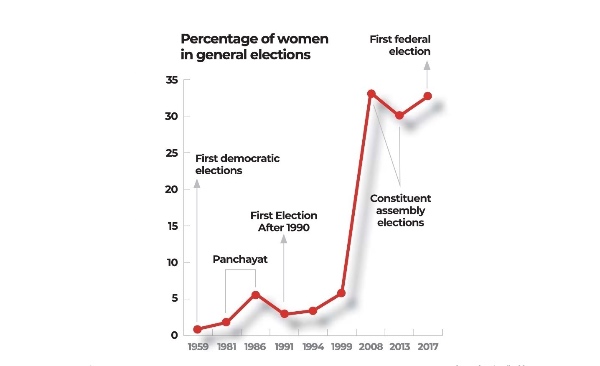
In the 2017 elections, 41% of locally elected representatives were female, whereas there was 34% women’s representation in provincial elections. At the federal level, the Upper House has 37% female representatives, while 33.1% of MPs in the House of Representatives are women.
The Global Gender Gap Index ranked Nepal 61st out of 155 countries in political participation, and 40th in terms of women in parliament. Nepal is currently one of only 35 countries in the world that has a female head of state or government.
Nepalis like to tout positive statistics, and the fact that we have a female president and once had a female Speaker and Chief Justice finds its way into every discourse about gender equality. While these numbers are encouraging, the ground reality of Nepali women politicians is starkly different.
Read also: “Nepali leaders unable to accept women in power”, Nepali Times