
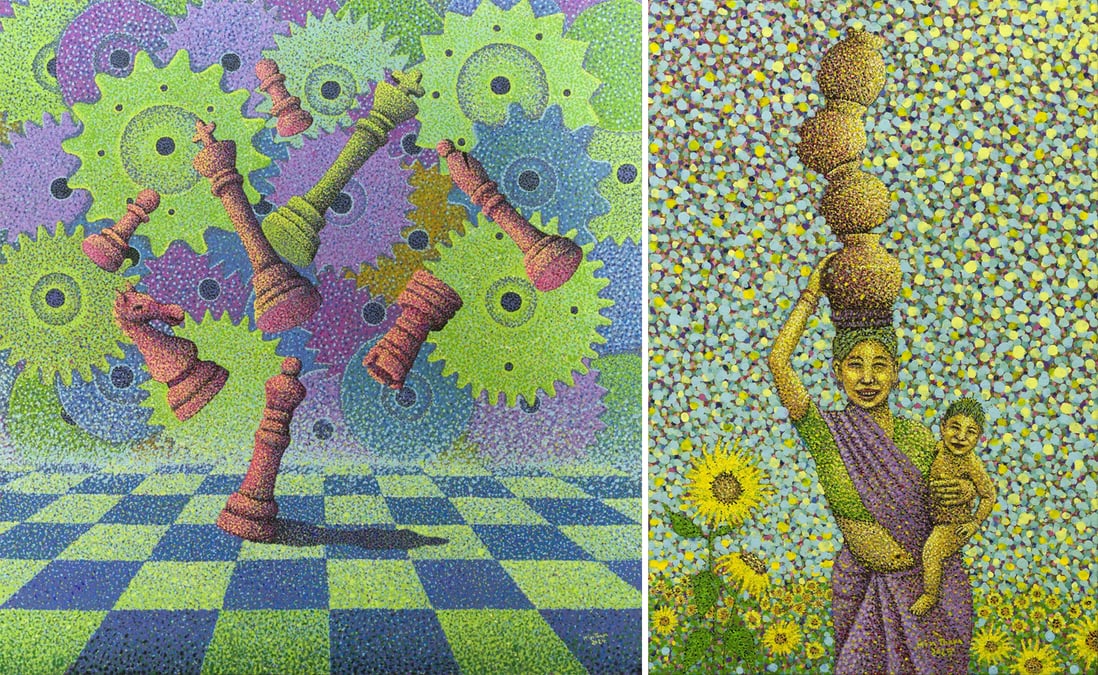
In the exhibition Witnesses of the Inner World, artist Min Thapa explores the theme of parental sacrifice in 21 works in the neo-impressionist pointillism style.
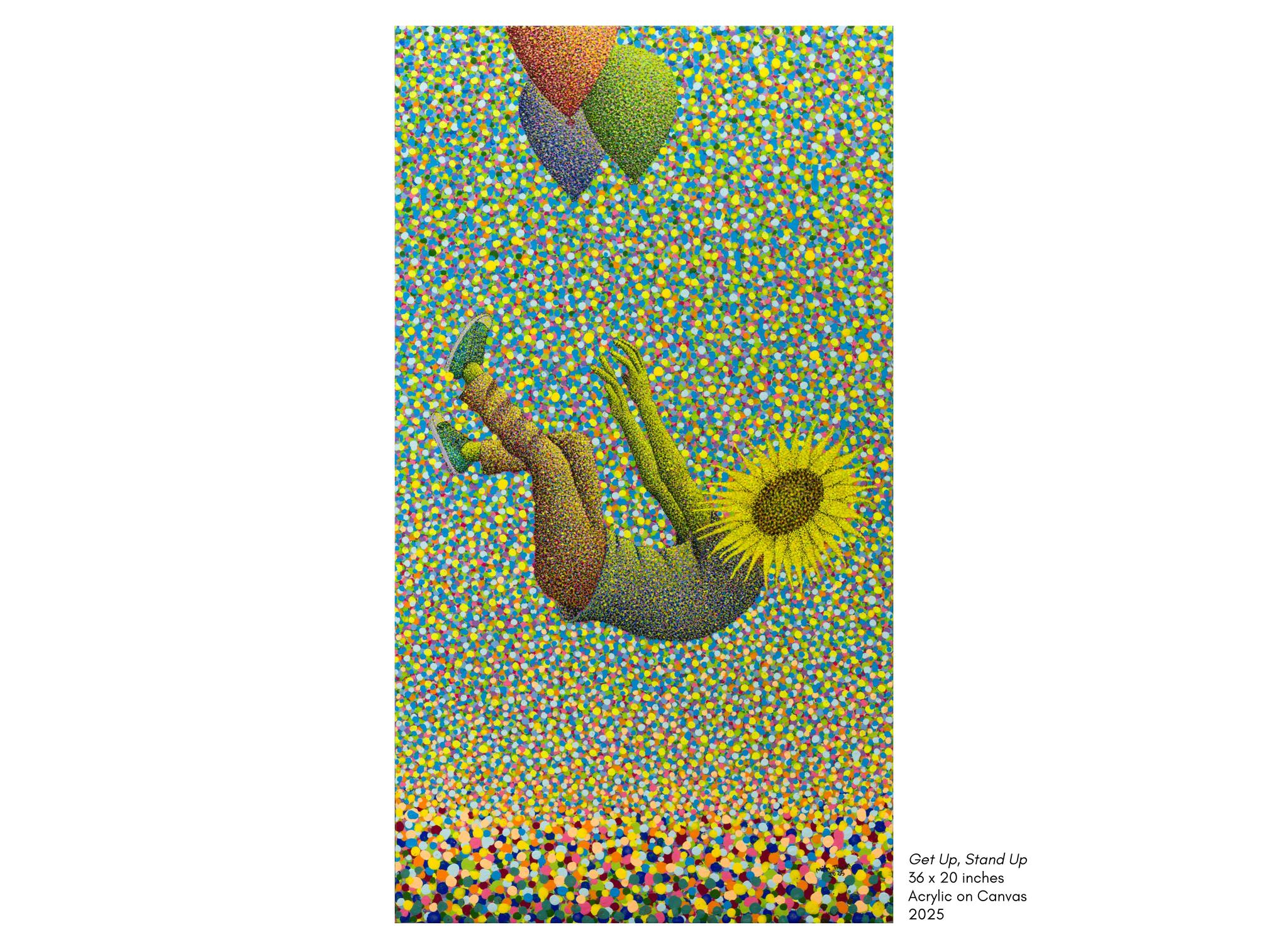
Drawing on his own experiences Thapa paints in vibrant dots parents who navigate obstacles while maintaining careful balance, to create a carefree childhood for their superhero kids to dream in. Thapa draws inspiration from his own observations of his parents, and his own as a father.
“It is a very labour-intensive painting style, each painting takes a month, even if I work seven, eight hours a day,” says Thapa who is committed to the style regardless.
He adds: “I was struck by the view of dots of coloured flowers against a field I once saw while trekking.”
This connection shows up in his paintings. The hair of the subject in The Garden Mind, for example, is covered with specks of light and colour against black, reminiscent of stars or flowers “to mean that you should keep the mind fresh, always learning.” Several paintings also include flowers, particularly sunflowers, that are arranged in perspective.
HUMBLE BEGINNINGS
Other paintings recognise and pay tribute to the journey that Thapa has been on. Originally from remote Mugu district near the scenic Rara Lake, Thapa worked in a bookstore in Thamel for a long time before his art career.
“That was a period of my life where I felt robotic, like I was having the same day over and over again,” remembers Thapa, who represents that time in two paintings with a chess board, pieces, and a background of gears. “It was really difficult to see a way out of that routine, and I could not think creatively at all. That’s what the chess pieces represent.”
Thapa saved money from his job to study painting, and now he is able to dedicate all of his time to his craft. He also works at Takpa gallery.
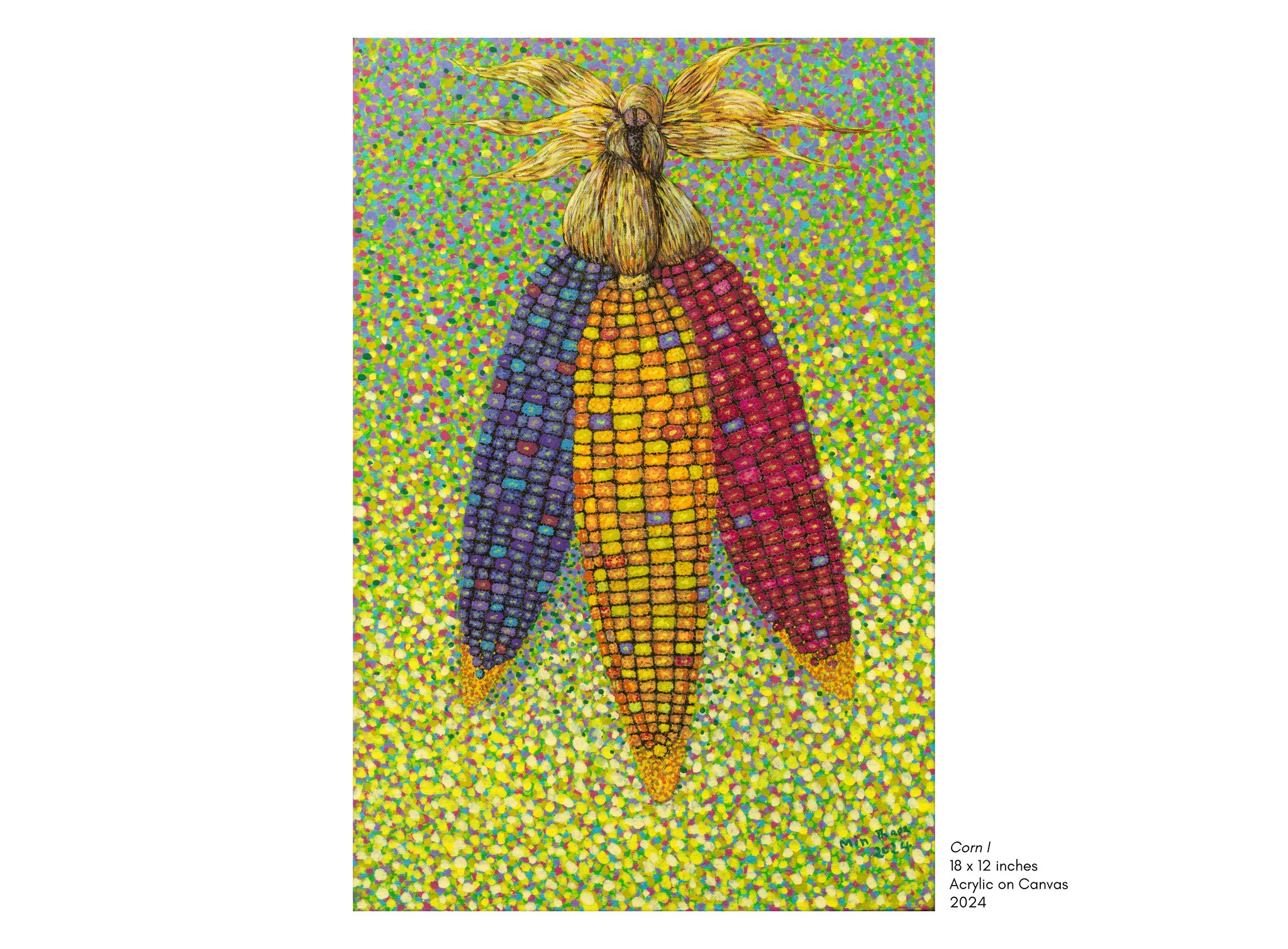
In another pair of paintings, Corn I and Corn II, Thapa recalls the struggles of the Indian Blockade after the 2015 earthquake: “Those were hard times. I had nothing to eat, but corn would hold me over.” In keeping with the rest of the exhibit, each cob is coloured vibrantly in yellow, blue, red and purple.
The style instantly sets these works apart from other Nepalis who paint traditionally. Thapa has never been trained in classic paubha or thank styles.
The dots give the impression of light, so that the paintings seem to be happening at sunset, and others in bright sunlight. There is a dreamlike quality to them, reality fades and only the person and their activity or loved one remains in focus. This is in keeping with the joyous, blissful childhood created by parental sacrifice that Thapa wants to communicate.
Various dots coming together to make up the painting are also suggestive of atoms making up reality itself, and perhaps how what we see is limited by what we can perceive. Thapa wants the paintings to convey a slight sadness about the parents’ sacrifices for their children, which can be poignant for visitors who are parents but for others the paintings feel very vibrant and cheerful.
Thapa holds a Master’s in Fine Arts from Tribhuvan University, and his work has been shown at Takpa as part of group exhibitions in previous years. He has also exhibited in Japan and France, winning awards nationally and internationally.
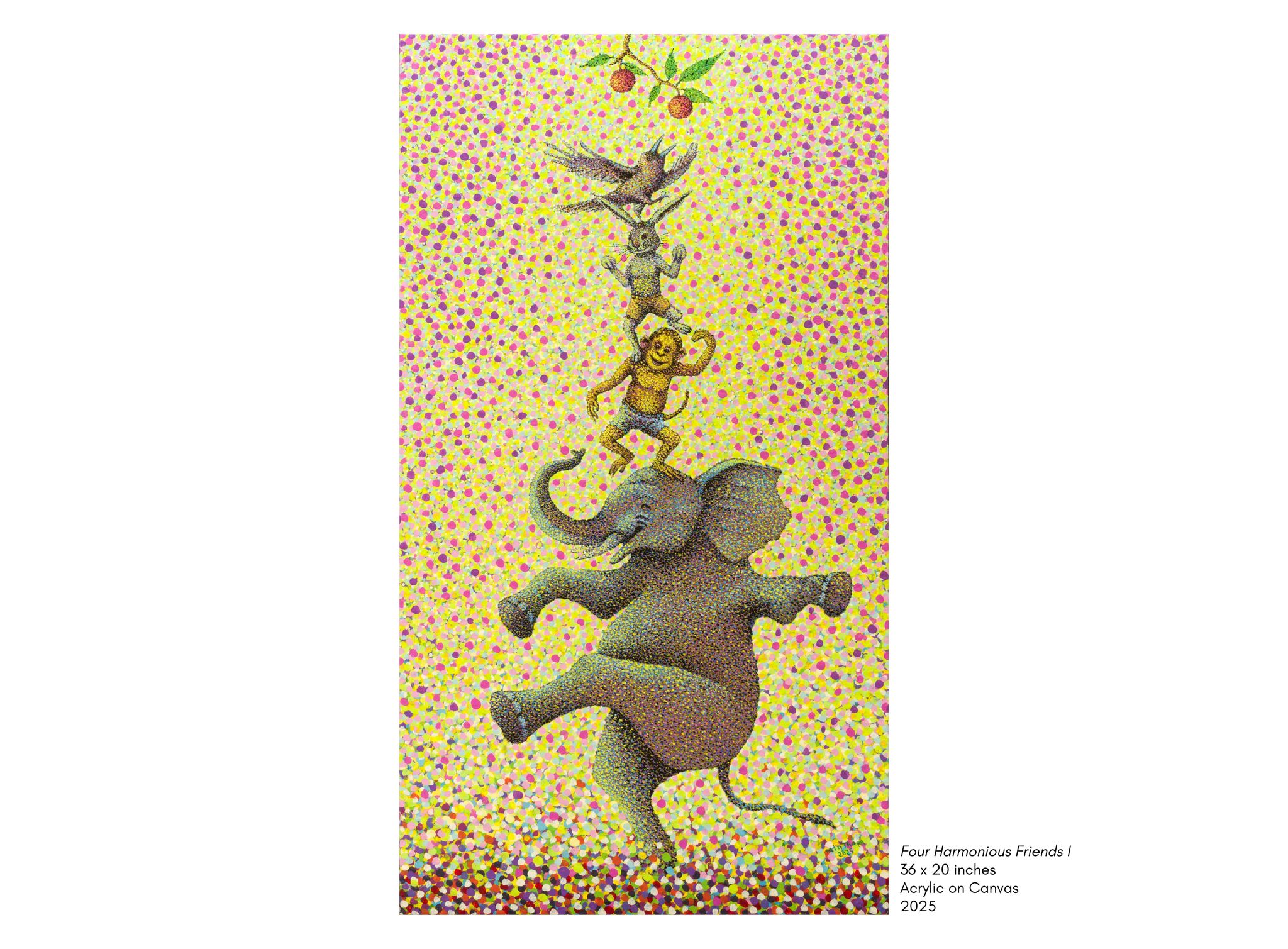
In one fun painting, Thapa places a bird perched on a rabbit that is dancing on a monkey, which is in turn prances on a happy elephant balancing on one foot. The painting depicts a Buddhist fable about respecting elders, and Thapa also has statues of the four animals, made in pointillism using acrylic on resin.
Developed in the 1880s by French artists Georges Seurat and Paul Signac, pointillism applies small dots of colour of various sizes across the canvas, which the eye turns into a painting when viewed from a distance. The style is the precursor to the modern era of screens and phones, which use millions of distinctly coloured pixels to create the illusion of a photo or video. The style can be seen in Pablo Picasso’s early work, and Vincent Van Gogh was influenced by it.
Witnesses of the Inner World
Takpa Gallery, Lazimpat
Till 6 June