
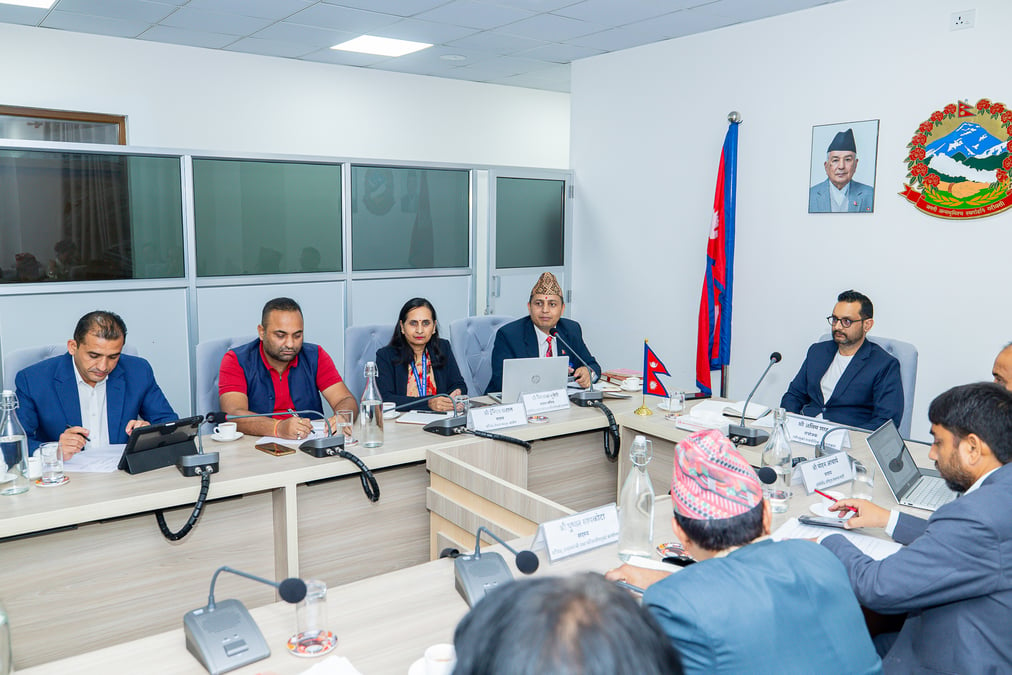
Four political parties – the Nepali Communist Party (NCP), the Loktantrik Samajbadi Party (LSP), the Janata Samajbadi Party (JSP) and the Rastriya Janamorcha -- have withdrawn from the Constitutional Amendment Taskforce review, questioning the panel’s jurisdiction and legitimacy.
They quit, accusing the panel led by the prime minister’s adviser Asim Shah of attempting to rewrite the Constitution. Earlier, the UML attended two meetings and left. The Nepali Congress (NC) did not even participate, and its chair Gagan Thapa warned earlier this week that Nepal’s hard-won freedoms were in jeopardy from “populist whims”.
Constitutional amendments such as having a directly elected executive head of the country was one of the demands after the youth-led protests in September. But even before that, the Rastriya Swatantra Party (RSP) had been ambiguous about federalism and called provincial assemblies a waste of money, and in its recent general convention it pushed for amendments.
Political scientist Sucheta Pyakuryal says that would be like amputating the heart from the body. It would dismantle federalaism even before it started functioning properly. She adds, “Provincial assemblies account for only 1-2% of the national budget, yet it is deemed too expensive and we want to scrap an important state apparatus while funding with our taxpayer money the prime minister's political advisers who are outside the bureaucracy.”
The seven provinces were never given the financial and political authority to exercise autonomy. Three legacy parties made sure provincial assemblies remained proxies, and devolution was just on paper. Provinces were deliberately made dependent on Kathmandu, never allowed to generate internal tax revenue.
They were not given their own police because of parties in the federal government. Past governments also dragged their feet on the Federal Civil Service Act which would equip provinces with their own bureaucrats.
In other words, Nepal was never a truly federal country. So it does not make any sense to scrap federalism – you cannot abolish a structure that was never permitted to function as it was supposed to.
DUE CREDIT
But let us give credit where it is due. Many of the amendments for electoral reforms such as ensuring voting rights for overseas Nepalis, the right to recall, and age and term limits for ministers reflect the aspirations of the youth-led protests last year that gave Nepal a chance to make a new beginning.
It is argued that a directly elected executive head of the country would end chronic instability because of fickle electoral alliances and feckless coalition governments of the past. But the March election proved that a single party can still secure a super majority and possibly complete its full term.
More importantly, given how polarised Nepali society is right now, a directly elected executive head would pose real and present danger to democracy. If an executive head not directly elected can exhibit such erratic and authoritarian behavior, imagine what a directly elected one would do.
No doubt, four decades of corruption and governance failure by the ‘oldiegarchy’ fed public disillusionment. But this does not mean strongman rule would make government any more transparent and efficient. The way to fix a bad democracy is to improve it, not replace it with an autocracy.
If the last 100 days is a trailer of what a directly elected executive head would be like, then we are not looking forward to the full feature.
In a long conversation, political journalist Santa Gaha Magar told me: “In just the first 100 days, the prime minister has shown that he is not the type who is accountable to anyone. Even the taskforce on constitutional amendments looks like a show; he will do what he wants in the end.”
The RSP has shown to be technocratic in which merit is the main criteria for appointments. But only taking technical expertise into account can be a shortcoming. A good physician may not be the best health minister, an outstanding academic may not be the best manager of a country’s monetary policy. The bigger question is, who decides on merit? Who are the boys in the PMO kitchen cabinet? What is their merit?
The proposed amendment for unelected non-parliamentarian Kathmandu-based minister, for example, may lack the local knowledge and experience to deal with, for example, a new strategy for Humla and Mugu to adapt to climate breakdown.
As constitutional expert Radheshyam Adhikari told a recent Centre for Investigative Journalism podcast: “We have to make sure the amendments strengthen and not weaken republicanism, democracy, federalism and proportional representation, otherwise the very spirit of the Constitution will be dead.”
Sonia Awale