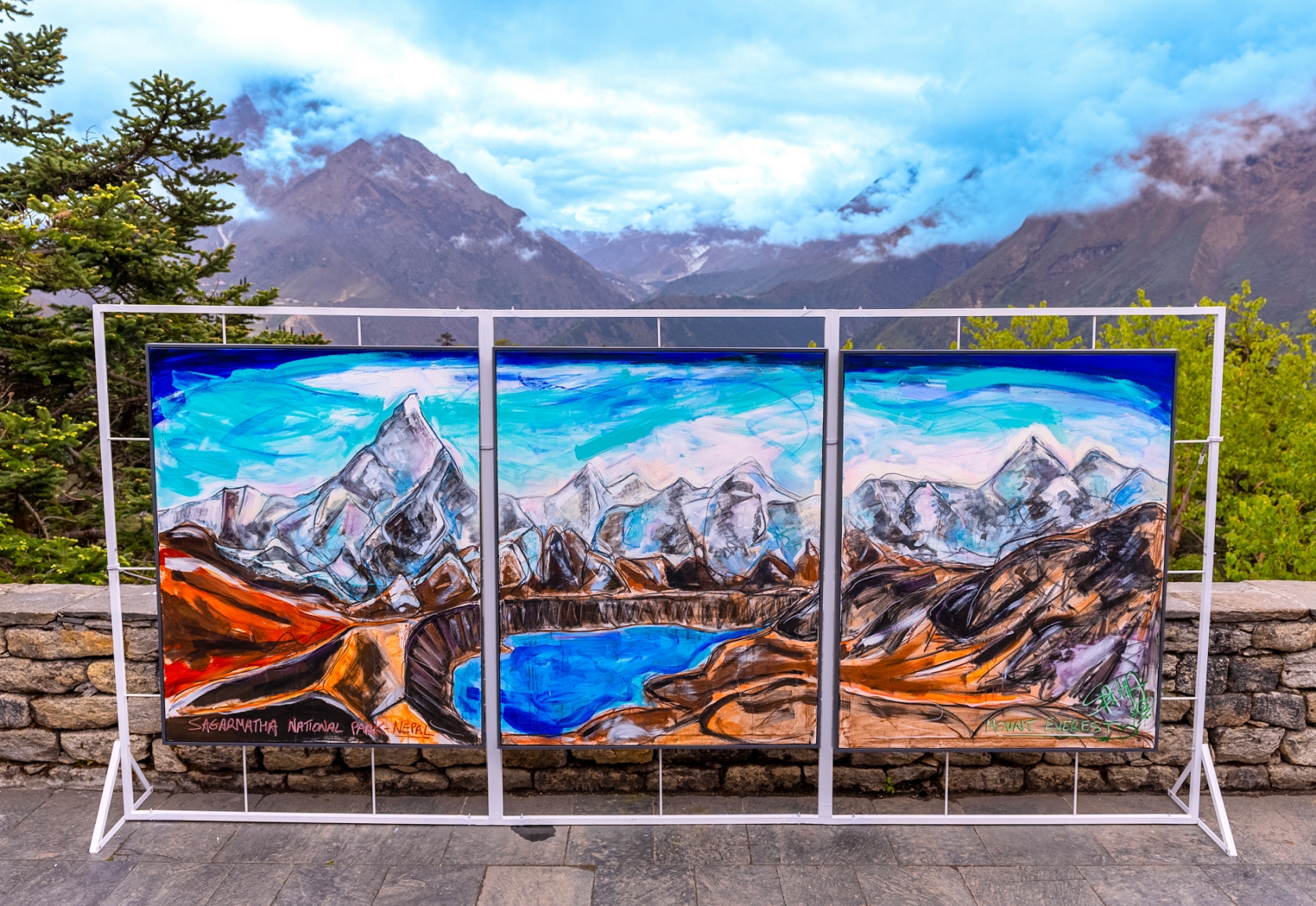
A painting of Mt Everest could have only been unveiled on Everest Day 29 May at the iconic Hotel Everest View in Syangboche.
The triptych by British visual artist Sacha Jafri shows the panorama of a discoloured mountain range, the black of the rocks seeping into the fluid snow, against a sky progressively deeper the higher it goes.
Below are reddish-brown hills gathered for a conference of sorts, their heads ever so slightly bent as if they are listening and thinking. At the centre lies a pool of water so blue it seems to be collecting the whole sky above.
The painting appears as an almost abstract expression of the mountain rather than its reflection. It is Jafri's subconscious journey to the Himalaya, and there can be found immediately something childlike, innocence without pretense - a theme recurrent in his other artworks as well.
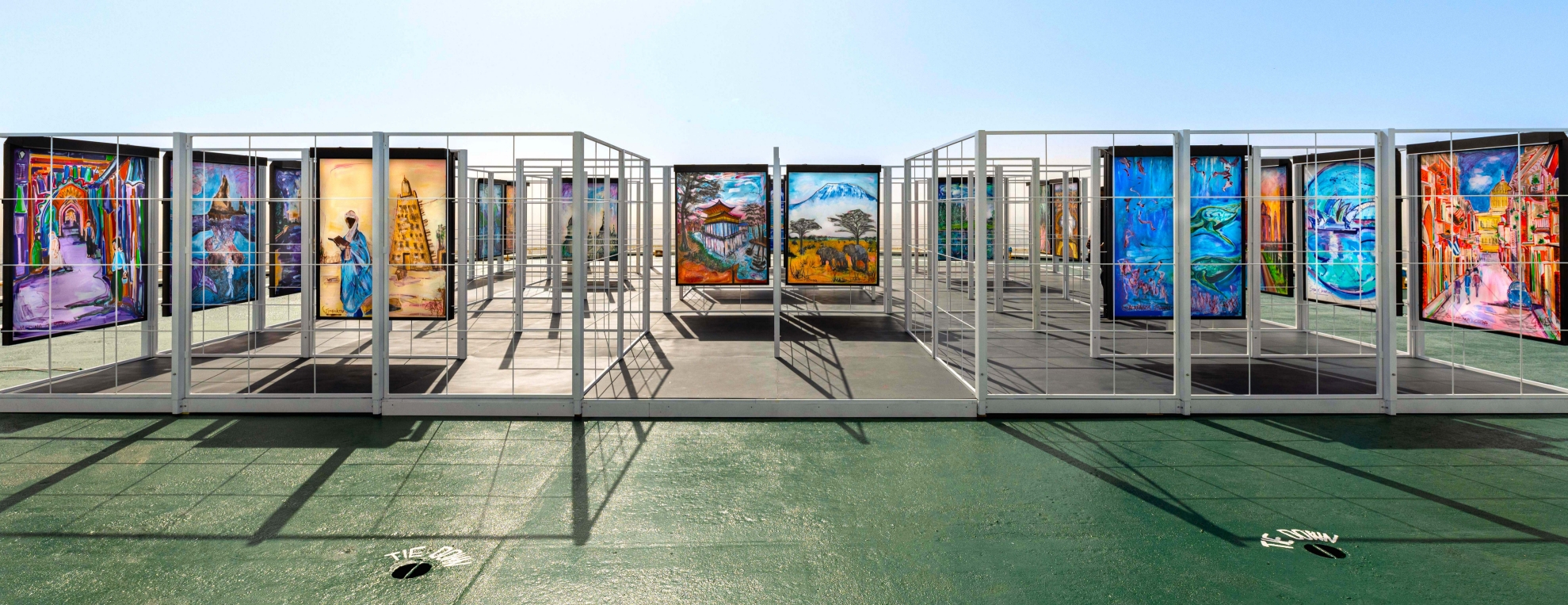
The Everest painting is one of 50 Jafri is creating for the Art Maze project in partnership with UNESCO, and commemorates the 50th anniversary of the UNESCO Convention concerning the Protection of the World's Cultural and Natural Heritage signed on 16 November 1972. The Convention then came into force on 17 December three years later.
“This comes at a time in the world, with climate change, the pandemic, the geopolitical flux, to reflect on the next 50 years and ask ourselves what we truly value as individual, societies and countries, and what should be passed down to the future generations,” says UNESCO Representative to Nepal Michael Croft.
As such, the UNESCO’s The Next 50 campaign forms the foundation for the Art Maze, and 34 of the paintings of World Heritage Sites, including the Acropolis in Greece, Angkor Wat in Cambodia, the Hyrcanian Forests in Iran, the Saint-Sophia Cathedral in Kyiv, the Pyramids of Egypt, and Lumbini in Nepal have been completed.
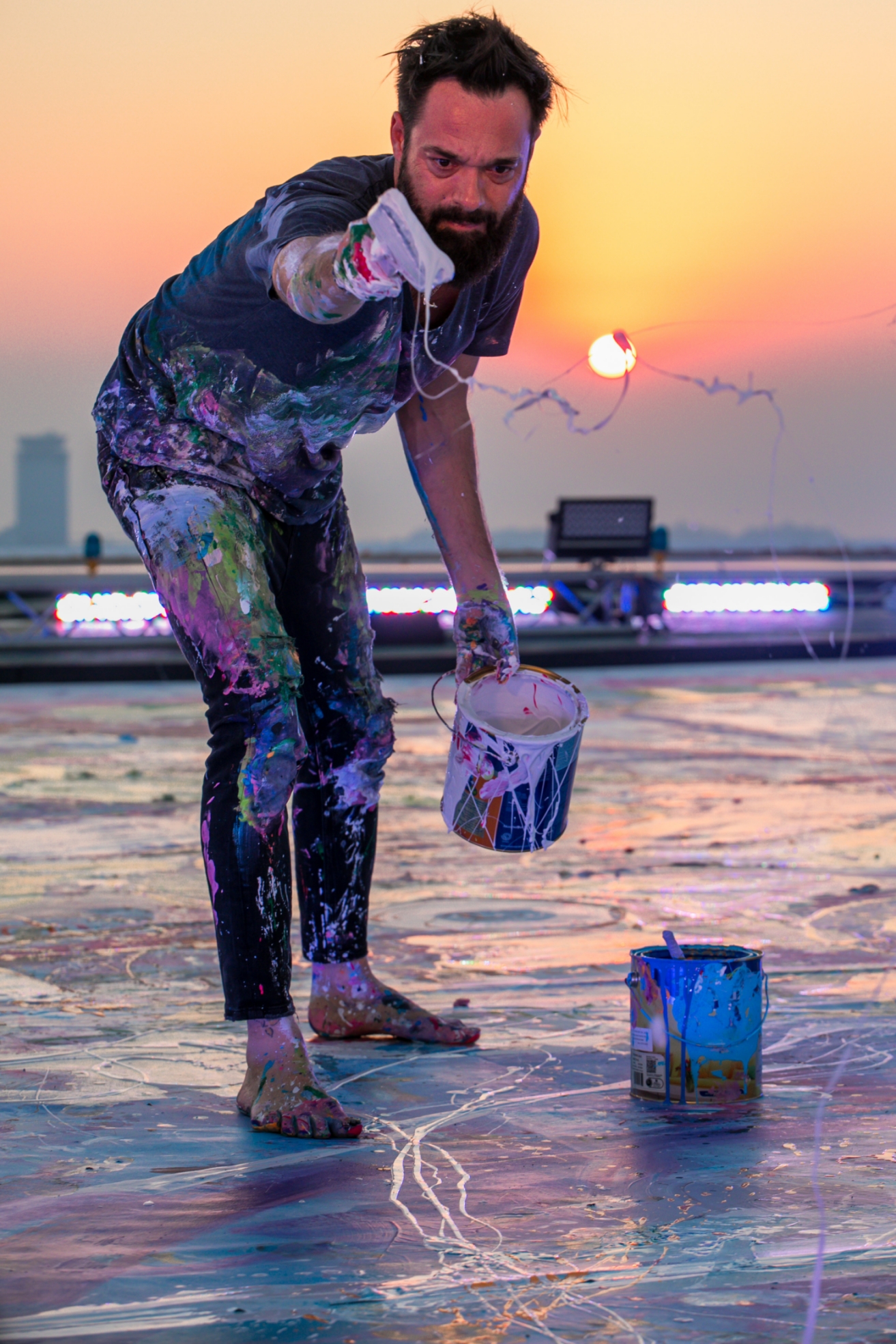
The paintings are characterised by their unique assortment of colours, which is reminiscent of lively crayons from childhood. Textbook realism has no place in these canvases, as the paintings are stripped to their essence.
“We over analyse, become pompous and over-intellectualise art,” Jafri explains. “But all art, at the end of the day, is rubbish and superb.”
This apparent contradiction finds reconciliation in the artist’s intent with which they create. “And I think if you focus on your intentions, then everything you create will be perfect,” Jafri adds.
There is a sublime simplicity to Jafri’s method and work, enabling viewers to be more conscious in their world, their lives, and be open to love and compassion.
The Art Maze curated by Marcus Schaefer is a 12x12m steel labyrinth gallery with Jafri’s paintings, giving visitors the opportunity to choose which path to take and create an experience where “the journey is the destination”.
For over 25 years, Jafri’s work has been about reconnecting with the soul of the earth. His Journey of Humanity (2020) is dubbed the world’s largest and took him a year to create during the pandemic.