
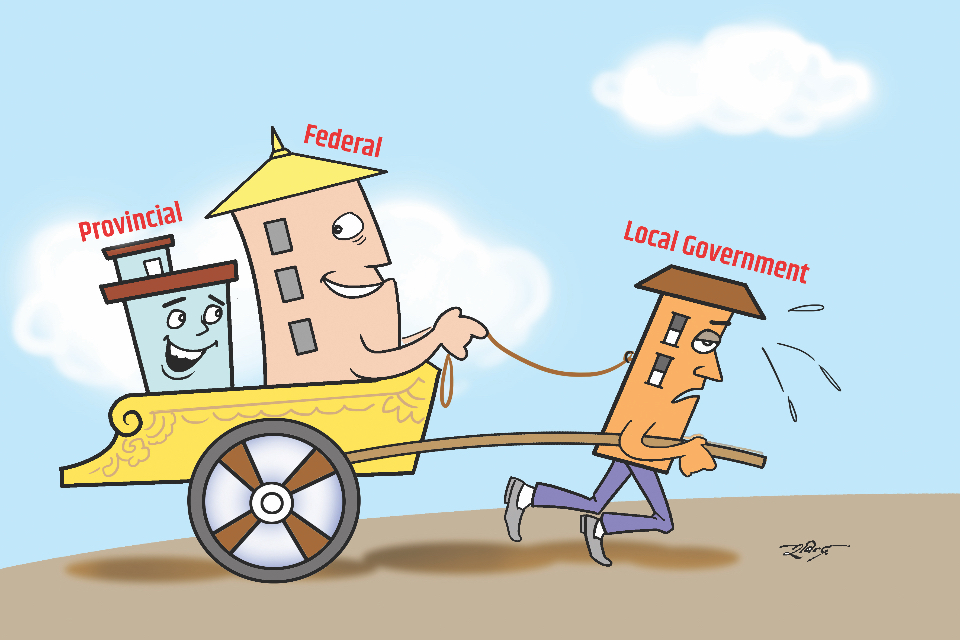
Over the past 30 years since the first People’s Movement, we have seen that things start moving in Nepal when local governments are empowered. Devolution to village and district development councils in the 1990s forced local leaders to be accountable, especially in service delivery.
In fact, everything that has worked well in Nepal till now has the word ‘community’ in it: community radio, community forests, community women’s groups, community-managed schools and hospitals, community irrigation systems.
Unfortunately, political intrigue, the Maoist conflict and a return to an authoritarian monarchy meant that there were no local government elections for 20 years till 2017. Their five year tenure is now coming to an end, and the second local elections under the federal system are being held on 13 May in 460 rural municipalities, 260 municipalities, 11 sub-metropolitan cities and six metropolitan cities. Candidates are already on the campaign trail, and for many this is a chance to prove through performance that they deserve a second term.
These new mayors and ward chairs were guinea pigs. They not only had to make up for lost time but also deal with a complex maze of new overlapping regulations and jurisdictions. There was confusion galore on budget, revenue, civil service appointments.
Despite having swept the 2017 elections, bitter political strife within the ruling Nepal Communist Party led to its fragmentation into the UML, Maoist Centre and Unified Socialists last year. The stranglehold of political parties over the federal structure also meant that corruption and infighting got decentralised as well.
All this gave the ‘F’ word such a bad name that the alternative Bibeksheel Sajha Party in its manifesto even calls for scrapping federalism altogether. Much of this negative public perception is fed by cynical Kathmandu-centric analysts and commentators.
The reality is different. An evaluation by the National Natural Resource and Fiscal Commission (NNRFC) has given nearly all 753 municipalities above pass marks. In fact, the top three that scored more than 75 out of 100 points in the survey are all rural municipalities. Public opinion polls have shown that most respondents are happy with the functioning of local governments, especially in rural areas.
Read also: Nepal's local election gives power back to people, Rabin Giri
To be sure, many municipalities have been captured by corrupt contractors who got themselves elected in 2017. They rented out their own excavators to their municipalities, and awarded themselves road contracts.