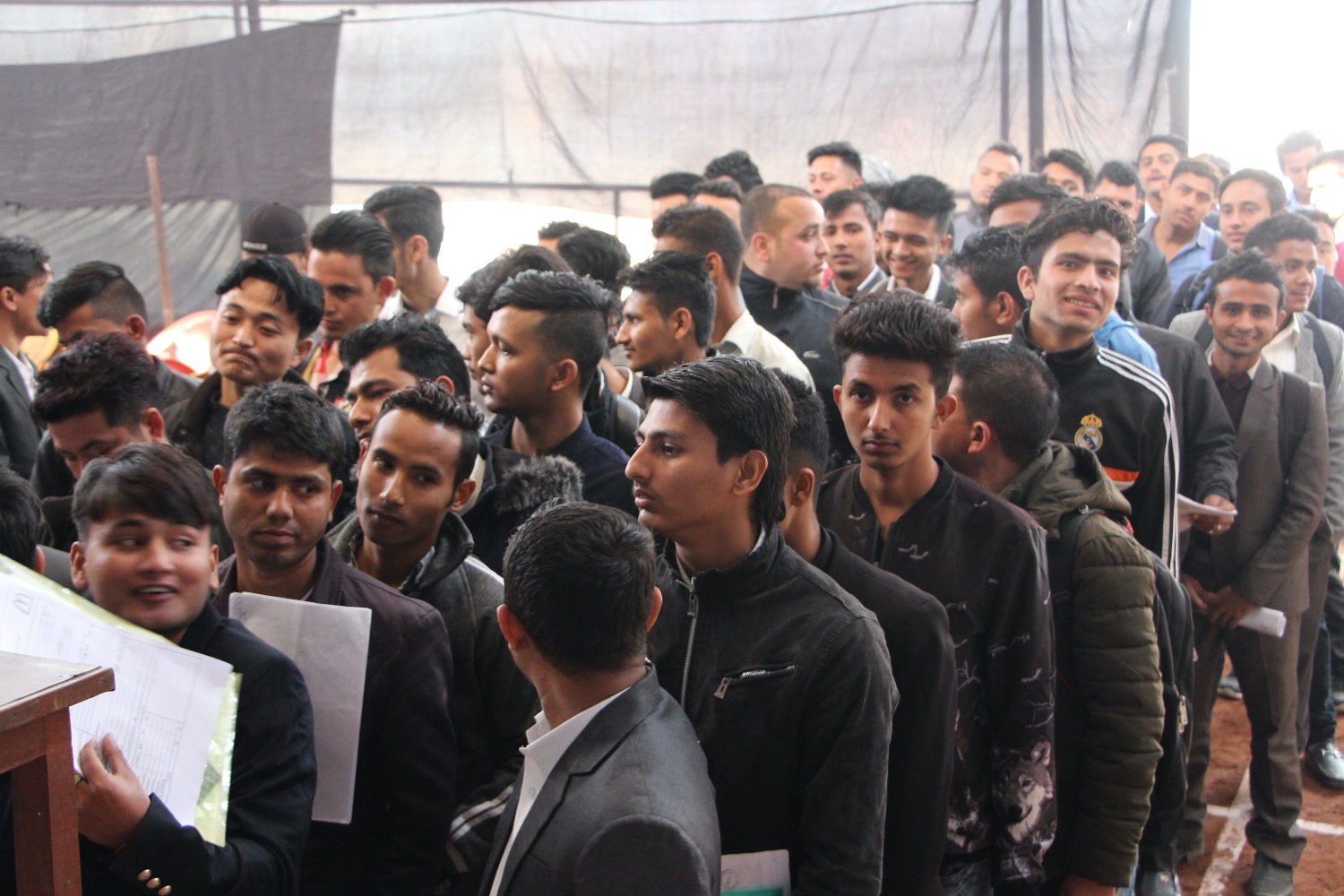
Almost exactly two years ago, Prime Minister Oli launched an ambitious employment creation scheme, which was widely considered at the time as a potentially significant contribution to the reduction in unemployment within the country.
In the budget for 2018-19, the government had allocated Rs3.1 billion for an employment ‘drive’. Two years later, the ambitious program had not provided the promised jobs, even as the need grew for employment for the many migrant workers who returned, mainly from India, last year.
The scheme would provide guaranteed public sector employment for 100 days to those currently unemployed, across a dozen different sectors, including irrigation, commercial agriculture, drinking water, river control, forestry, tourism, transport infrastructure and other public works across the country.
The Plan
The plan was to was to be delivered through Employment Service Centres (ESCs) to be set up in the 753 local administrative units to those registered as unemployed. Already, 2,259 candidates had been shortlisted to run the ESCs.
Unemployed persons between 18 and 51 would be covered under this scheme, which would assign them jobs according to their qualifications and interest areas. Additionally, they will also receive vocational and skill-oriented training.
With the implementation of the new program, each unemployed person would get a paid job for a minimum of 100 days in a fiscal year, along with a subsistence allowance worth 50 days of work. The then Minister for Labour, Employment and Social Security, Gokarna Bista, promised that the program would be instrumental in bringing down the massive outflow of the country’s youth to foreign lands.
The scheme reminded some of a similar project introduced in India under the Mahatma Gandhi National Rural Employment Guarantee Act, whereby India also aimed to guarantee 100 days of paid work annually.
That program was fraught with corruption and malpractice, and although the proposal made by Oli was generally welcomed in Nepal by economists, journalists and other commentators, it was recognised that much depended on successful implementation – not something for which the government of Nepal was considered to be particularly effective.
Also Arjun Kharel, researcher on labour and migration at the Centre for the Study of Labour and Mobility warned that much depended on the successful implementation of the programme and also reminded policy makers of the importance of remittances from migrants working abroad for the national economy.
As regards the former warning, even PM Oli himself recognised the enormity of the task ahead. He was quoted by the media as saying: “We all need to come together for its effective implementation to ensure that there is no poverty and no unemployment in Nepal.”
But he clearly had high hopes for its realisation. When he formally inaugurated the scheme at the beginning of June 2019, he promised “no Nepali will now have to go abroad looking for work as the government would provide employment to all within the country itself”.
He described the Prime Minister Self-employment Programme as an illustration of the broader campaign of nation building on which he and his government was now embarked. “Now, no one will face problems, as the government has conducted a campaign of life security for all, from children to the senior citizens ... this is a new beginning, a new campaign. Among many problems of the country, unemployment is the major one, which is directly linked with poverty. This program aims to resolve both,” Prime Minister Oli added.
The Minister for Labour, Employment and Social Security Gokarna Bista, said that the government had initiated the Prime Minister Self-employment Programme with a goal of making the unemployed youth self-employed.
He added that, although this program had been implemented only partially in the current fiscal year, it would be expanded throughout the country with the goal of providing jobs to at least 500,000 unemployed youths from the coming fiscal year. He said the government had designed an employment programme for both educated and uneducated people.
Lawmaker and former Minister for Industry, Mahesh Basnet, said that the government had provided Rs24.6 million for the employment program in four municipalities of Bhaktapur, and added that the municipalities would mobilise the unemployed youths at the ward level in work from 16 June 2019.
“The government should set up an Employment Bank and provide employment to the unemployed youth based on their qualification as per the data of unemployed youths,” he said, predicting that “employment can be given to 1.2 million youths in the agriculture sector alone, while more than 700,000 youths can be given work in the construction industry.”
He reported that, already, around 750 unemployed young people in Bhaktapur had found work under this program, and that some 1,500 youths had enlisted their names in the unemployed youth list.
Meantime, in April 2019 the British development agency DfID had launched a complementary four-year Skills for Employment Programme (SEP) which was intended ‘to support the generation of new employment by working with government, employers in the private sector, training and education institutions, and youth to carry out innovative employment interventions, including skills training and job placement which provides higher wages for the individuals and increases the productivity of firms in growth sectors’.