
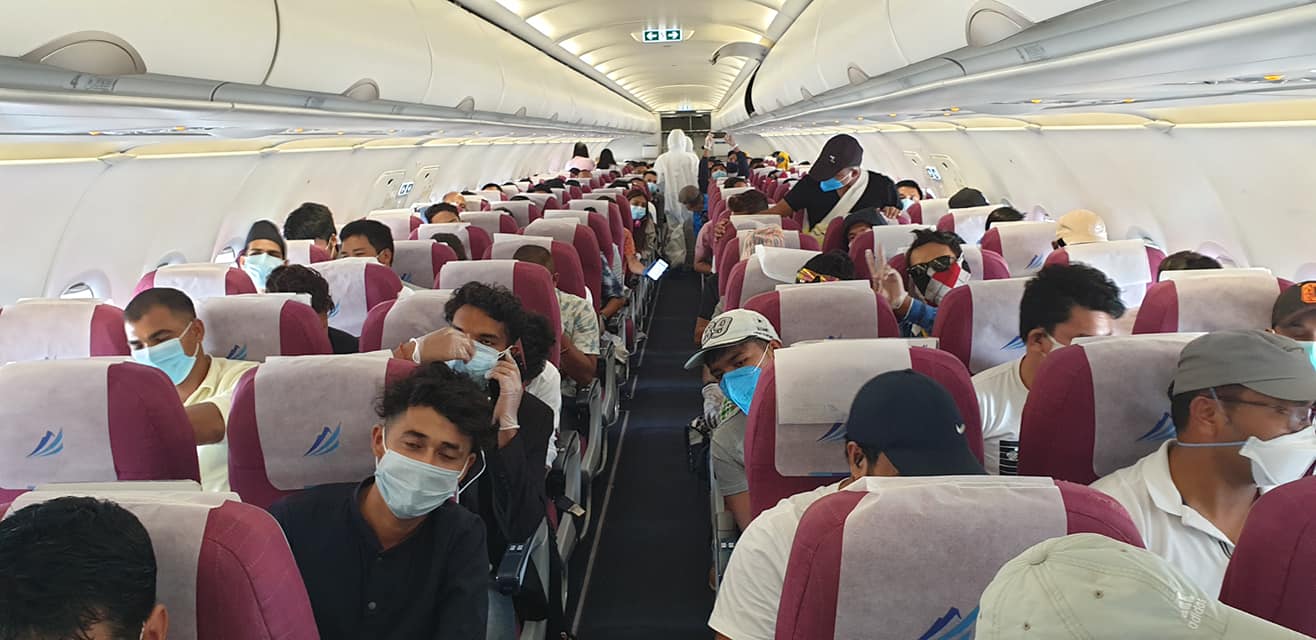
There should be a simple rule of thumb to decide whether interventions in Nepal’s migration sector are useful: does it help the worker?
However, the gap between policies and the ground reality is so wide that the most vulnerable migrants often fall between the cracks. Nepal announced free-visa-free-ticket policy, but workers still pay exorbitant amounts to get jobs. Domestic work was banned, but workers bypass it.
The consequences of these policy failures are felt especially strongly by migrants during the crisis. Nepali migrant workers like Miya paid $3,450 for a job in the UAE. Laxmi travelled overland through India to Kuwait to circumvent the ban on domestic work.
The lapses in the repatriation of workers have been well-documented. There are many players engaged in promoting worker welfare, and it is when there is a crisis like COVID-19 that society needs to step up to help fellow-Nepalis in need.
If a repatriated worker is thrown out of a bus taking female returnees from Kuwait home from a quarantine centre because she had no money, then it means the system is not working, and there are too many lapses.
A recent project initiated by the International Labour Organization (ILO) has taken a more practical approach towards addressing problems of repatriation. It has involved destination countries where migrants are stranded and embassies are overwhelmed, and in their management upon arrival. It engages unconventional partners like Nepal’s embassies abroad and the Non-Resident Nepalese Associations (NRNA).
The project supports Nepal’s embassies by adding volunteer staff, extending their reach outside the capital by setting up outreach camps in major migrant hotspots, providing paralegal support by adding legal staff to facilitate mediation with employers or providing short-term shelter support to those displaced.
At the Nepal end, the project provides transfer and transportation to ensure more humane reception of returnees at the holding centres and their transportation to home districts. The initiative pushes more unconventional interventions at ground level among Nepali workers stranded in the major destination countries, and can be replicated elsewhere as well.
Nepal struggles to make repatriation easier, Nepali Times
The ILO’s Nepal Country Director Richard Howard spoke to Upasana Khadka at Nepali Times about the overall situation of migrant workers during the pandemic.
Nepali Times: What is so unique about this project?
Richard Howard: This is not a new project, but the key thing about our approach with support from the Swiss government was to help Nepali missions abroad provide for migrant workers during normal times. There are lessons to learn from countries like Sri Lanka and Philippines on their one-country-team approach to support migrants in the destination country. And the Ministry of Foreign Affairs, even before the pandemic, has been keen on moving in that direction to strengthen Nepal’s missions abroad. It takes time to bring such changes, especially in countries where the volume of workers is high. When COVID-19 came about, it showed more than ever the need to have services in place. We often realise what we don’t have during a crisis, and this pushed us to think about what we could do this year to help the missions respond better to the needs of the large share of vulnerable migrants.
What about countries where Nepal does not have embassies?
We had to start where the numbers are the biggest and we may have to make adjustments as we go along such as add countries, but we need to move quickly. There are also other countries with stranded migrants even if the numbers are smaller and without missions where you can tweak the model in response to the context and work with different types of partners there.
Some migrants cannot afford tickets, and even if the Foreign Employer Welfare Fund (FEWF) was mobilised it would exclude those without valid labour approvals who are the most vulnerable. Should we think beyond the Fund?
The government has an obligation to support all workers regardless of their legal status. Many left irregularly because of the bans in place and they did not have alternate options domestically, and now they are stuck. FEWF might be a tough sell because it is based on contributions by workers that have paid into it. All of us have an obligation to help all workers, both the government and the big international donors. The latter would also be willing to support if the government moved in that direction. It also points to the need to reconsider policies like the ban that have made workers more vulnerable even if they were imposed to protect them.