
Nepal’s public health system has no mechanism for recording suicides, and the only statistics about suicides can be found in police records. This data shows that about 5,000 Nepalis kill themselves every year.
But since only police records are counted and attempted suicides are not reported, the official data gives no sense of the incidence of people trying to take their own lives.
Based on police data and projections, the World Health Organisation put Nepal as the country with the 7th highest suicide rate in the world (24.9 per 100,000). Public health experts say that suicide is just the symptom, and that the real disease is poor mental health.
Read also: Suicide by pesticide in Nepal, Sonia Awale
Most people who commit suicide suffer from depression and other mental illnesses like schizophrenia and substance abuse disorders. The Nepal Health Research Council (NHRC) is for the first time conducting a nationwide survey of mental health by year-end, and already the picture is not looking good.
Do not shy away from seeking help. If you, or anyone you know, would like to speak to a trained mental health professional, please contact:
TUTH Suicide Hotline: 9840021600
Transcultural Psychosocial Organization-Nepal Crisis Hotline: 1660 0102005
Mental Health Helpline Nepal: 1660 0133666
“From our pilot survey, we found depression in 3.4% of people, and suicidal tendencies in one out of every ten Nepalis,” says Kriti Adhikari of NHRC.
Most of these people cannot access the counselling and treatment they need since Nepal has only 0.13 psychiatrists per 100,000 people, and most of them are concentrated in urban areas. Nepal Police is the only entity that deals with suicide, and it is more concerned about the criminality of the act than about mental health.
“Nepal’s law classifies suicide and abetting suicide as crimes, so our priority is figuring out the criminal element of the cases,” explains police spokesperson Shailesh Thapa Chhetri. “There is no punishment for suicide because the person is already dead. But we investigate to find out if the death was a murder or a suicide.”
Read also:
Down and Out, Smriti Basnet
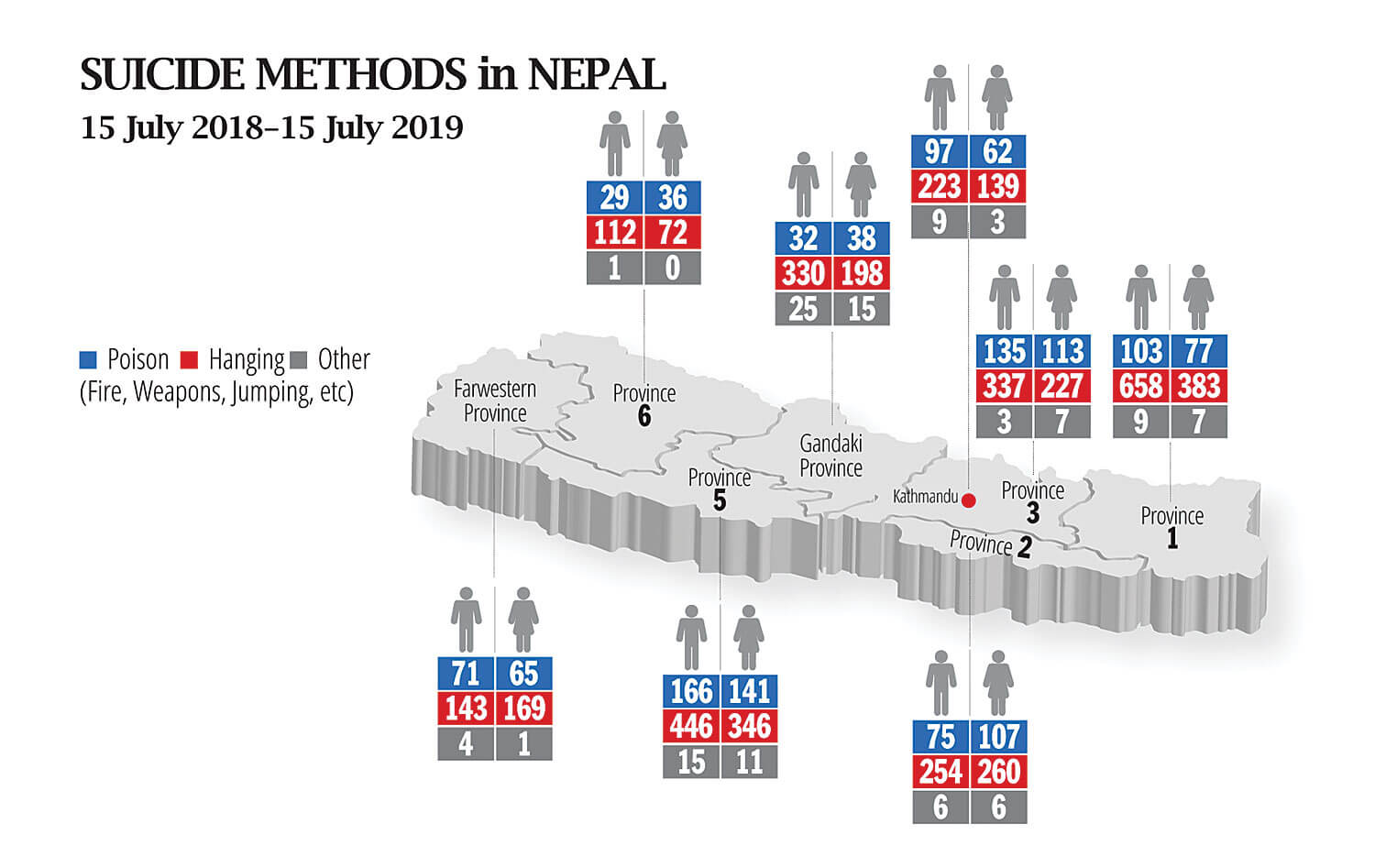
The fact that Nepal Police personnel are not trained in mental health, and that the health system does not record suicides or suicide attempts means that there is no entry for suicide in the Health Information Management System, the database of all patients at government health facilities. This keeps suicides hidden.
“The police data on suicide understates the problem of mental health in Nepal,” says Ravi Shakya, a physician at Patan Hospital, which has a mental health department. “We know more men die from suicide than women and they tend to use more violent means. But in fact, many more women attempt suicide and fewer of them succeed. They may come to hospital, recover, and go back home, but that does not mean their mental illness is over.”