
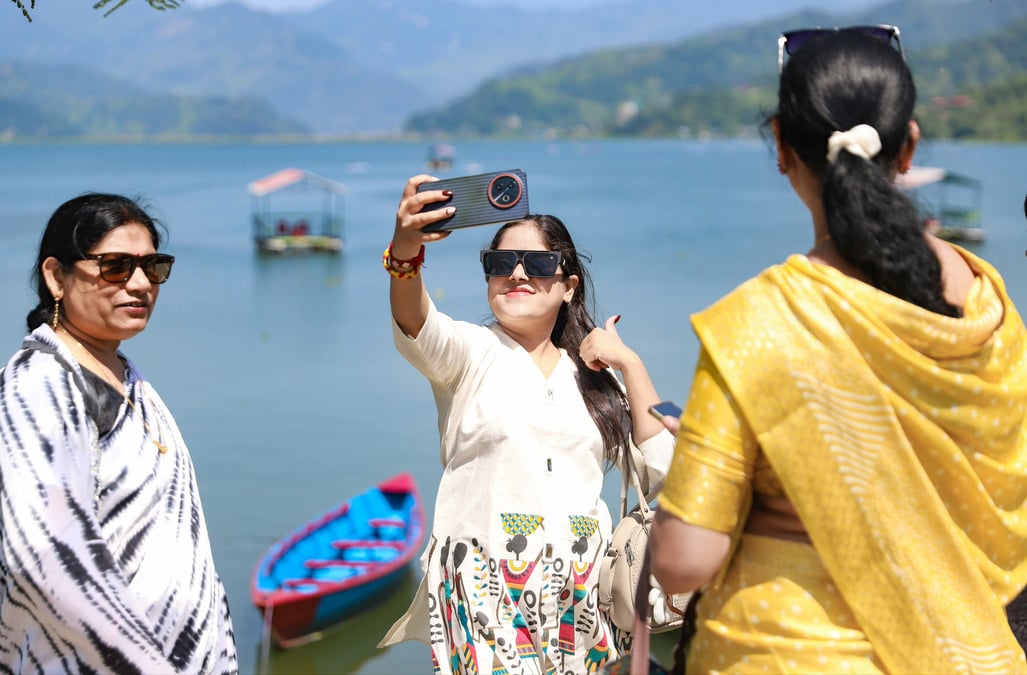
India has reimposed restrictions on export of Nepal’s tea, but here in the tea gardens of Ilam the roads are jammed with Indian vehicles bringing tourists to the cooler mountains of eastern Nepal.
Over in Pokhara and Mustang, it is the same story. June has traditionally been the lean season. Not this year. An unexpected surge in Indian tourist arrivals has transformed what used to be Nepal’s off season.
Hotels are fully booked, accommodation is increasingly hard to find, and visitors have been forced to spend nights in tents along the highway or by the lake. For many Indian visitors, it is tourism mixed with pilgrimage, plus a refuge from the heat of the plains.
According to local tourism officials, Mustang experienced a record surge in visitors between mid-May and mid-June. Data from the Annapurna Conservation Area Project (ACAP) show that nearly 66,000 tourists visited the district during this one-month period, of whom 94% were Indian nationals. Remarkably, Indian arrivals during this period accounted for more than half of all Indian visitors recorded in Mustang over the previous five months and represented a substantial increase compared with the same period last year.
Muktinath remains the ultimate destination with the shrine drawing Hindu and Buddhist pilgrims. Many Indians arrive in their own SUVs, buses or Royal Enfield Bullets. During a landslide-induced traffic jam near Tatopani, there were 50 vehicles waiting for the road to reopen – most of them had Indian license plates.
This surge is undoubtedly good news for Nepal’s tourism industry. Hotels, restaurants, homestays, and local businesses have benefited from increased visitor spending. Yet the boom has seen a backlash on social media with derogatory comments about low budget India tourists.
It has also exposed deeper questions about who ultimately benefits from this book in tourist arrivals, and whether current policies are structured to maximise gains for local economies.
There appears to be confusion regarding the fees and permits required but Indian tourists reported paying relatively modest border and permit charges. Meanwhile, Nepal recently introduced an online road permit system that sets daily permit fees at Rs100 for motorcycles and Rs600 for cars and jeeps. Regardless of the exact amounts paid, self-driving remains significantly cheaper than hiring transport within Nepal.
Local jeep operators, particularly in Mustang, fear that the Indian arrivals does not benefit them. They also say that the playing field is not level: Nepalis wishing to drive into India face lengthy permit procedures and restrictions, whereas Indian tourists can enter Nepal relatively easily, pay modest fees, and travel extensively across the country.
In Sandakphu along Nepal’s eastern border with India, local transport operators are frustrated by this assymmtery in cross-border mobility. Indian vehicles routinely transport tourists through border areas where Nepali operators struggle to compete, while Nepali vehicles face tighter restrictions when entering India.
On a recent journey from Gorkhe to Manebhanjyang, we traveled in a Nepal-registered vehicle but were required to switch to an Indian one to continue along a border stretch and reach Lamedhura, despite the destination being in Nepal.
While destinations such as Mustang and Sandakphu attract rising visitor numbers, local transport companies do not benefit, even though hotels, homestays, and restaurants do get more business.
BHUTAN MODEL
Bhutan offers an instructive comparison. Until 2020, Indian visitors could enter Bhutan without paying ITS Sustainable Development Fee, and charges for Indian-registered vehicles were minimal.
Now, the fee has been raised to Nu1,200 (Rs1,920) per night for Indian tourists and a Green Tax of Nu4,500 (Rs7,200) per day for Indian vehicles. These measures encouraged visitors to hire Bhutanese vehicles and helping retain a greater share of tourism revenue within the country. Policy tools like this in Nepal can also distribute the benefit of Indian tourism more equitably.
Over the past weeks, social media has been filled with images of littering along highways, waste discarded in public areas, and visitors relieving themselves by the roadside. The authorities have appealed for responsible behaviour and respect for local norms and cautioned Nepali influencers against online hate speech.
These concerns raise the uncomfortable issue of the lack of preparedness in Nepal as regards tourism infrastructure. Is the country adequately prepared for the scale of visitor growth it is experiencing?
In many popular destinations, public toilets are scarce, waste management systems are weak, parking space is limited, and signage for essential services is often missing. Both federal and local governments have been slow to anticipate and respond to rapidly changing tourism patterns. As visitor numbers grow, the gaps in infrastructure and management become increasingly visible.
In such conditions, poor visitor behaviour cannot be attributed solely to individual irresponsibility. It also reflects weaknesses in destination planning and service provision. While tourists must act responsibly, destinations must also enable responsible behaviour through adequate facilities and clear systems.
It is easy to blame visitors. Yet Nepalis traveling abroad or even within Nepal, often face similar challenges. Sustainable tourism therefore requires both responsible tourists and effective destination management.
Tourism is one of Nepal’s strongest economic assets. The country’s natural beauty, cultural heritage, religious sites, and hospitality continue to attract visitors from around the world. But sustaining this growth will require more than rising arrival numbers.
Policymakers must ensure that tourism benefits are distributed more equitably, particularly in border regions where local operators risk being sidelined. At the same time, investment in infrastructure and destination management is essential to cope with increasing visitor flows.
The crowded streets of Muktinath and the long traffic queues in Mustang are clear signs that demand for Nepal is strong. The challenge now is not attracting more tourists, but managing them better so that it is beneficial for both visitors and local communities.
Shailendra Thakali, PhD, is a freelance consultant on environmental conservation, tourism and livelihoods.