
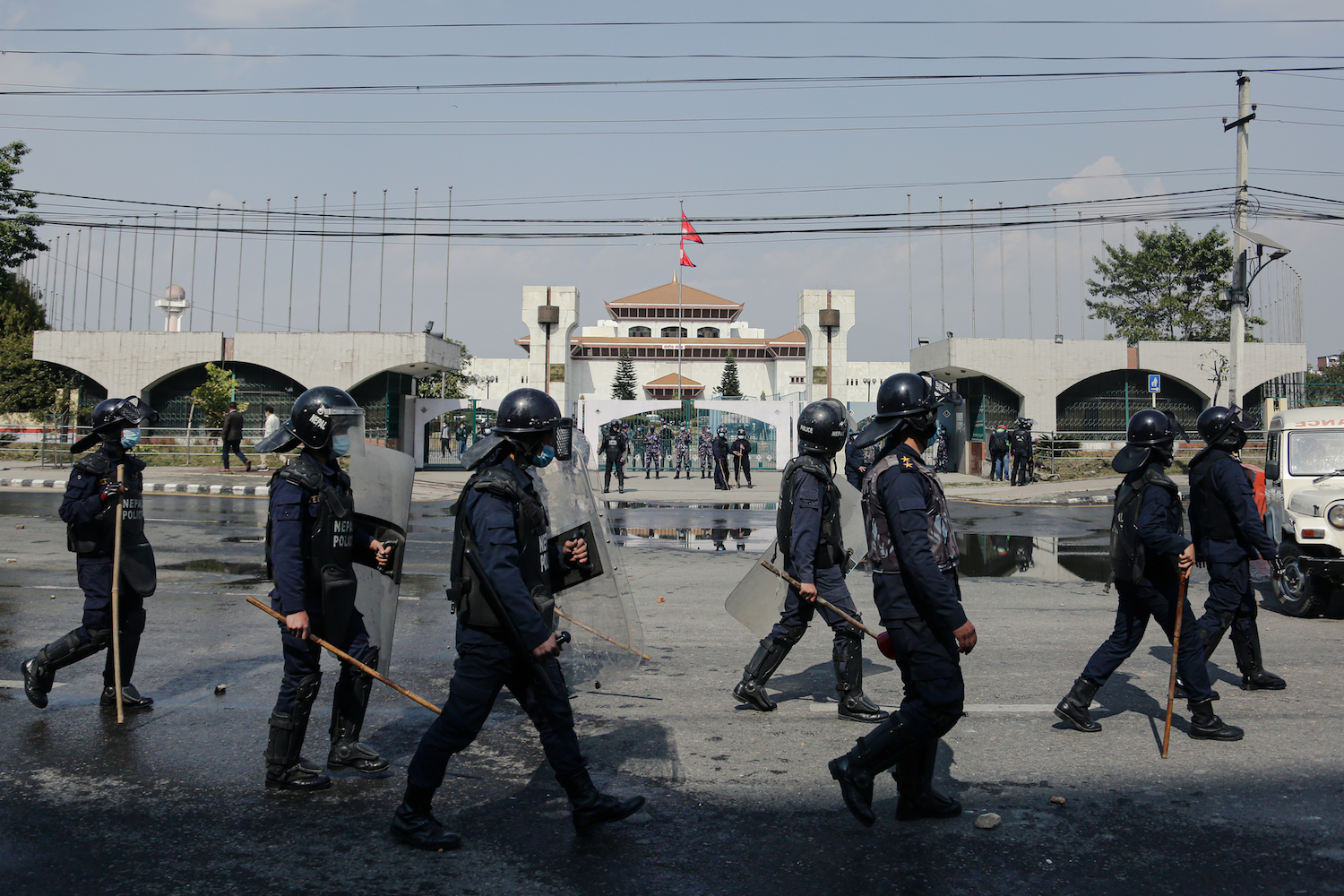
There is intense international diplomatic pressure for and against a $500 million American project, as Nepal’s main political players try to strike backroom deals ahead of the 28 February deadline for ratification of the compact by Parliament.
This being Nepal, lawmakers will be expected to go late into the night to vote. And if they still need more time at the stroke of the midnight hour on Monday, 28 February, they might argue that there is another 12 hours before it is midnight in Washington DC.
Whatever happens in the coming days, by playing political ping-pong with the MCC Nepal’s leaders have damaged Nepal’s international reputation and have come across to both the Americans and the Chinese as being untrustworthy, prone to playing petty party politics to undermine the country’s own national interest.
The MCC is a bilateral United States foreign aid agency established by Congress in 2004 to help improve the economies of under-developed countries that have democratic safeguards. Nepal was the only other South Asian country besides Sri Lanka to be offered the grant to ‘maintain road quality, increase the availability and reliability of electricity, and facilitate cross-border electricity trade between Nepal and India’.
All agree that those things are needed. The problem has been that rivals of former prime minister K P Oli used his support for the MCC to bring him down, accusing him of selling out the country. It is no secret that Beijing overtly opposed the American project in Nepal, and has used the two Communist parties in the coalition government to reject it.
The history of US aid to Nepal begins in the 1950s, and since then it has poured hundreds of millions of dollars into development projects, infrastructure and training. The MCC grant is a continuation of this involvement, and the reason it has become a political hot potato now is because the compact needs Parliament ratification. Ironically, that clause was added because of chronic political instability in Nepal.
With growing Sino-US polarity on the global stage, the MCC grant has brought Washington and Beijing on a collision course in Nepal. China is a geopolitical influencer in Kathmandu, and has always been wary of Western support for Tibetan nationalism. The Communist Party of China (CPC) has maintained fraternal relations with Nepal’s Communist parties, and wants them united to reject the MCC.
Read also: High tension in Nepal, Rabin Giri
A fierce power struggle since the 2017 election resulted in a three-way split last year in the once-powerful Nepal Communist Party. Oli’s UML is now in the opposition, while the Maoist Centre led by Pushpa Kamal Dahal and Madhav Kumar Nepal’s Unified Socialists are members of a five-party governing coalition led by Prime Minister Sher Bahadur Deuba of the centre-right Nepali Congress (NC).
Deuba has been a vocal supporter of the MCC. So was his predecessor Oli who now sees the project as a wedge to split the coalition ahead of polls. It is an indication of just how high the stakes are that American Ambassador to Nepal Randy Berry met Oli on Tuesday, just weeks after the Chinese Ambassador Hou Yanqi also met him. The UML’s stance will be key to having the MCC passed, although the NC and smaller parties will have enough members for a simple majority if the Communist parties stay away.
Democratic disarray in the US since 2016 and the rise of China have made Beijing more assertive in Nepal. China has been the largest source of foreign investment in Nepal for six consecutive years, it has provided large loans for Pokhara airport, and is negotiating another one for the Budi Gandaki dam. The Tibet Railway will arrive at Nepal’s northern border in Kerung by 2025, offering easier overland connectivity to the mainland.