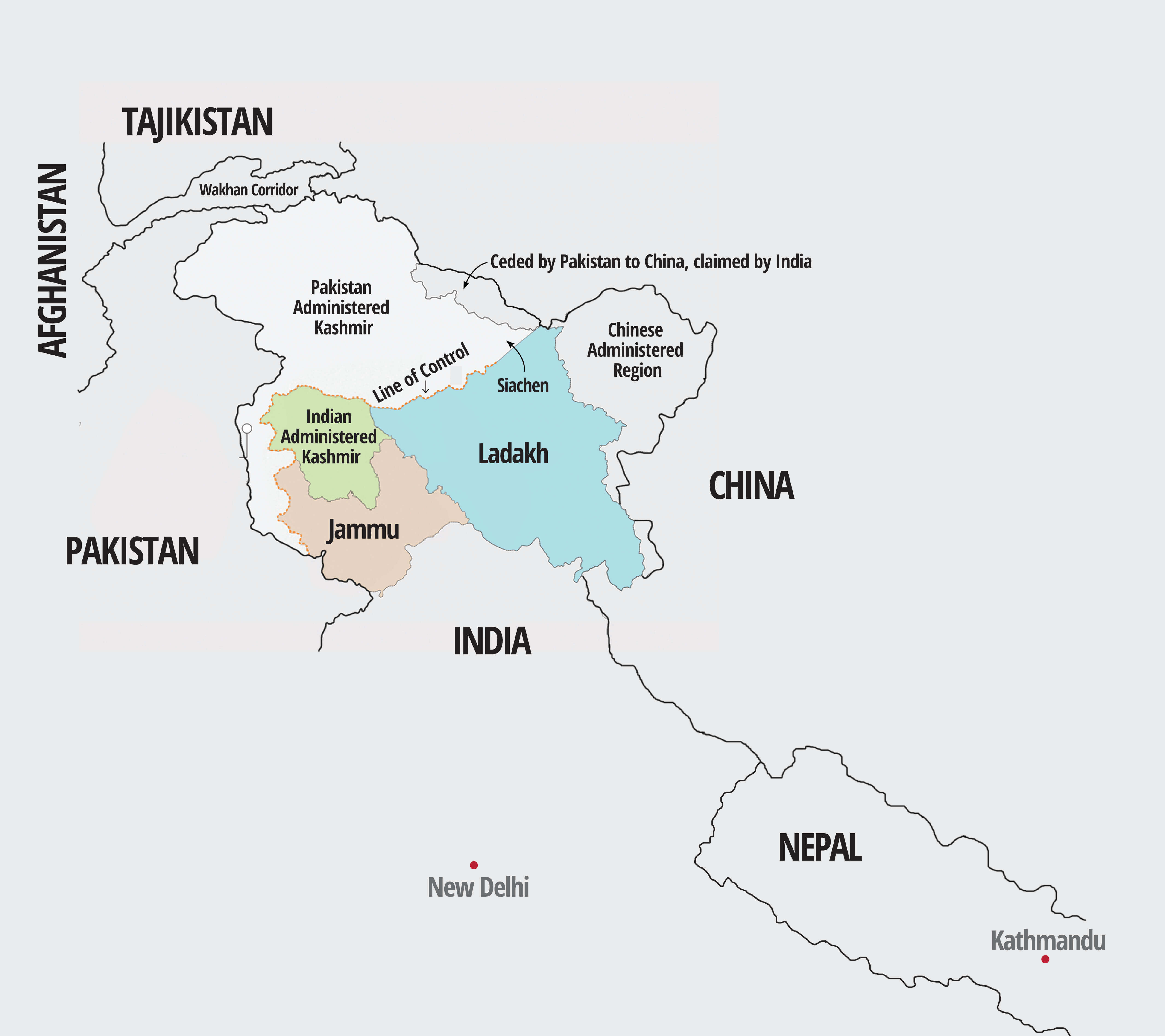
Earlier this month, India’s BJP government abruptly told all tourists and pilgrims to leave Kashmir, it shut off the phone system and blacked out the Internet. The entire Himalayan state is still under lockdown.
On 8 August both Houses of the Indian Parliament amended the Constitution to abolish Articles 370 and 35-A that had given Kashmir a special autonomous status. For the past 69 years since 1950, Kashmir was allowed to be governed locally, except in matters pertaining communications, security and foreign policy. At a theoretical level, this was a deal not very different from how New Delhi directs Bhutan’s foreign policy and defence.
At India’s independence Kashmir was a ’princely state’ governed by a Hindu dynasty even though the state’s population was predominantly Muslim. After partition in 1947, the last King of Kashmir, Hari Singh, decided to stay with India in return for assurances from Prime Minister Jawaharlal Nehru (himself a Kashmiri Pandit) of a plebiscite and autonomy. By then, Kashmir had already been carved out by Pakistan which laid claim its western half, and China which took the Askai Chin region of Ladakh.
Last week, Hari Singh’s descendant Karan Singh gave qualified support for the BJP move to abrogate Article 370, welcoming Ladakh being turned into a union territory, while supporting statehood for Jammu and Kashmir so as to maintain communal harmony.
Kashmir has been a strategic flashpoint for seven decades now, with India and Pakistan having gone to war at least thrice over the territory, while India fought briefly with China over Askai Chin in 1962. Kashmir is a volatile and emotive issue for Indians and Pakistanis, and has held the entire South Asian region hostage.
India’s security clampdown and communication blackout has meant that the world is not getting the full picture of Kashmir. There is a trickle of videos showing Kashmiris out in the streets, and hospitals full of injured demonstrators. Meanwhile, in the Hindu-dominated regions of Jammu as well as the mainland Prime Minsiter Narendra Modi’s move has been welcomed as “bold” and “decisive”.
Except for Pakistan and China, there has been only muted reaction internationally, with the United Nations and the United States calling for “calm and stability”. Interestingly, India's Minister for External Affairs is in Beijing as China itself tries to come to grips with its own pro-democracy protests in Hong Kong.
Here in Nepal, there has been surprisingly little interest. There has been no official comment yet from the government. Prime Minister Oli was away, and his often voluble party co-chair Pushpa Kamal Dahal who goes out of his way to comment on places like Venezuela has had nothing to say about Kashmir.
There are many reason why Nepalis should take Kashmir seriously. Firstly, there are many Nepalis working in Kashmir and Ladakh this time of year in the tourism industry. There are also tens of thousands of Nepali nationals serving in the Indian Army who are eye-ball-to-eye-ball with Pakistan across the Line of control, and with the Chinese Army in Ladakh. As in previous hostilities between India and Pakistan, and between India and China, Nepalis have shed their blood for the Indian side.