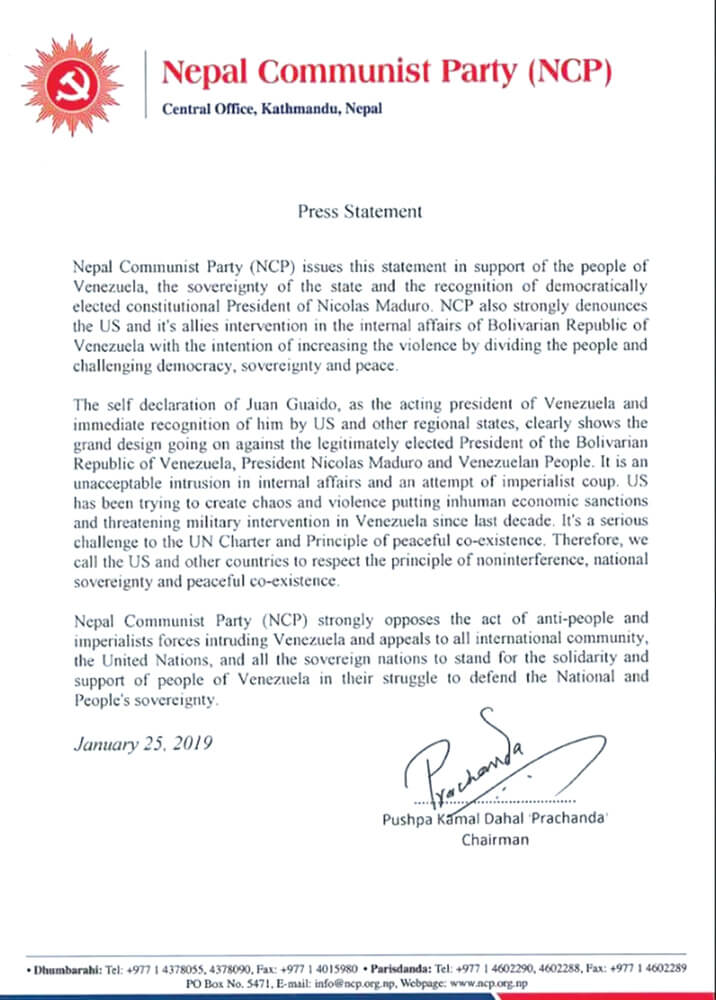
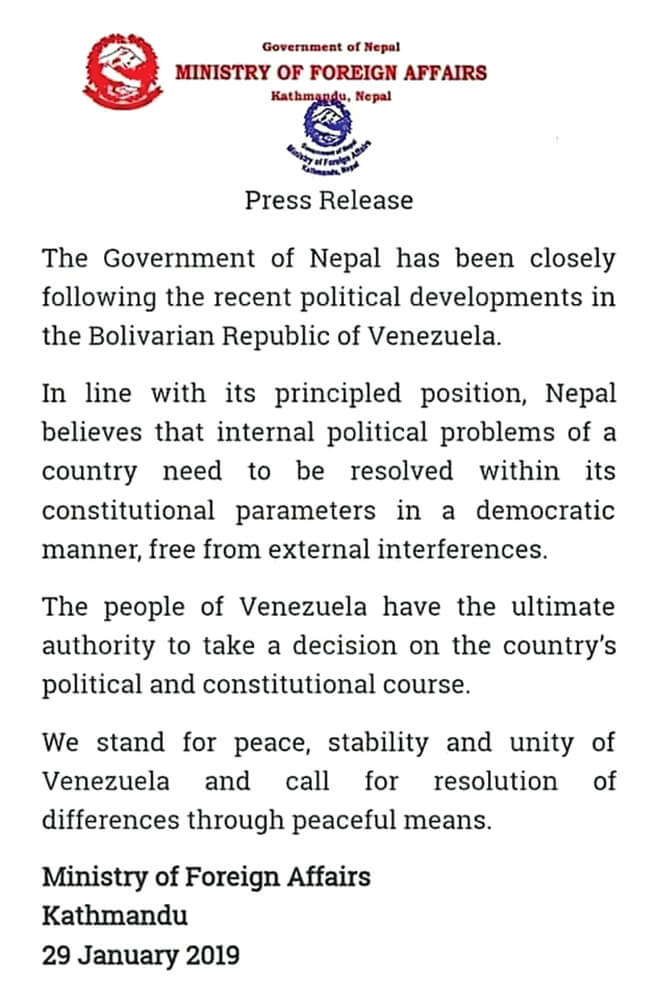
Nothing has exposed the ideological chasm between the ex-UML and ex-Maoist components of the ruling Nepal Communist Party (NCP) more than the two widely divergent statements issued on Venezuela this week.
Who would have thought that the Bolivarian Republic of Venezuela would loom so large in exposing fissures in a government of a country on the other side of the world with which the Federal Democratic Republic of Nepal has no real strategic interests.
Read also:
Nepal now has to balance not just India and China, but also the West, Bhairaja Pandey
Eminently beneficial for India and Nepal, Ajit Baral
The Co-chair of the NCP and prime minister-in-waiting Pushpa Kamal Dahal fired off a statement in full support of the glorious revolutionary comrades under Nicolas Maduro, and denounced US intervention.
It has to be said that the US has indeed come across, as it has in the past, as a global bully throwing its weight around with sanctions and threats against a poor and badly-governed country. When will America learn to pick someone its size?
But Dahal made a boo-boo by aligning his party, and by association Nepal, needlessly in a power struggle reminiscent of the Cold War.
There were two problems with the NCP statement. First was the timing: why would Dahal want to issue it while his party co-chair Prime Minister K P Oli was in Davos trying hard to make a good impression on foreign investors?
Oli had admitted before he left that his job was to convince the international community and multinational companies that his government was ‘Communist’ only in name, and that Nepal was open for business. Even if Oli had been only partially successful in removing the stigma, Dahal’s communique firmly identified Nepal as an adherent of an obsolete ideology and a relic of the past.
The only explanation we can give to this juvenile behaviour is that Dahal has a sad case of FOMO. By launching a heat-seeking missile aimed at no one in particular, Dahal may also have been trying to re-establish his rather frayed Communist credentials. But the unnecessarily strong language denouncing American 'imperialism' which was creating 'chaos and violence’ was inappropriate, undiplomatic and counterproductive.
Oli looked uncharacteristically flummoxed when asked about Dahal's missive when he returned from Davos. The statement also came less than a month after Foreign Minister Pradeep Gyawali’s meeting with US Secretary of State Mike Pompeo in Washington DC during which the two discussed implementation of America’s $500 million assistance through the Millennium Challenge Corporation (MCC) Nepal Compact for road and power connectivity.
The two are also understood to have discussed America’s Indo-Pacific Strategy which, together with the MCC, are seen as a counter by China as a challenge to its Belt Road Initiative (BRI) which Nepal has signed on to. Gyawali trod a tightrope to balance the geostrategic interests of the two global powers, and clarified that Nepal was not going to join any US-led alliance in the Indo-Pacific.