In the five years since transitioning into the federal system, Nepal’s local governments have garnered much more trust among voters than the country’s provincial and federal governments.
The 2017 local elections were the first in two decades, so elected representatives had a lot of catching up to do, and large gaps to fill. Some performed better than others, mostly rural municipalities and wards.
A 2021 survey by the Sharecast Initiative Nepal confirmed that half the respondents nationwide were satisfied with the performance of their grassroots leaders. In comparison, only a third of the respondents said they were happy with provincial and federal governments.
A similar poll by the Asia Foundation and Kathmandu University in 2020 was even more revealing: almost 70% of respondents were satisfied with local governments. More than 85% of them said they trusted their local representatives.
Read also: Nepal’s local election gives power back to people, Rabin Giri
Indeed, Nepal’s local bodies and elected officials have consistently ranked above average in performance evaluations and institutional self-assessments in the last five years. Political insiders also agree that local levels have done a better job at governance than their federal and provincial counterparts.
“The work and conduct of leadership at our federal level in these five years does not inspire confidence at all,” says former finance secretary Rameshore Khanal. “However, Nepal’s future development will be very much driven by the local governments.”
Joint Secretary of the Ministry of Federal Affairs and General Administration Gopi Krishna Khanal agrees, adding that Nepal has successfully adapted to the federal system in a relatively short period in large part due to elected grassroots leaders.
Read also: Feudalism to Federalism, Editorial
“Local governments have ensured that our public schools and health posts no longer have leaking roofs,'' he says, “roads and infrastructure have improved, markets have been decentralised from district headquarters to reach the hinterland.”
Local governments were more effective in responding to the impact of the pandemic, often leading from the front to set up tracing, testing, quarantine and isolation centres, tightening security measures, and distributing relief materials— with some elected officials personally stepping up to transport the sick to hospitals.
"While our unstable federal government was embroiled in controversy and provincial governments struggled to adjust, local governments that started from scratch have given Nepalis a sense of how governments should function,” says self-governance expert Shyam Krishna Bhurtel.
Former prime minister K P Oli, whose opposition UML party has dominated local governments in the past two elections, publicly thanked local leaders in Parliament recently, saying: "The role of locally elected representatives in times of crisis has never been clearer than it is now, as these officials worked tirelessly to prevent the spread of the virus and to provide relief to families in their communities. ”
While the federal government bungled, and was embroiled in allegations of corruption in the import of testing kits and could not ensure adequate oxygen supply to hospitals, local governments were quick off the mark and saved countless lives.
Indeed, the report of the Auditor General shows that much of the relief provided to those affected by poverty, unemployment as well as victims of natural disasters have come from Nepal’s local governments.
Elected mayors and ward council members for the past five years have been reaching their constituents with improved access to health care, providing citizenship certificates and other essential documents, government allowances, agricultural resources and information, and many other services previously limited to bureaucrats at district headquarters.
Read also: Power to the periphery, Sonia Awale
“Access to essential government services at the community level have ensured that Nepalis can reach out to elected officials about any problems,” says Kavita Dhungana, deputy chief of Nuwakot’s Belkotgadi Municipality.
Nepal’s local governments have also been granted the power to make and implement acts, directives, and legal procedures within their jurisdiction under the Local Government Operation Act 2018.
Rajendra Prasad Pyakurel, executive director of the National Federation of Village Municipalities of Nepal, says that while citizens have valid criticisms regarding local governments, that censure does not extend to the access to and delivery of essential services.
Sanju Kumari Chaudhary, deputy chief of Banke’s Kohalpur municipality, agrees. "Officials are aware that inefficient work equals a lost vote,” she says. “Such concern about their political future is enough to ensure that services are provided promptly and competently.”
Local institutions have also made it easy for Nepalis to access and exercise their judicial rights. Constitutionally mandated three-member Judicial Committees headed by the Deputy Chiefs of local governments take complaints regarding domestic, community, agricultural, and other local infrastructural disputes, facilitating hearings and reconciliation — often mitigating problems and administering justice before issues become more serious and have to be taken to court.
“The Judicial Committees have taken a lot of pressure off Nepal’s district courts,” says Kavita Dhungana, deputy chief of the Belkotgadi municipality, and vice-chairperson of the Nepal Municipal Association.
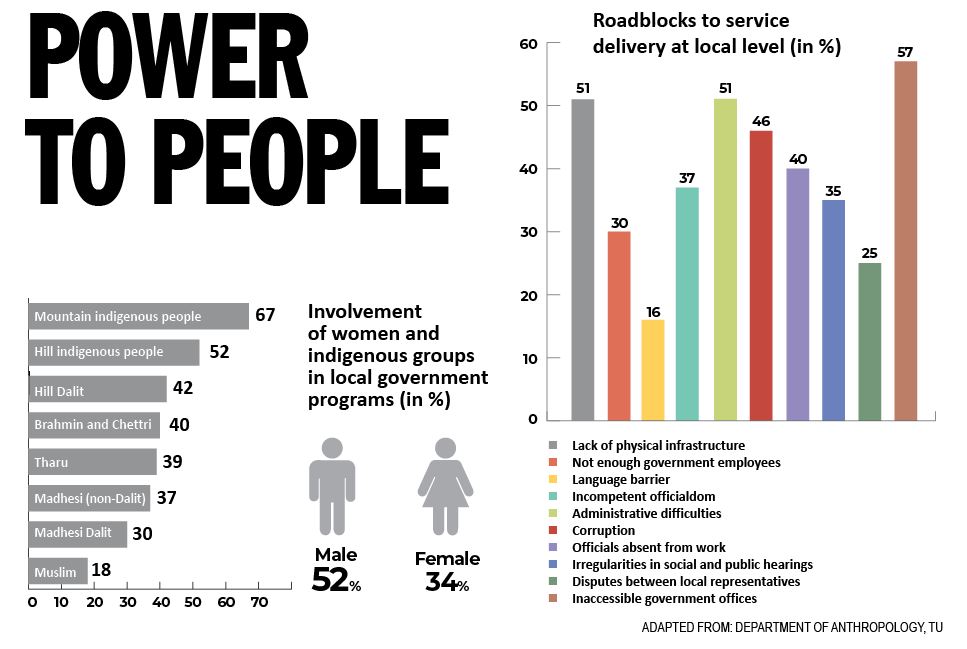
Local-level institutional self-assessments have consistently identified judicial performance as one of the most effective functions of local government. Indeed, judicial committees have been key to settling land and agricultural disputes in districts from Mahottari to Kanchanpur. In Banke, reconciliation centres have been set up in every ward to facilitate solutions to minor disputes.
The 2021 Sharecast survey identified three main tasks of the government prioritised by respondents: job creation, poverty alleviation and road construction. Of the three, road connectivity has also been the priority for many of Nepal’s local governments, as evidenced by their budget allocation.
Morang’s Kanepokhari Municipality, where local politicians campaigned on a platform of new road infrastructure in 2017 has upgraded 118 km of roads and asphalted 29 km. Similarly, Jhapa’s Kankai and Syangja’s Waling municipalities have also blacktopped most of their roads.
In 2020, Nepal’s local governments expended 44% of their budgets on social development, 27% on infrastructure, and 17% on administrative functions. Collectively they spent 64% of the Rs2.44 billion budget allocated to them.
Their performance shows that drinking water services, electricity, agriculture and irrigation, education and health care are priority areas. Many local governments have invested in fire engines and ambulances. They have made considerable progress in clean energy.
Dang’s Ghorahi Sub-metropolitan City has begun producing bio-gas, with plans to deliver it to households through a pipeline. Palpa’s Nisdi village has facilitated wind-powered electricity to 150 households, while 300 households in Surkhet’s Chowkune village have electricity from solar arrays.
Elected leaders in Rawaveshi village of Khotang have provided water supply to 256 households, while in Batteswor village of Dhanusha 14 modern wells have been drilled to provide irrigation water.
Read also: "Everything is political", Durga Karki
Many local governments have also taken strides in socio-cultural preservation and development. Humla’s Namkha Municipality introduced grammar textbooks to preserve its Homlu Bhote-Lama language spoken by the local community. Ilam’s Rong municipality has added Lepcha curriculum in its primary schools, while Ramnagar village in Sarlahi developed a local syllabus for the preservation of the endangered Bajji language.
Rautahat’s Durga Bhagwati Municipality provides housing to under-served Dom families, while the Manahari Municipality of Makwanpur built homes for Bote families.
Many local governments have prioritised economic development and income generation, facilitating agriculture and small businesses across communities. In Dhankuta Municipality, known as Nepal’s ‘Avocado Capital’, farmers have been given subsidies. Gulmi's Isma village has been providing cash incentives to dairy and meat farmers to increase production, while villagers in Gulmi’s Dhurkot get support for bringing barren land under cultivation.