
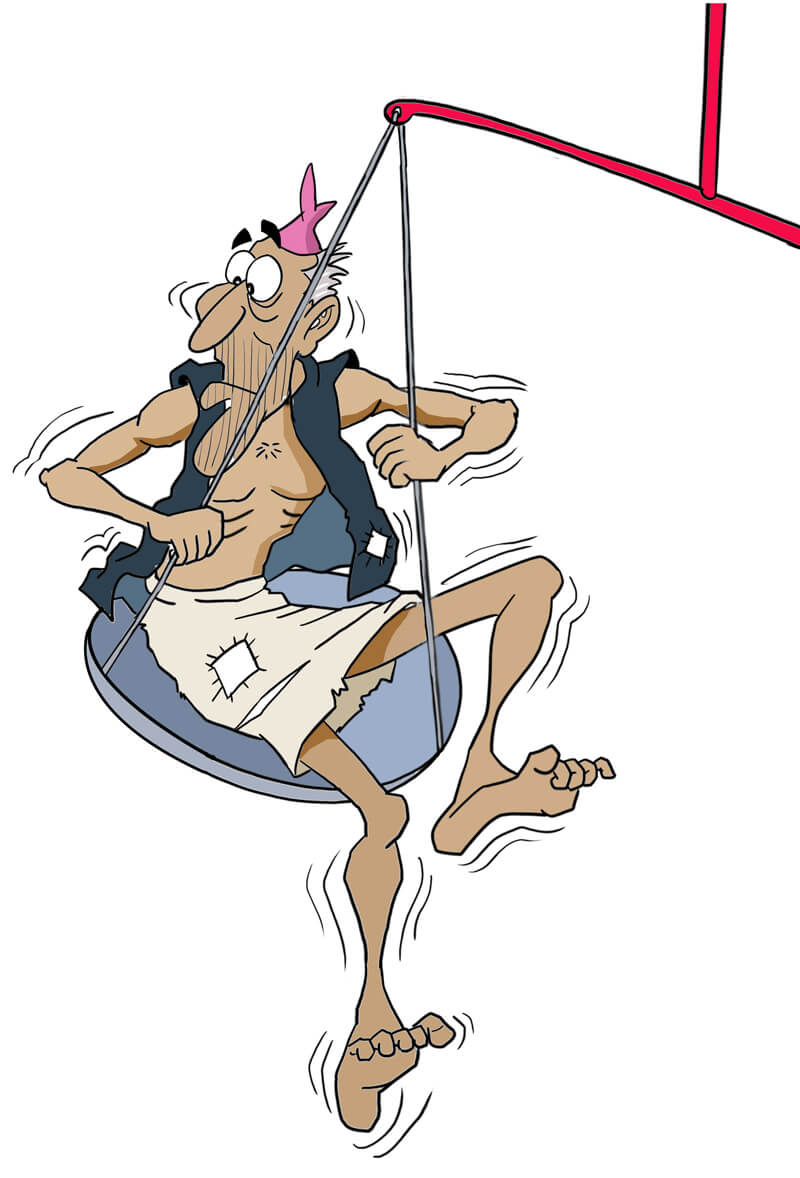
Whatever the political ambitions of the Maoist leaders, their justification for taking up arms was the inequality historically embedded in Nepali society. The rebels lit the spark on terrain that was tinder dry with disparities. Nepal would have gone up in flames sooner or later, the Maoists just had their timing right.
The tragedy, of course, is that in an allegory of Animal Farm 13 years after the war, the Maoist leaders people elected to government forgot what they fought for, and Nepal’s income and wealth gap have grown even wider. As our review of a recent report shows, Nepal’s poor are trapped in poverty while the few rich have prospered.
The report by HAMI, South Asian Alliance for Poverty Eradication and Oxfam paints an alarming picture of deprivation and disparity in Nepal: the average income of the richest 10% of Nepalis is more than three times that of the poorest 40%. Worse, the richest 10% own 26 times the wealth of the poorest 10%.
Read also:
Nepal's great income divide, Ramesh Kumar
Some are more equal than others, Anil Chitrakar
Removing poverty with jobs, David Seddon
It's a rich man's world, Ramesh Kumar
Economic inequality is most evident in agriculture in which 66% of Nepalis still depend. The wealthiest 7% of households own 31% of the agricultural land, and many landless are tenant farmers at the mercy of landowners. Social discrimination multiplies the misery: 81% women are landless, as are 44% of Dalits in the Tarai.
Nepal’s wealthiest man has a net worth of $1.6 billion and is the 1,561 richest in the Forbes list. His wealth grew by $200 million last year. A history of feudalism, a rent-seeking state and neoliberal economic policies have concentrated Nepal’s wealth in the hands of a dominant elite which has made policies and laws to perpetuate its hold on it. Rulers and hangers-on have deliberately kept the poor out of reach of new opportunities, depriving them of a chance of a better life.
Such disparity also gives the movers and shakers an unfair advantage in a democracy because they can bend the system to keep getting elected, which then deprive the underserved even more. Politicians, bureaucrats and businesses can carry on with business-as-usual with no accountability, full impunity and no fear of retribution from a rigged system.
The government’s failure to deliver on basic services like health and education have driven the private sector to fill the gap. But consequent over-commericalisation and lack of regulation have put quality schooling and medical care out of reach of the poor. The government’s reaction has been to back a populist call for nationalisation to cover up its own delivery failure.
Inequality is taking its toll on the physical and mental development of children. Malnutrition begins at a very young age: 36% of Nepali children under five are stunted, 27% are underweight, and 10% suffer from wasting due to lack of adequate food. There is no greater proof of chronic governance dysfunction than this: the apathy and failure of the state to protect its most vulnerable.