
The Asia and the Pacific SDG Progress Report 2024 published by the UN’s Economic and Social Commission for Asia and the Pacific (ESCAP) earlier this month shockingly revealed that the region will achieve all 17 Sustainable Development Goals (SDG) only by 2062, and not by the target year of 2030.
While the region has taken positive steps towards eliminating poverty, and bolstering sustainable industry, innovation and infrastructure; progress in other goals related to hunger, health, clean water and sanitation, affordable and clean energy and sustainable cities and communities have been less noteworthy. These require much more political will.
The UN adds in a supplemental note that while the country has shown progress to meet most targets in gender, inclusion and maternal-child health, Nepal is lagging behind in SDGs #2 and #10: achieving food security and combating undernourishment, as well as in reducing inequalities within and among countries.
Translated from UN-ese, this means: many Nepalis (especially children) still go to bed hungry every night, and some Nepalis are more equal than others.
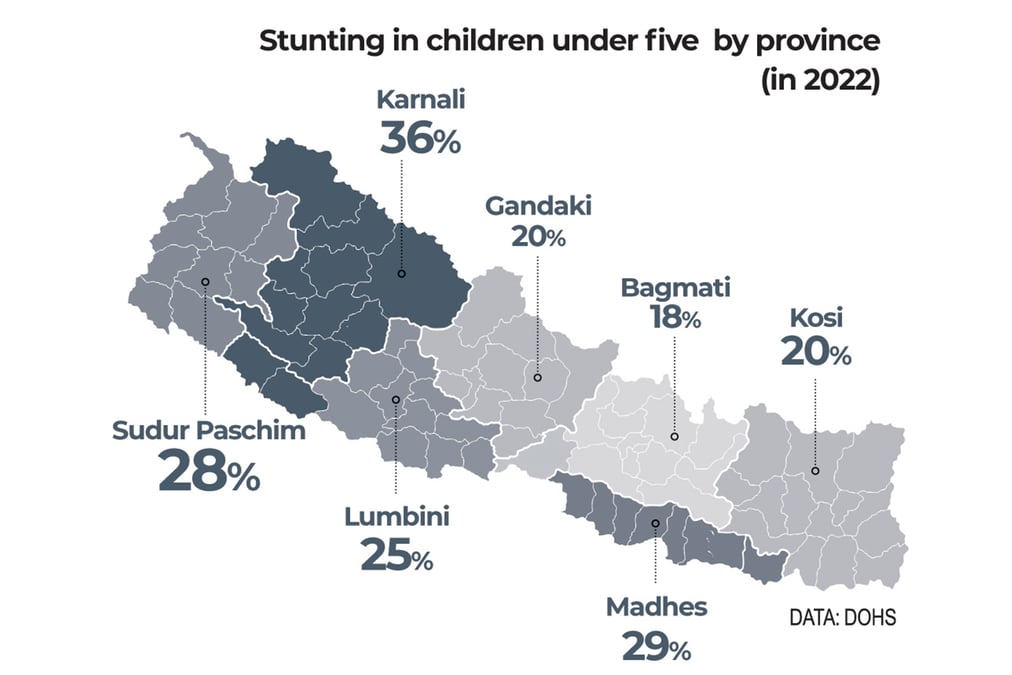
Chronic hunger is measured by wasting and stunting in children. One of the targets under the SDG’s second goal is to eliminate stunting and wasting in children under five. The 2023 Joint Child Malnutrition Estimates by UNICEF, WHO and the World Bank Group stated that in 2022, stunting affected 26.7% of children under five in Nepal. The Demographic Health Survey in 2022 put stunting slightly lower at 24.8% of children under five.
To be sure, Nepal has reduced stunting significantly from 67% in 1995, when it was one of the highest in the world, to where it is now. But that is a nationwide figure, and there are parts of Nepal that are still far behind.
In Karnali Province 36% of children under five years of age are stunted. It is 29% in Madhes Province. Despite a reduction in Nepal’s poverty rate and improvements in the national nutrition levels, hunger still persists in these areas.
Food insecurity and undernourishment do not exist in a vacuum, they are also symptoms of societal inequities. Stunting is nearly three times as high among Nepali children from the lowest wealth group than among children of richer families. Undernourishment is directly affected by a mother’s education level.