
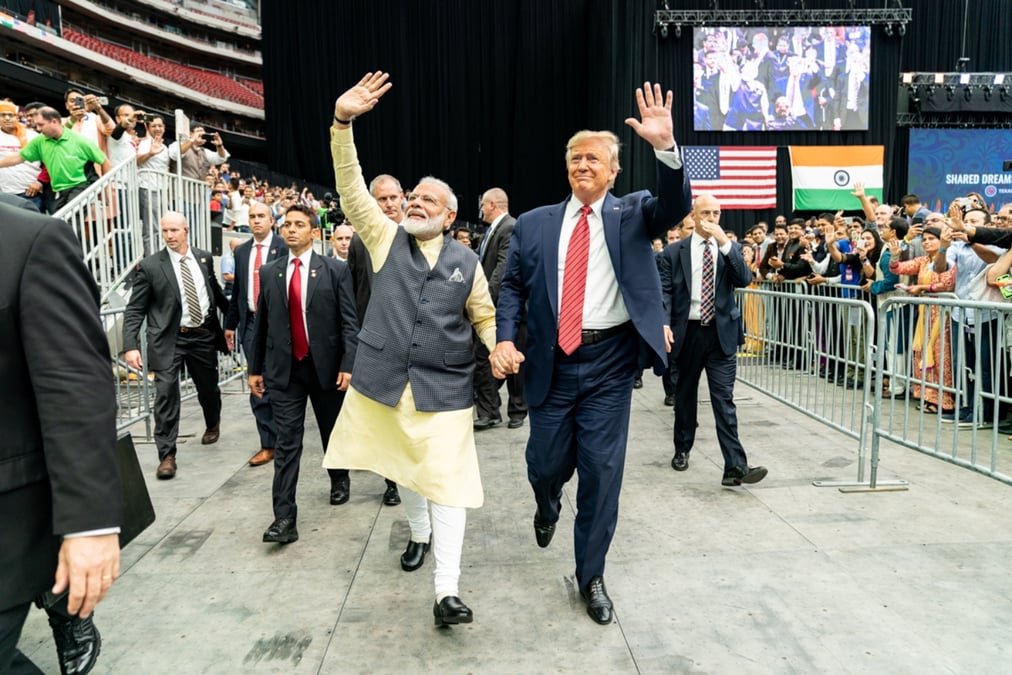
Indian Prime Minister Narendra Modi and US President Trump have had a love-hate relationship. The two populist leaders have now fallen out, threatening a full scale Indo-American trade war.
Many of Nepal’s exports to the United States like garments and rugs are also what India sells to the US. So, after Donald Trump announced additional tariffs on Indian exports to total 50%, Nepal could have an advantage.
But this is only if the government plays its cards right and develops a long term strategy to boost export of items in which it has comparative advantage, and find new export products.
The recent fallout ostensibly comes after India ignored western sanctions and continued to purchase Russian oil, and could be linked to Trump’s meeting with Russian president Vladimir Putin in Alaska on Friday in which he wants to use India as a bargaining chip.
“Trump has not honoured any international trade agreements, making the global trade regime unstable,” says economist Posh Raj Pandey. This could mean that the US could still pull back on tariffs, just as he has given China a reprieve of another 90 days this week.
Compared to other South Asian countries, including India, Bangladesh and Sri Lanka, Nepal faces a relatively low tariff rate of 10%. Theoretically this could put Nepali exports at an advantage for items like garments and other products like tea. But it also carries its own risks.
Some 64% of Nepal’s imports are from India, and US tariffs could make those products more expensive. A stronger USD vis-a-vis the INR would also devalue the Nepali rupee and increase the cost of imports from India of raw material for its exports, for example, garments.
The manufacturing sector in Nepal has never reached its true potential, its main export items to India are soya and palm oil which are actually just bulk imports of the same oils repackaged for export. Domestic production lacks capacity to keep up with demand.
“Nepal’s productive capacity must be increased in order to boost exports, and the market should be diversified for Nepal to take advantage of a competitive market,” says Pandey.
Indian exporters could try to reroute their finished products through the open border with Nepal, changing the tag from ‘Made in India’ to ‘Made in Nepal’ to avoid US tariffs. China did this by relocating its factories to Vietnam in the past, but such re-labelling may result in punitive measures.
“It is not worth the risk, we should be careful. Besides, there is no domestic value addition in such cases,” states Kharel.
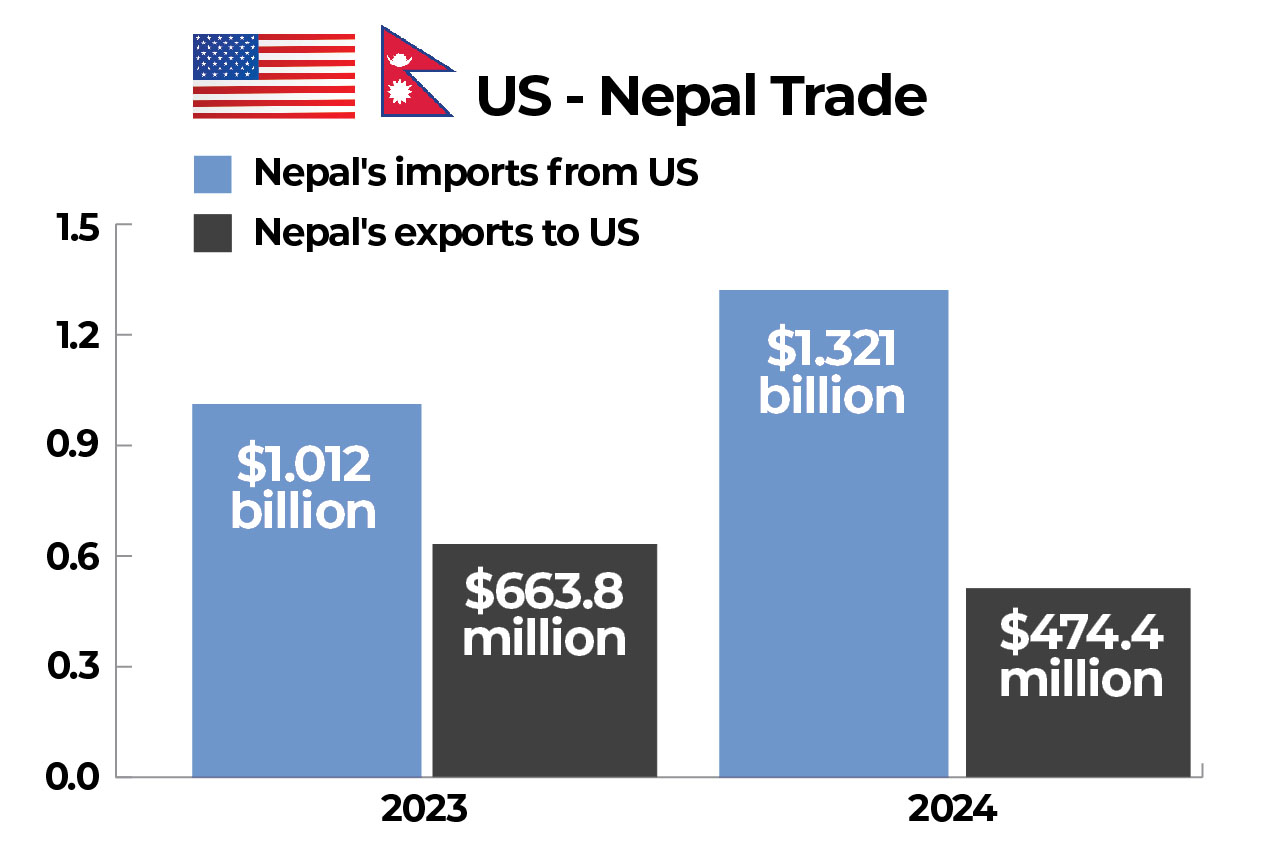
Nepal has a trade deficit with the US of Rs7.64 billion, which is probably why Trump has not increased tariffs on Nepal’s exports to more than 10%. Nepal’s main exports to the US are ready-made garments, dog chews and carpets. Nepal had preferential market access to the US, but did not take much advantage of it.
“Nepal’s garment export to the US stands at Rs2 billion, and we could try to increase production and export more to take advantage of relatively lower tariffs, but reaching production worth Rs10 billion is not practical and Nepal does not have the capacity either,” says Pandey.