
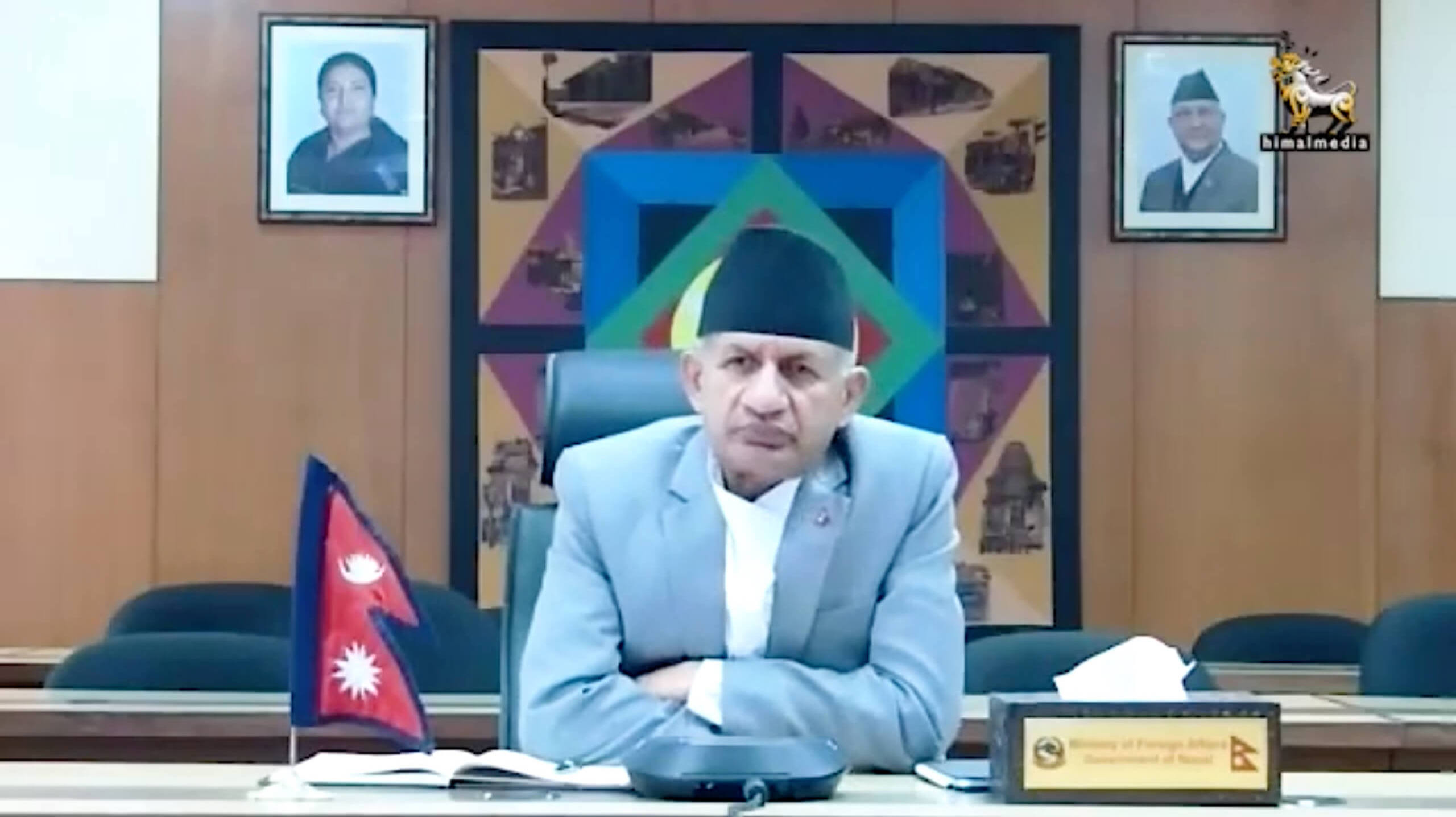
Special interview in Saglo Samaj tv magazine program with Foreign Minister Pradeep Gyawali, who is also a member of the government’s Covid-19 Control and Management Committee (CCMC). Kanak Mani Dixit asks him about the government’s response to the Covid-19 pandemic so far, and its strategy to deal with the crisis now that there is a brief respite from the political stalemate.
Kanak Mani Dixit: We have often heard that both the government and citizens are responsible for the second wave. But was it not the government’s job to warn people of the risks and make sure precautions were taken?
Pradeep Gyawali: I have just come from a meeting in which the prime minister instructed the new Cabinet that the complete focus of our work henceforth should be to fight against Covid-19 by using every means at the government’s disposal. It is true that there were lapses, we knew the wave was coming but the state was bogged down with party power struggles and that prevented us from concentrating on battling the pandemic. But it is not that the government has stood idly by, since last year we had added testing centres, HDUs, ICUs, ventilators. But this second wave was so aggressive, all this was not enough. For example, last year only the really serious patients needed oxygen, this time there are more patients needing critical care, which means more oxygen flow. Our preparations were not enough to deal with the severity of the second wave.
If the situation is so serious, why does the government not declare a health emergency?
The existing Infectious Disease Act gives the government the power to punish those flouting rules to stop the spread of communicable diseases. But the situation is serious, and many have advised us that we should declare a health emergency which would allow the state to deploy private hospitals to treat patients, and get all agencies of the state to concentrate solely on health. But so far, the existing laws are adequate to deal with the situation.
The CCMC has not been effective as the main state mechanism in tackling the emergency. Are there plans to change that?
We set up the CCMC because the war against Covid needs various ministries of government to work together. The Health Ministry is the frontline agency, but it has to coordinate with the Home, Foreign, Finance, Tourism, Supplies and other ministries. If the CCMC had not been there, there would be chaos. The CCMC is empowered with the authority to take its own decisions. Obviously, its work needs to be more effective and visible.
Maybe we need more than ‘coordination’? Maybe we need more effective and accountable leadership.
The Health Ministry gives a good daily briefing. But Covid response is not just a health issue, there are decisions regarding supplies, transport, enforcement that need to be conveyed better to the public. We will activate the CCMC to be more proactive in communicating its decisions and situation reports.
The prime minister told CNN that Nepal had the pandemic under control, a few days later in an appeal in The Guardian, he asked the international community for urgent help. Why this mixed message?
It also depends on how the question is framed. CNN asked if it was true that the Covid-19 pandemic was out of control in Nepal. Even in the current situation, we cannot say it is out of control, and it is not. It is true that we are overstretched, and there are shortages of hospital beds and oxygen, but that does not mean that it is out of control, and we have surrendered. We have been telling the international community that the country is in difficulty at the moment, and the reason is that we have a 1,800km open border with India and even last year the trend was that what happens in India follows in Nepal within 12-13 days. This has really stretched us to the limits.
What is the reason for the delay in bringing vaccines? Nepalis have not got a clear answer.
There is a huge rich-poor vaccine gap in the world. As soon as vaccines were available last year, we approached manufacturers and international agencies. We had to look at affordability, efficacy, and the logistics for refrigeration. The most suitable was AstraZeneca’s Covishield vaccine. I was in India in January, and we put forward our case. Nepal became the second country in South Asia to start vaccinations. We got 1 million doses as a grant from India, after that we bought 2 million, of which 1 million doses were delivered. Then China gifted us 800,000 VeroCell vaccines, under the COVAX initiative we got 348,000 doses. India separately provided 100,000 doses for the Nepal Army. So we have received more than 3.2 million doses so far, and about 2.2 million so far have been fully or partially vaccinated which is about 8-9% of the total population. This means we rank 80th in the world in vaccinations, which is not bad. We paid for 2 million doses of Covishield at $4 a dose, a price the government set, of which 1 million doses were sent immediately. But then the pandemic suddenly spread in India and the court and government there banned exports. There was no other reason for the non-delivery of the remaining 1 million doses, it was not because of any middlemen or commissions. The allegations are totally false, I am willing to go to any court in the world to debate this. The remaining doses will come to Nepal.
But this issue came up because the Health Minister himself accused middlemen of behind the delay.
He was not talking about the 2 million. After this we tried to buy another 5 million doses from India and that deal did not happen because there was demand for vaccines within India itself, but it is true that the Serum Institute of India told us to talk to their authorised agent in Nepal. However, we said we sent you advance payment of which half the doses have not even been delivered. It is unfortunate that without even understanding the issues, the opposition parties have turned this humanitarian issue into a political agenda.
We are in talks with Sinopharm to buy 2 million doses of VeroCell for delivery by June. The second is the Russian Sputnik vaccine for which we have already provided permission for emergency use, but the problem is that Russia is not producing enough. Even so, we have said we need 8 million doses, of which 4 million are required right away. We are waiting for their answer.
Then there is America which has booked and bought 60 million doses of AstraZeneca, and there is a debate within the United States about whether this vaccine stockpile can be donated to other countries. We have activated diplomatic channels to convince the Americans that they should provide us some of these doses. But the US Food and Drug Administration, the Centre for Disease Control and even the security agencies need to give approval for export. But I am sure that once these requirements are fulfilled, Nepal will be a priority.