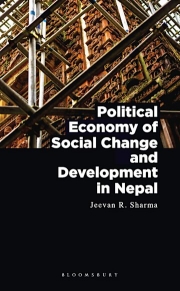
This short book, Political Economy of Social Change and Development in Nepal, by Jeevan Sharma, a senior lecturer on South Asia and international development at the University of Edinburgh, packs a punch.
Drawing on his own original field research and the ideas of Karl Polanyi on The Great Transformation (1944) as well as secondary literature, Sharma has produced a holistic overview and analysis of the economic, social and political transformation that Nepal has experienced over recent decades.
`His work challenges many of the prevailing characterisations and explanations of that process, and identify some of the contradictions that underlie the more visible fault lines that others like Ram Sharan Mahat and Baburam Bhattarai also have identified.
In his Introduction Sharma writes that ‘change, transformation and development have been recurrent themes, not only in everyday conversations, political rhetoric and social movements, but also in Nepali public culture and literary writings since the 1950s’.
He then reviews both the main features of the changes that have taken place since the 1950s and also some of the different theoretical and empirical studies that have addressed those changes.
Sharma warns against the uncritical adoption of Polanyi’s framework for ‘the Global South’, but argues that a more complex model, involving ‘a three-sided constellation of conflict among proponents of marketisation, adherents of social protection and partisans of emancipation’, would make it possible to connect ‘politics, society and economy’.
He does not consider in any detail alternative approaches to the ‘political economy’ of social change and development in Nepal (eg the ‘neo-liberal’ and the Marxist) although he sees the ten-year Maoist insurgency (1996-2006) as part of a broader movement for social justice, rights and citizenship that he argues has been developing ‘since the 1950s’.
The book has four main chapters, each considering an axis of change. Chapter 2 ‘From Subjects to Citizens’ considers Nepal’s political ‘transition’ focuses particularly on the period since the 1950s.
The first half of the chapter charts the uneven process the transition from subjects to citizens at the national level, the second half examines local perceptions of the dynamics of social change with particular reference to changes in caste, gender and local power relations and to the role of the Maoist insurgency in bringing about these changes. This section draws on Sharma’s own fieldwork in western Nepal.
Chapter 3 ‘Peasantry, Mobility and the Changing Face of Rural Nepal’ looks briefly at the economic and social history of the peasantry in Nepal and ‘changing rural society’, exploring the diversification of rural livelihoods, the weakening of ‘caste-based feudal relations’ and the commodification of labour. This leads on to a consideration of migration, which he rightly sees as having a long history from the mid-18th century onwards.
Somewhat controversially, Sharma identifies three to five ‘waves’ of migration, the last of which became more widespread after the 1990s and ‘has come to shape the nature of the remittance-based national economy of Nepal’ – leaving many Nepalis in low-paid, highly exploitative and precarious employment.
I would have preferred to see migration as characterised by different ‘forms’ or ‘regimes’, often contemporaneous rather than sequential. And despite the undoubted importance of remittances in contemporary Nepal would contest the notion that Nepal’s economy is ‘remittance-based’.
There are many different strands in Nepal’s complex integration in the wider regional and global economy, including not only the export of labour, but also of other resources as commodities, and the importation of commodities from other countries, foreign direct investment, loans and ‘foreign aid’.
It is also debatable, as the climate crisis deepens in this most vulnerable of countries, whether paid employment away from home is necessarily more precarious than livelihoods based on agriculture and embedded in a local economy and society often characterised by hierarchy and inequality.
Chapter 4 ‘Mobility and Educational and Occupational Futures’ focuses on the experiences of young men from rural Nepal as they struggle to overcome the challenges of mobility and find secure, and salaried employment.
It draws heavily on Sharma’s fieldwork in Palpa and explores ‘social meanings and patterns of mobility’, looking at the links between education and employment in particular, but also considering the significance of caste and ethnic identities in determining outcomes.
This chapter is particularly rich in ethnographic terms, and complements Sharma’s earlier work on ‘youth, migration and masculinities in Nepal’. It would be good if some anthropologist were to undertake a similar investigation into the education and subsequent livelihoods of girls and women.
Chapter 5 ‘Development and Patronage Politics’, while referring to programs undertaken during the early 20th century ‘that would fall under what is broadly regarded as development’, Sharma sees 1950 as ‘a critical moment in Nepal’s development history’.
He examines briefly what he calls the ‘initial rush for development’ in the 1950s and then the program of ‘nation-building through Bikas’ under the Panchayat System dominated by King Mahendra.
This is followed by a review of the period after the first Jana Andolan from 1990 to 1996 (‘democratisation for development’) and of the Maoist insurgency (‘conflict and development’) from 1996-2006.
Sharma considers the Maoists’ theory, strategy and practical contribution to economic, social and political change. While recognising that ‘development was at the core of Maoist ideology and strategy’ and acknowledging their positive influence in certain areas – notably addressing inequality and social discrimination – he seems largely unimpressed by their actual achievements and has a number of negative things to say about their practice.