
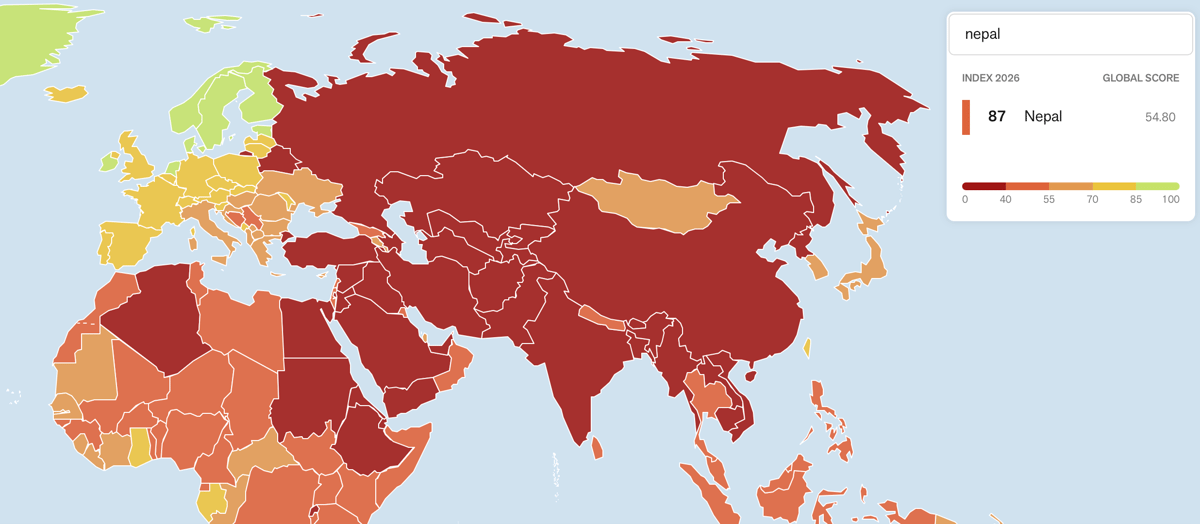
Nepal advanced in the annual global ranking for press freedom this year compared to last year— not because the country improved, but because others did worse.
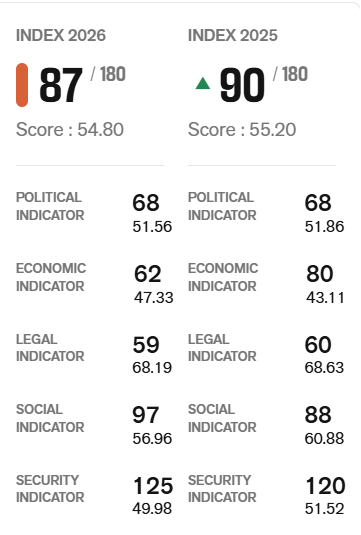
The Reporters Without Borders (RSF) World Press Freedom Index for 2026 (pictured, above) places Nepal at an improved #87 rank, compared to #90 the previous year. However, the condition for journalists in the country has deteriorated from ‘Problematic’ in 2025 to ‘Difficult’ this year.
This is largely due to the pre-September government's crackdowns, which restricted press freedom with new laws and banned 26 social media platforms that helped spark the GenZ protests and led to regime change. But there are worrying signs that the new government is not doing much better.
Nepal’s ranking in the Press Freedom Index had been improving steadily in recent years: from #106 in 2021 to #70 in 2022, but it has since slid in both its global position and the general situation for journalists.
The main concern is Section 47 of the Electronic Transaction Act 2006 which can penalise online publication of content deemed ‘against public morality and decency, spreads hatred, enmity or disrupts social harmony’.
While even press freedom activists admit a need to regulate hate speech and disinformation — especially fake AI-generated clips — there is concern that the definition of what constitutes a ‘threat to social harmony’ is too vague and can be used to silence critics.
An example of treading this fine line was the arrest last month of a YouTuber in Panchthar under Section 47 for ‘derogatory’ posts deemed to defame Prime Minister Balendra Shah. Soon after, the Ministry of Information and Communication warned media that those disseminating ‘unverified content’ could be charged under cybercrime laws.
Last week, journalists covering the forced evictions of thousands of families from squatter settlements in Kathmandu were prevented from interviewing families and some were forced to delete photos and videos from their cameras. Police said there were “orders from above” to restrict media access.
Earlier, the Nepal Army took the unusual step of issuing a warning against ‘baseless and fabricated content against it and its leadership'. More ominously, the military said it was surveilling content: ‘The Nepal Army and concerned agencies are monitoring such disruptive and lawless activities.’
Ironically, the September protests, the formation of the interim government and the RSP victory in the March election were all made possible by social media. An anti-establishment force is now the establishment, and it seems to have developed a thin skin.
Prime Minister Balendra Shah is also the Defence Minister and Home Minister, giving him civilian control over both the Nepal Army and Nepal Police. Both arms of the security forces have been present during the evictions of squatter settlements. The prime minister himself has not spoken to the media, refuses to meet foreign emissaries including this weekend an envoy of US President Donald Trump, and rarely makes public appearances.
One of the RSP government's first acts last month was requiring that all government notices and public service announcements be channeled exclusively to state-owned media. Although there was much hanky-panky in releasing the notices, many smaller media in the districts depended on this revenue for their public service journalism.
These attempts to stifle freedom of expression come even as the government under Prime Minister Balendra Shah, has bypassed Parliament to enact a slew of laws by ordinance, despite its near two-thirds majority. Without much of an opposition to speak of, such a move was not even necessary and indicates an intentional state-led dismantling of democratic norms and freedoms.
ELECTED DESPOTS
For the first time since RSF started its World Press Freedom Index in 2001, more than half of the world’s countries now fall into the ‘Difficult’ or ‘Very Serious’ categories for press freedom.
'In 25 years, the average score of all 180 countries and territories surveyed in the Index has never been so low,' RSF reports, blaming this on the spread of increasingly restrictive legal measures that erode the right to information — even in democratic countries.
Threats to press freedom today come not only from authoritarian regimes, but increasingly from elected despots. The technique is the same: exert corporate control over mass media, buy out publishers, frame journalists with SLAPP (Strategic Litigation against Public Participation). It is not necessary to kill journalists anymore, killing journalism is more effective.
The situation in the world’s two biggest democracies looks dire. The United States, for example, has fallen seven places from #57 to #64, while India dropped from #151 to #157. The report says the US is ‘falling apart under President Donald Trump … who has turned repeated attacks on the press and journalists into a systematic policy’.
The report says the situation in India is ‘very serious'. Besides controls on content across the media spectrum, the Narendra Modi government has introduced new rules on the Digital Personal Data Protection Act. It would restrict publication of information that is in the public interest sourced from official documents which implicates the government.
Says RSF Editorial Director Anne Bocandé: “Authoritarian states, complicit or incompetent political powers, predatory economic actors and under-regulated online platforms are directly and overwhelmingly responsible for the global decline in press freedom.”
She adds: “The ball is in the court of democracies and their citizens. It is up to them to stand in the way of those who seek to silence the press. The spread of authoritarianism isn’t inevitable.”