
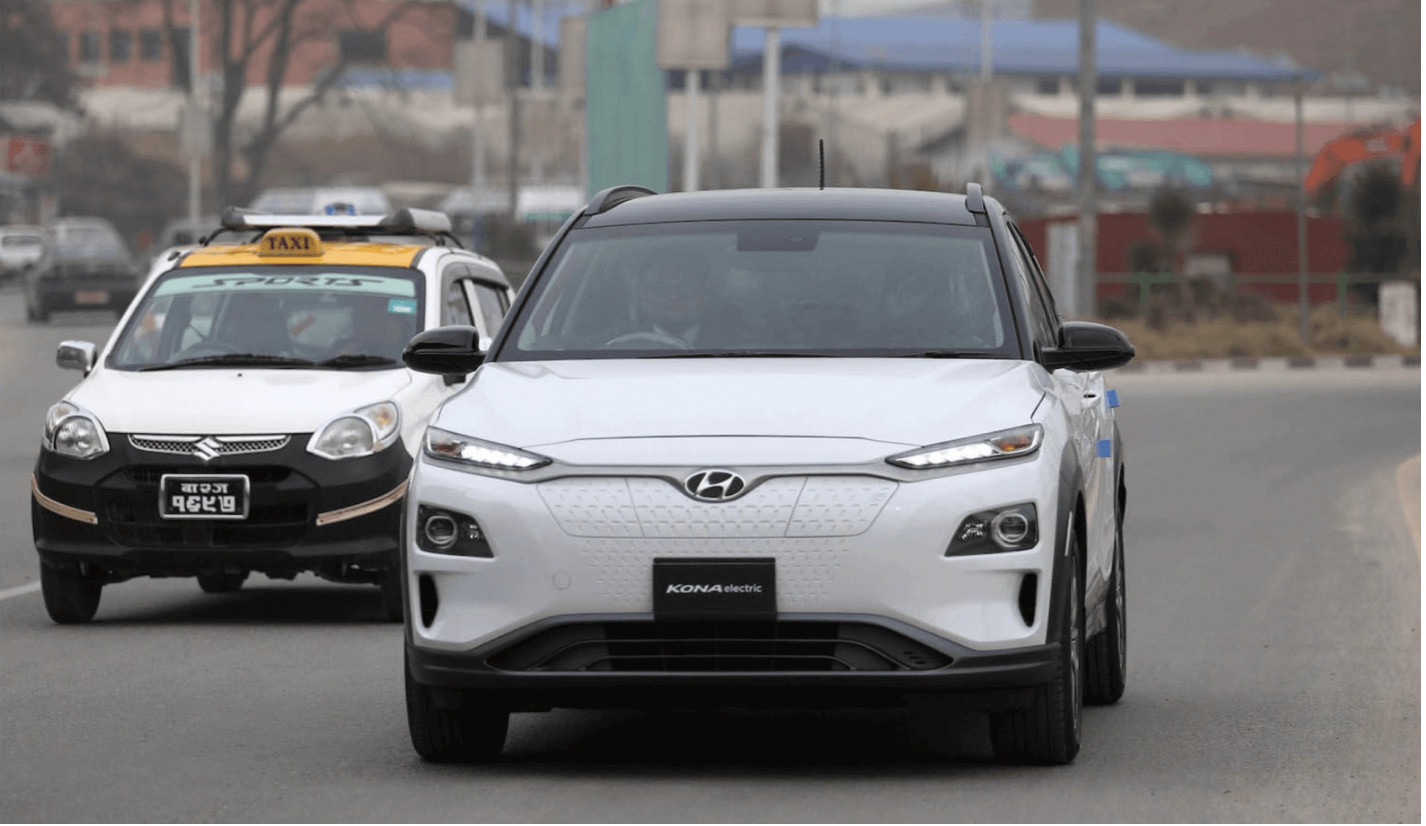
Widely criticised for its hefty tax on battery-powered vehicles in last year’s budget, Prime Minister Oli’s government under a new finance minister has backtracked to scrap the controversial tax hikes on e-vehicle imports.
Last year, Finance Minister Yubaraj Khatiwada slapped excise duties on e-vehicles of 30-80% depending on their capacity, and levied customs duty of 60%. He justified it saying electric SUVs were luxury items, and the government needed to augment revenue to fight the Covid-19 pandemic.
The move priced e-vehicles out of the market at a time when sales had just started to pick up, and various brands of electric vehicles were gaining popularity because of their expanded range. But Khatiwada’s move spiked prices of electric vehicles by 120-140%, making them less competitive vis-a-vis fossil-fuel alternatives.
The government’s move appears to be geared to reducing the import of petroleum import bill, and also to increase electricity consumption as Nepal’s new hydropower plants come online this year, giving an energy surplus.
Saturday’s new budget presented by Finance Minister Bishnu Paudel has completely repealed excise duties on e-vehicle imports while cutting customs duties down to the earlier 10%. This takes the tax formula back to 2016 when cuts in excise and customs duty had made battery-operated vehicles gain popularity.
Paudel also announced that renewal and road taxes will be waived for five years if an existing petroleum vehicles switches to battery power.
The new policies are based on Nepal’s ambitious plan to phase out petrol-diesel vehicles with e-vehicles by 2031, especially as lockdowns increase public consciousness on Nepal’s growing air pollution problem caused mainly by vehicular emissions.
Analysts say that the government had no choice because most countries that Nepal imports cars from, including India and China have announced phaseouts of new petroleum vehicles in the next decade.
Following the budget announcement, Nepal Electricity Authority (NEA) signed a contract with Chinese firm Wanwang Digital Energy Corporation for the installation and maintenance of 50 e-vehicle charging ports across Nepal.