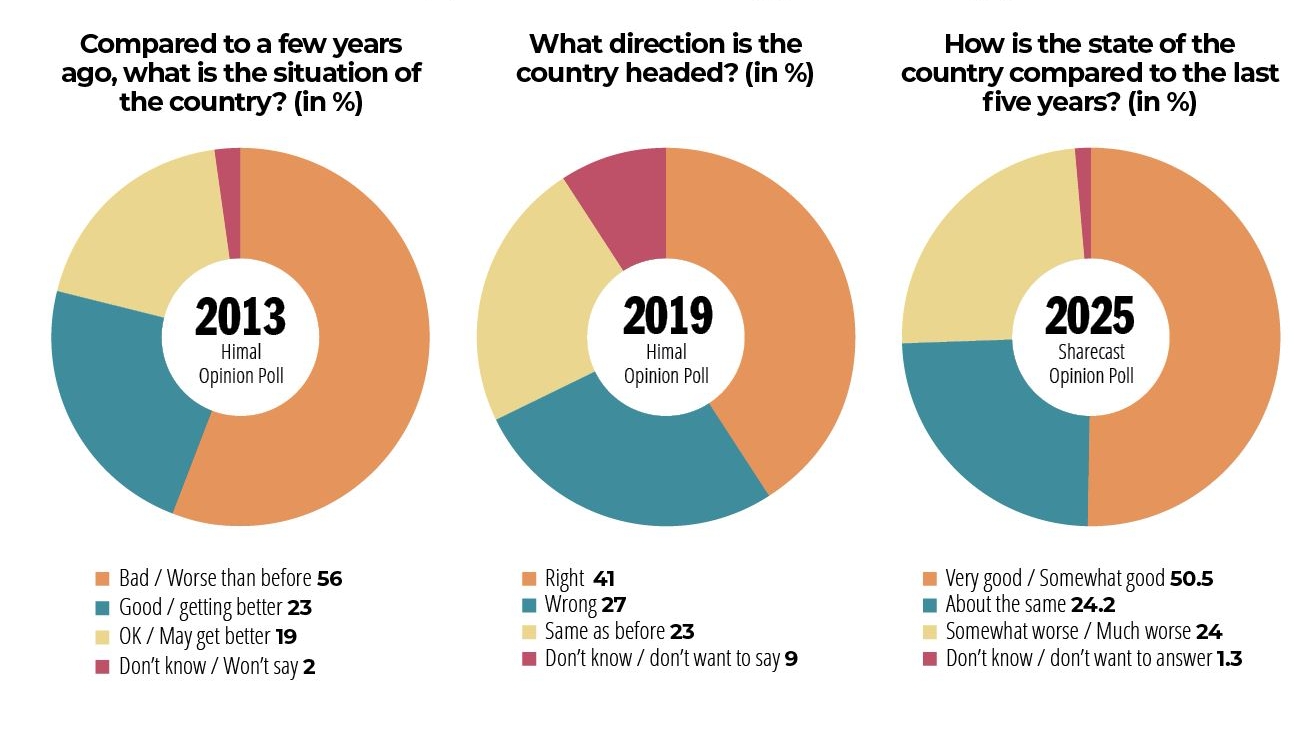
Half of Nepalis think the country, and their families, are doing better than five years ago. Really?
The prevailing narrative is that Nepalis have given up on Nepal, are fed up with geriatric serial prime ministers, and are fleeing the country in droves.
But the latest Sharecast Initiative poll found that half the respondents felt their lives had improved, and the country was doing mostly okay. But it has become unpopular in Nepal to say that things are not so bad, and analysts who cited the survey were mercilessly trolled on social media for being ‘hope-mongers’.
“There is a strong narrative that Nepali society is in a deep state of depression and most of us want to make it self-fulfilling,” says Rameshwar Bohora, editor at the digital portal Ukaalo which got much hate mail after publishing the survey findings. “What I saw in the survey result was not despair but anger and dissatisfaction at politicians, which means there is still hope.”
To be sure, the poll also registered mass discontent with a dysfunctional government, its non-performance and corruption. Respondents had a long list of complaints that included unemployment, poverty, poor service delivery, inflation, etc. The survey indicated that their ultimate outlet was foreign employment.
“The fact that people are dissatisfied with politics and criticise politicians means they still have hope and expectation, democratic politics is also the only way to improve things,” says political analyst Indra Adhikari. “People vent out their frustration to build public pressure so leaders and institutions will correct their behaviour and perform. This is how a healthy democracy works, and if we reject public opinion and treat it negatively, then it is our weakness.”
Comparing previous nationwide public opinion surveys conducted over the past 20 years by Himalmedia (the publisher of Nepali Times) reveals an interesting pattern. The polls in 2013 and 2019 had similar questions: ‘Compared to a few years ago, what is the situation of the country?’ and ‘What direction is the country headed?’
Tracking the trend, it is evident that Nepalis are becoming gradually more optimistic. One has to remember that by 2013, the post-conflict euphoria had evaporated during the fragile peace process and the Constituent Assembly was deadlocked over demands for ethnic federalism.