
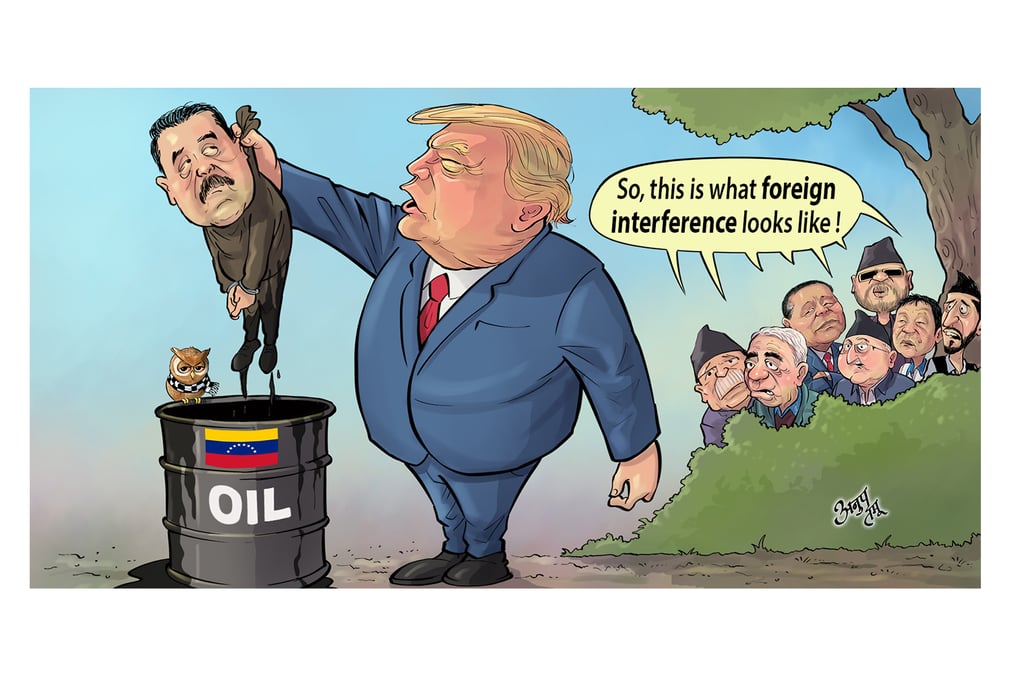
The American military action in Venezuela and the abduction of President Nicolás Maduro Moros may redefine Nepal’s geopolitics as it juggles between three world powers, India, China and the United States.
Nepal’s interim government is busy preparing for elections on 5 March, and it was late issuing a statement on the American intervention in Venezuela, but the country may have to re-evaluate how it deals with its immediate neighbours and the global power.
“How does Nepal avoid being the next Ukraine or Venezuela? Small countries shouldn’t go around irritating big neighbours. And when big neighbours really get upset, they usually put up a moral fig leaf justifying their miltary action,” says energy economist Dipak Gyawali. “What we see with Venezuela today is bereft of such moral content, essentially banditry which in today’s day and age is unacceptable. Neither the rising new powers nor much of the Global South will take this lying down.”
International relations experts have said that there is now a new world order in which rules-based diplomacy has been thrown out of the window, and the world has been carved into America leading the western hemisphere, Russia is allowed to do what it wants in Ukraine and Europe, and China’s sphere of influence is now the Indo-Pacific.
Foreign affairs expert Nischal Pandey says there is a lesson for smaller nations like Nepal: “We have to be aware of the sensitivities of the major powers in the vicinity.”
There is also a lesson for smaller resource-rich countries not to give an excuse for intervention with poor governance and political instability due to inequity. In Venezuela’s case it was throttling democracy and not using its immense oil-wealth to uplift its people.
Nevertheless, the Trump administration’s abduction of a sitting president of a foreign government regardless of the dictatorial nature of his regime and Venezuela’s volatile internal politics, is illegal and breaches the international order that has been in place since after World War II and its devastation on humanity.
While Trump’s intervention in Venezuela, and threats against Colombia, Cuba and Greenland have brought international condemnation, here in Nepal it has not been taken as seriously as it should.
Says Amish Mulmi, author of the book All Roads Lead North: Nepal's Turn to China: “Some of the reaction on social media has been that of glee over the fall of a dictatorial Communist government on the other side of the world. However, the government statement about fully respecting the principles of sovereignty and the Charter of the United Nations is a strong statement that makes clear Nepal's position on the matter.”
“The abduction of Maduro is a clear sign of Trump's America ensuring its sphere of influence through might and a warning to toe the line,” Mulmi adds. “It also infringes on the sanctity of borders and the preservation of sovereignty. Trump's actions reek strongly of a bygone era of imperialistic control and resource capture.”
Venezuela has 17% of the world’s reserves of crude oil, even though refining this heavy tar-like oil will be costly, and is possible in only a few places including Texas.
“This has to do with a larger political economy of oil, the unravelling of pax Americana and the post-World war II order. This is USA’s heavy-handed response to remain on the top as well as to partly solve its debt of $39 trillion,” explains Gyawali. “But this is not going to help: China is far ahead, Russia has recovered from its 1990s low point, and manufacturing capital has moved away from America. So controlling only financial capital - and using military power so brazenly - is not going to work.”
The might also be specific lessons for Nepal as a smaller country with vast water resources. While water, unlike oil, is renewable, India’s interest in Nepal’s hydro resources cannot be ignored. Ironically, America’s capture of Venezuelan oil reserves could exacerbate climate breakdown and the melting of Himalayan glaciers, which will put Nepal’s water resources in jeopardy in the coming decades.
The only way to deal with this for Nepal and downstream India will be to build reservoirs on rivers to store monsoon precipitation, and that makes water a strategic commodity for the future.
“If we continue in the current mode of hydropower-biased water resources development ignoring irrigation, flood control, navigation, fisheries, tourism and other benefits, India will get the free benefit of regulated water while we pay the upstream environmental and social costs. History will blame our elected leaders for having undersold our resources,” adds Gyawali, who served as water resource minister in the early 2000s.
As for a larger geopolitical lesson: “We in Nepal are fortunate in having not one threatening hegemon but two superpowers India and China: they don’t agree with each other, but do agree on a peaceful Nepal for their own security. However, our current political leaders are irritating both the neighbours, unlike since the centuries past when our rulers looked solely after Nepal’s core interests and our neighbours knew that.”
American intervention in Venezuela also calls for strengthening of our institutions and diplomatic outreach. Nepal has been a non-aligned state, and for all its history has tried to follow a policy of equidistance between India and China. The difference with Venezuela is that Nepal has to deal with two giant neighbours, and not just one.
Says Mulmi: “It is no more only about balancing great power relations but also about benefiting from them. But that will be increasingly difficult as international law and the principles of sovereignty are encroached upon.”