
Sometimes, we need to take a step back to realise what a tectonic movement Nepali politics witnessed this month.
In a region and world ruled by elected authoritarians, Nepalis went to the ballot box freely to express a collective will for change.
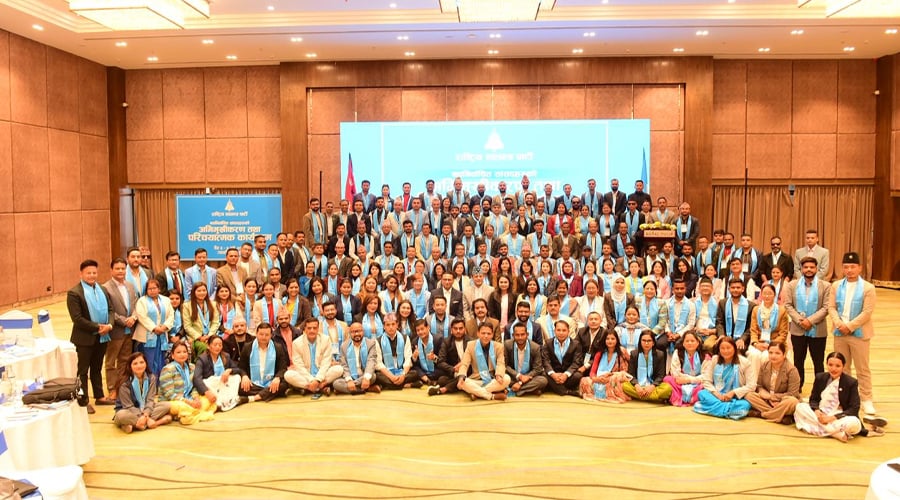
These faces in this group photo of the RSP’s 180 freshly-minted MPs at the ballroom of the Royal Tulip Hotel on Wednesday is symbolic of what Nepal has come through.
The ship of state righted itself after the September Storm, installing an interim government that held an election within six months in which voters banished obsolete politicians and their parties into oblivion.
Nepalis, fed up with the inept kakistocracy of the past three decades, took the country into a post-ideological phase — replacing Marxists, Maoists and monarchists with a belief in a new governing culture that rewards delivery and accountability. And they have trusted the RSP to carry it through.
Nepal’s history has never been linear, it jerks ahead in lurches. The polity also tends to take one step forward and two steps back, so the public’s great expectations is tempered by a sense of cautious optimism and guarded pessimism.
This could be the great leap forward that Nepalis have waited for and deserve, but it could also be a Gramscian interregnum in which the old is dead and the new is not yet born. We will have to wait to see whether this transitional period will also see ‘morbid symptoms’.
As disruptor-in-chief, it was the Balendra Shah ‘wave’ or ‘craze’ that propelled the RSP to power. The former Kathmandu mayor needed a party platform, and the RSP’s tainted leader Rabi Lamichhane required a booster. Nepal's voters were looking for a saviour.
Personality-wise Shah and Lamichhane are poles apart: one is Type B and the other Type A. One is enigmatic, the other phlegmatic. But yin and yang do also tend to complement each other.
Kathmandu’s chattering class is already making self-fulfilling prophecies about the two falling out, and are fishing for hints that they already have. Shah’s absence from the RSP’s orientation this week was taken as a clue.
Closing the two-day tutorial on Wednesday, Lamichhane delivered a fiery 30-minute speech that laid out the RSP’s main agenda: to function differently from the old parties, serve the people, avoid middlemen, become true lawmakers without taking the law into their own hands.
“The old political parties contributed to history, we will build the future with a new political contract with citizens,” he said, trying to rise over past controversies and his abrasive rhetoric to sound statesmanlike.
GIVE AND TAKE
Lamichhane is said to be in touch with the reclusive Shah to announce a compact cabinet next week. Its composition will be an indication of how much give-and-take there was, and whether the criteria for selecting ministers is competence or loyalty.
Will RSP ministers behave like rulers or service providers? The new government will dive right into the economic fallout of the West Asia war with soaring fuel prices, inflation and uncertainty about remittance inflows.
On Thursday, Gagan Thapa resigned as NC chair, taking moral responsibility for the party’s election loss. The UML’s unrepentant K P Oli does not share the same sentiment about who is responsible for his own party’s historic downfall.
NCP chair Pushpa Kamal Dahal, who was luckier than his cross-party cohort, is now a comparative relic in a Parliament largely comprised of freshmen and sophomore lawmakers.
But the NC, UML and NCP still control provincial and most municipal governments. The old parties could try to make things difficult for the RSP at the centre, but it is also an opportunity for them to clean up their act ahead of local elections next year.
Another test for the RSP will be dealing with a heavily-politicised klepto-bureaucracy which has to frontend its policy decisions.