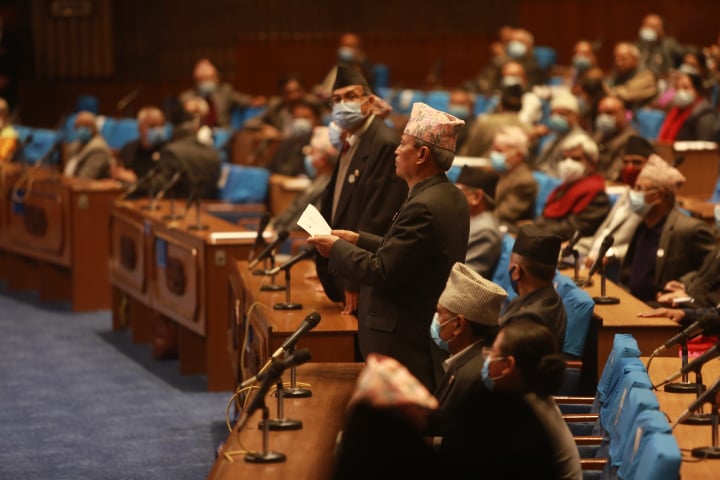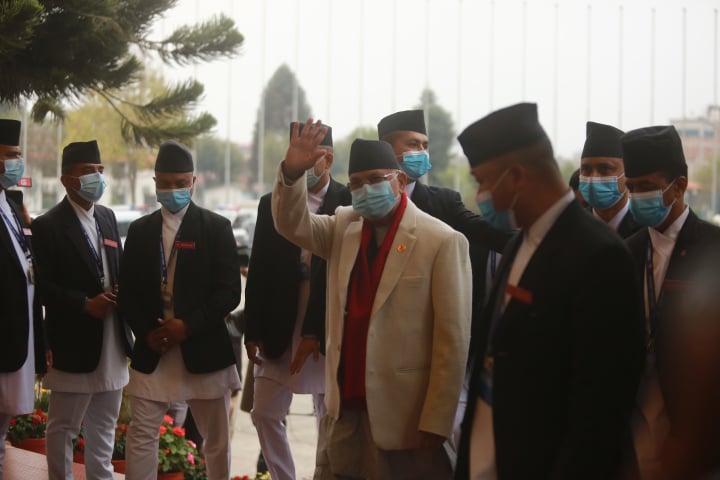
The decision on Sunday by the Supreme Court that effectively makes the unification of the ruling Nepal Communist Party (NCP) null and void, just hours before a crucial recovering of the dissolved Lower House, has thrown the country’s politics into further turmoil and uncertainty.
This was reflected in the first session of the restored House on Sunday (pictured below) as the NCP faction led by Pushpa Kamal Dahal staged a walk out, saying Prime Minister K P Oli had no moral right to present ordinances in a House that he himself had dissolved on 20 December.
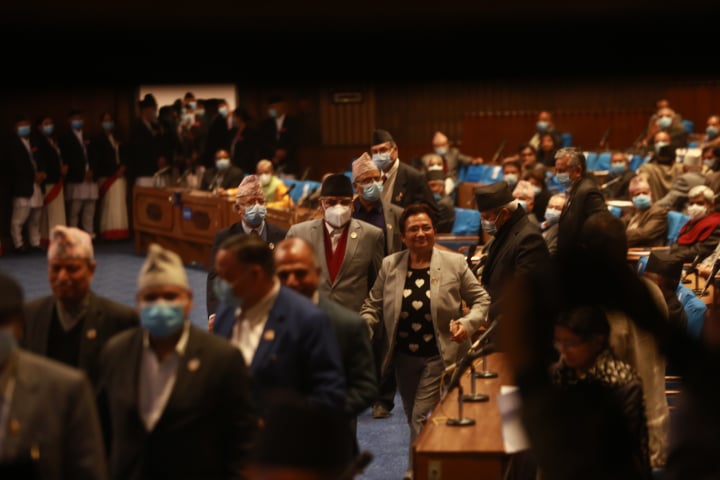
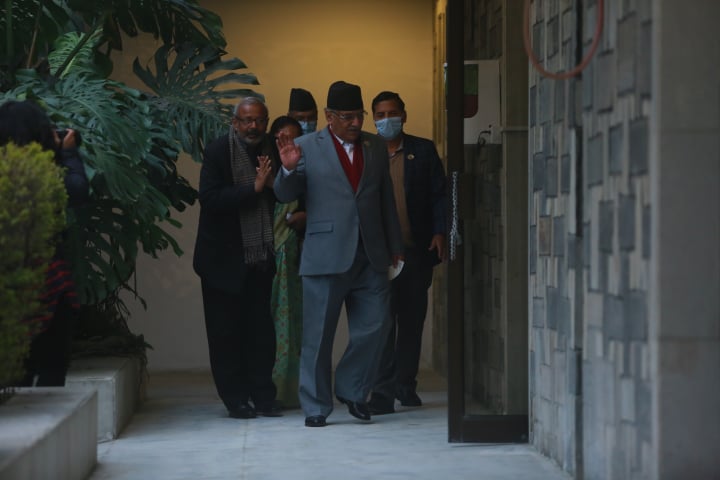
Photos: AMIT MACHAMASI
As the House sat for the first time in two months, there was confusion about whether MPs of the NCP were in the ruling party or the opposition. Dahal called the Supreme Court decision “unexpected” and is said to be in consultations with his colleagues about the way forward.
The alliance between the erstwhile UML led by Prime Minister K P Oli and the Maoist Centre headed by Dahal had won a near two-thirds majority in the 2017 election, and promised political stability in the country. Nepal’s politics has been anything but stable — mainly because Oli and Dahal could not get along.
The general impression was that Oli had pulled the rug from under his rivals, by going back to his old party and turning the clock back on unification. However, in doing this, Oli might have sacrificed his own leadership of government.
Prime Minister Oli will now have to prove that he has the confidence of a majority of the members of the House. However, there is no chance that the 53 or so members of the Dahal faction will now support him.
“There are now two parties, and as soon as the rival party withdraws its backing, the prime minister has to demonstrate that he has the support of the house,” says constitutional expert Bhimarjun Acharya.
The House was reconvened by a Supreme Court decision on 23 February that overturned Prime Minister Oli’s dissolution. However, with the Dahal faction walking out and the opposition Nepali Congress (NC) raising slogans against the ordinances being proposed, the session had to go into recess. Speaker Agni Sapkota then recessed the House till Wednesday.
Another expert, Prof Purna Man Shakya said: “If he wants to remain prime minister Oli’s party will have to get additional votes for which the only way to muster support is from the Janata Samajwadi Party (JSP). Failing that, the Maoist Centre, NC and JSP could also form the government.”