
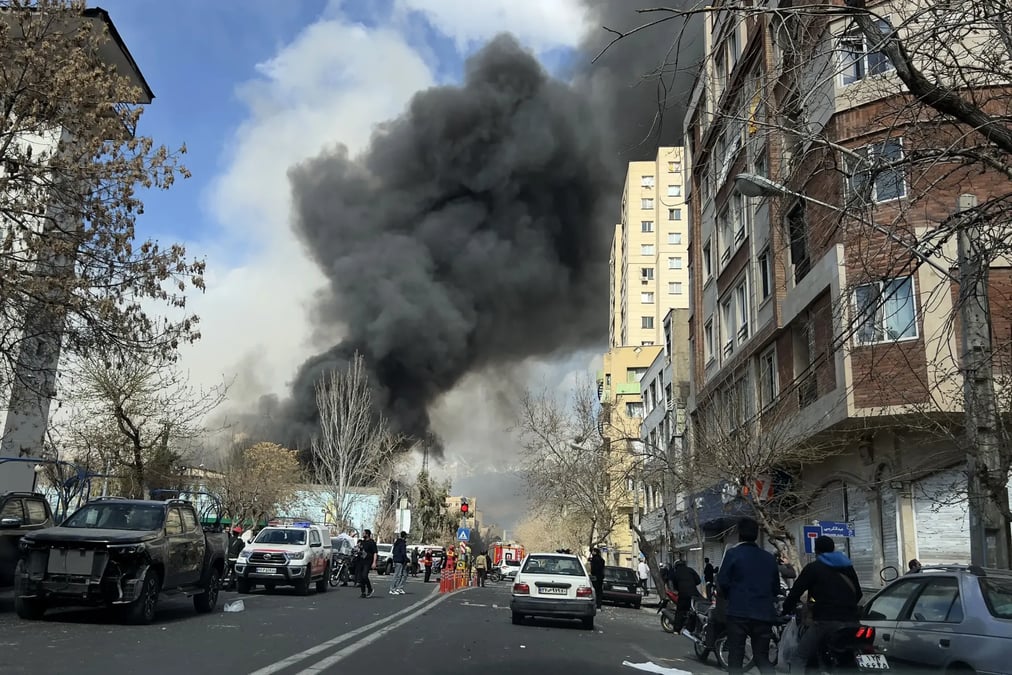
There is a term from psychology that has been quietly making its way into conversations among academics, policy thinkers, and ordinary citizens trying to make sense of what they are watching unfold: moral injury.
It is not the fear of being harmed. It is the damage done when human beings are forced to witness, or feel implicated in, events that violate their deepest convictions about right and wrong, about the rules by which civilisation is supposed to operate. It is what happens when everything you were taught to believe the world was built upon begins to dissolve in front of you in real time.
That dissolution is now a daily experience for millions of people. It arrives through screens, through speakers, directly into homes and offices and classrooms. The language of this moment is not the language of diplomacy or statecraft. It is the language of annihilation: eviscerate, decimate, stone age, eliminate, go fetch. These are not negotiating positions; they are performances.
Read also: Fuel price shock hits Nepal aviation, Nepali Times
Red lines, we were told, meant something. They were the architecture of deterrence, the invisible grammar of international order. For decades, this language organised how states behaved toward one another, how the public understood the limits of acceptable conduct, how generations of students were taught to think about power and its constraints.
Those students are now watching, in stunned disbelief, as line after line is crossed with impunity, and the consequences amount to more performance, more language, more noise. The red lines were always partly mythological — now they are undeniable.
DEMONSTRATION OF DOMINANCE
Power as performance changes everything about how conflicts unfold and how they end. When a war becomes primarily about the demonstration of dominance rather than the achievement of defined strategic objectives, there is no natural off-ramp.
Those who did not start this conflict and are most damaged by it may have to bear the unbearable reality that it must, to some degree, play itself out before any durable arrangement becomes possible. A forced resolution with no structural legitimacy would merely constitute an intermission.
Meanwhile, the real costs accumulate on a ledger that bravado consistently obscures: loss of life and livelihood, destroyed infrastructure and ecosystems, the hollowing out of a human rights architecture built over a century, and massive flows of displaced people.
Read also: When geopolitics becomes lived reality, Sophia Kalantzakos
Beneath all of this is the quiet structural transformation of the global economy, where thousands of layoffs already demonstrate not a cyclical correction but a permanent reorganisation of how work, capital, and technology relate to one another.
Markets gyrate, offering opportunities for speculation that a small number of people can exploit while a much larger number absorb the losses. This is not volatility. It is displacement dressed up as opportunity.
Much is sacrificed in the process. Humanity is living through the greatest technological revolution of the 21st century: artificial intelligence, the energy transition, the restructuring of entire industrial systems, the preparation of workforces for a world that will look transformed sooner than we think. These challenges demand serious investment, serious governance, and serious political imagination.
The funds to prepare are instead being diverted to defence industries for conflicts driven by the logic of 19th- and 20th-century warfare. Bad things are happening, but importantly, our capacity to respond is being actively depleted while no one is looking.
This week, as these wars grind on and these words of annihilation fill the air, the largest initial public offering in history was confidentially filed, according to media reports. SpaceX, valued at potentially $1.75 trillion, prepares to raise more capital than any company has ever raised in a single public offering, with stated ambitions that include data centres in orbit and a base on the Moon.
The previous record belonged to Saudi Aramco, a company built on the fossil fuel economy whose contradictions we are still living inside.
The new record belongs to a company whose founding logic is that Earth is a problem to be escaped from rather than a home to be cherished. We cannot afford to be distracted from what is important by the deafening noise of performance power.
What does it actually mean to be powerful in the 21st century, not rhetorically, but structurally and durably. The states and leaders that will matter in the coming decades are those that invest in their populations, that govern the technological transition with foresight, that understand energy and resources and climate not as inconveniences but as the central organising facts of this era.
It is not a coincidence that so many global leaders are currently showing restraint, and in some cases quiet dignity, refusing to be drawn into the theatre of escalation.
They are calculating differently, working through back channels and careful diplomacy because they understand that any durable solution will have to be built on solid foundations. Coercion, arm-twisting, the transactional humiliation of allies and adversaries alike are not the tools of durable power. These are the tools used to dismantle rather than reform, to torch rather than adapt.
No doubt there were deep flaws in the unraveling international order. It was uneven in its benefits, slow to reflect the rise of new powers, and ill-equipped for the challenges of this century. But it offered something that is now being actively upended: a degree of predictability, a framework of rules that created the conditions for negotiation and coexistence.
The better answer was never demolition. It was transformation, a harder and slower work that required exactly the kind of serious political imagination that performance power cannot supply.
The people absorbing moral injury today are not naive. They are paying attention. And the question that will define the coming decades is not whether the old order survives; it’s already too late for that. The question is what those who understand the stakes are willing to build in its place.
Sophia Kalantzakos is a Professor of Environmental Studies and Public Policy at New York University Abu Dhabi. She is the author of China and Geopolitics of Rare Earths and The EU, US, and China Tackling Climate Change: Policies and Alliances for the Anthropocene. This piece originally appeared in ekathimerini.com. Reprinted with permission.