
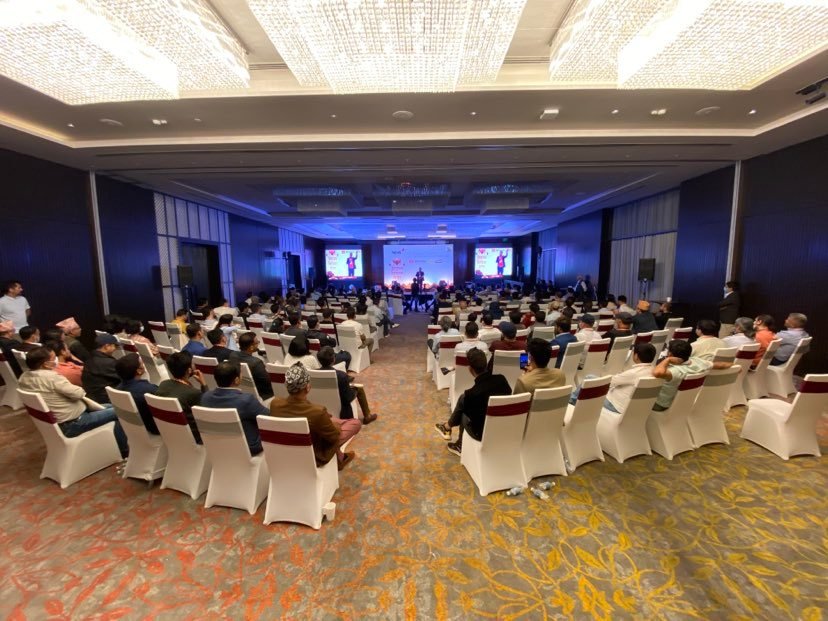
The Himal Media Mela 2022 continued on Saturday following the keynote address of Ravish Kumar, group editor of NDTV India.
The day-long conference of Nepali media professors, researchers, and other stakeholders involved four panels in which speakers which included members of the press, had wide-ranging conversation about the media industry and its changing narrative.
The first panel on Election, Fake News and Media Literacy included Ramkrishna Regmi, Sama Thapa, and Salokya in a discussion about how fake news and disinformation can influence elections as Nepal counts down to the local polls next week.
“The mainstream is getting driven by social media, which operates with non-processed content,” said Ramkrishna Regmi. “This has led to the omission of important issues around events including elections, in turn devaluing the significance of local polls.”
Added Sama Thapa of AP1: "Misinformation is not just fabricated news, it is also wilful ignorance and disproportionate coverage, even half-news that centres only on certain people, communities, and ethnicities.”
During the second panel on Ethical and Responsible Journalism, editors and reporters from the print, online and broadcast medium discussed the responsibilities and roles of journalism in the age of unfiltered digital and social media.
“Democracy is a behaviour as well as a way of life,” said Yuvraj Ghimire of Desh Sanchar. “But Nepali politics lacks accountability and our media reflects it.”
“Unless political parties are responsible, how can we expect the media to be?” continued Prateek Pradhan of Setopati. “But that is not an excuse for those of us in this profession.”
“As a profession that informs others, the media has to be informed itself. And for that, we need character and courage,” Ghimire noted.
“Credible and truthful information must be celebrated and supported by the public,” said Pradhan.
Prateek Pradhan delivered a rebuke of those he described were in the profession to eventually obtain political, diplomatic and other prestige positions.
He said: “Journalism requires passion, and a belief that the work and the stories will have an impact on those who see it.”
Meanwhile, journalist Sona Khatik, station manager of Radio Kapilvastu where she has worked for more than a decade, talked about the sustainability of radio in Nepal as media transitions to the digital.
“Radio is not and has never been for those in the upper echelons of Nepali society. It is for the people who still do not have access to proper networks to have conversations, data connectivity for mobile internet, money to buy and watch television and channels that represent their communities,” she says. “It is for those who are unable to read and understand newspapers or access it on time. Radio is going to sustain.”
If the media itself does not make space for Dalit, Madhesi, and marginalised people, how are they then going to represent those communities, asked Khatik. “Even then, there needs to be an understanding that it requires work to comprehend somebody’s story, not an hour-long phone conversation for a news story.”