In 1950, French mountaineers Maurice Herzog and Louis Lachenal climbed Annapurna I, the first ever eight-thousander peak to be climbed.
The French team walked down to the Indian border, took a train to Raxaul, re-entered Nepal and trekked up to Kathmandu to be felicitated by Prime Minister Mohan Shamsher Rana.
After being closed to foreigners for centuries, Nepal opened up to the world for the first time. Three years later in 1953, Tenzing Norgay Sherpa and Edmund Hillary catapulted Nepal and the Himalaya into the global limelight.
But more than 70 years later, Nepal’s tourism sector has yet to take full advantage of the economic opportunities that the industry can provide for domestic job creation, production of local products and foreign exchange income.
That Nepal’s tourism has not lived up to its potential to become the backbone of the country’s economy while it grows exponentially in the rest of the world — including in other mountain countries — proves that there are a lot of missed opportunities.
Summing up summits
Visitors flock to Nepal for culture, wildlife and pilgrimage, but our unique selling points are the world’s highest mountains. Some 16% of tourists who visit Nepal come for trekking and climbing, and yet mountaineering opportunities have been woefully under-advertised.
In fact, when Mt Everest does get into the international media, it is either for the ‘traffic jams’ on the summit or as the mountain of garbage. Lately, it is for how global climate breakdown is melting its glaciers. Apart from eight out of the 14 eight-thousanders in the world which are in Nepal, there are 326 mountains above 5,500m that are open for climbing in the country.
Records show that in 1964, only 9,526 tourists entered Nepal, rising to 500,000 two decades later. But it took another 34 years for it to double and exceed 1 million in 2018.
In comparison, 40 million tourists visited the relatively more isolated Tibetan region of China in 2018. Even Bhutan, which is four times smaller than Nepal in area, and has only 700,000 population, has priced itself on the higher side and got 315,000 tourists. Cambodia welcomes more than 6 million tourists annually, promoting its main attraction: the Angkor Wat temple complex.
“2022 did not go as expected,” says Deepak Raj Joshi, former CEO of Nepal Tourism Board. “But 2023 can be much better because Nepal is a nature-based destination, has isolation-based activities – exactly what most people are looking for post-Covid.”
Read also: Visit Nepal Again, Ashish Dakal
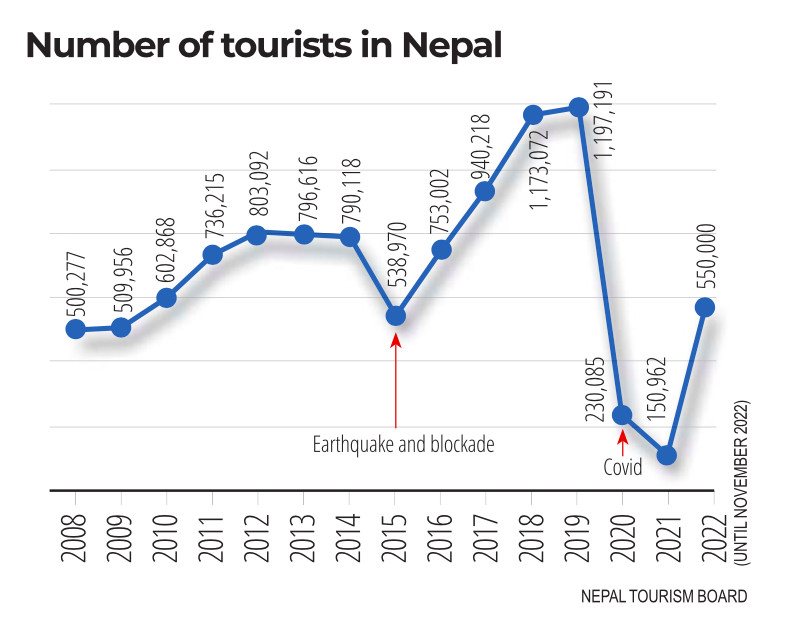
Nepal launched its Visit Nepal 2020 campaign just as Covid-19 struck. Nepal Airlines jets still have its logo on their fuselage, and it is a reminder of a failed drive. Tourism is beginning to pick up again after a two-year slump, but the prospects for 2023 are not so sure.
Even if the numbers pick up again, Nepal will not benefit as much as it should since it is selling itself too cheap. The tourist to Nepal spends an average of only $48 a day. Bhutan with its ‘high cost, low impact’ model, requires its tourists to spend $200-$250 per day in fees.
Despite the unique ‘product’ that Nepal has in its mountains, wildlife and heritage, the country is just not benefiting as it should from the tourism industry which now contributes less than 2% to the national economy.
In 2019, before the Covid-19 pandemic, income from the tourism sector was Rs60.8 billion, which made up only 4.6% of the country's total foreign exchange earnings.
Tourism’s contribution to Nepal’s hard currency income reached its peak way back in 1981, when it made up 36.8%, up from 30.2% in 1965.
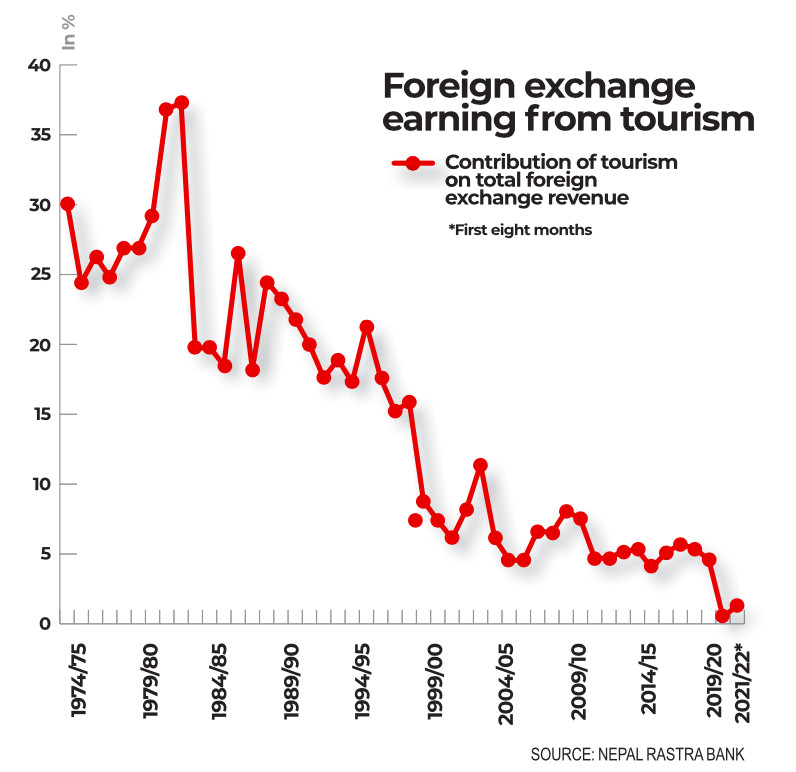
At the time, Nepalis seeking to go abroad for work or studies benefited greatly from being able to exchange dollars for rupees before they left. Ironically, by the 1990s as more and more Nepalis pursued foreign employment their remittance replaced tourism as the major contributor to Nepal’s economy.
Now, money that Nepalis abroad send home makes up two-thirds of the country's total foreign exchange income, while tourism, exports, foreign investment and development assistance, combined, contribute only one-third. Taking the annual average from 2010-2020, the tourism sector on its own made up only 5.2% of Nepal’s foreign exchange reserves.
This is not to say that tourism has not contributed to the economies of localities within Nepal. The Khumbu region, for example has an annual per capita income more than five times higher than the national average. Trekking has transformed the economies of Langtang, Manang and Mustang, where locals previously depended almost entirely on agriculture or pastoralism.
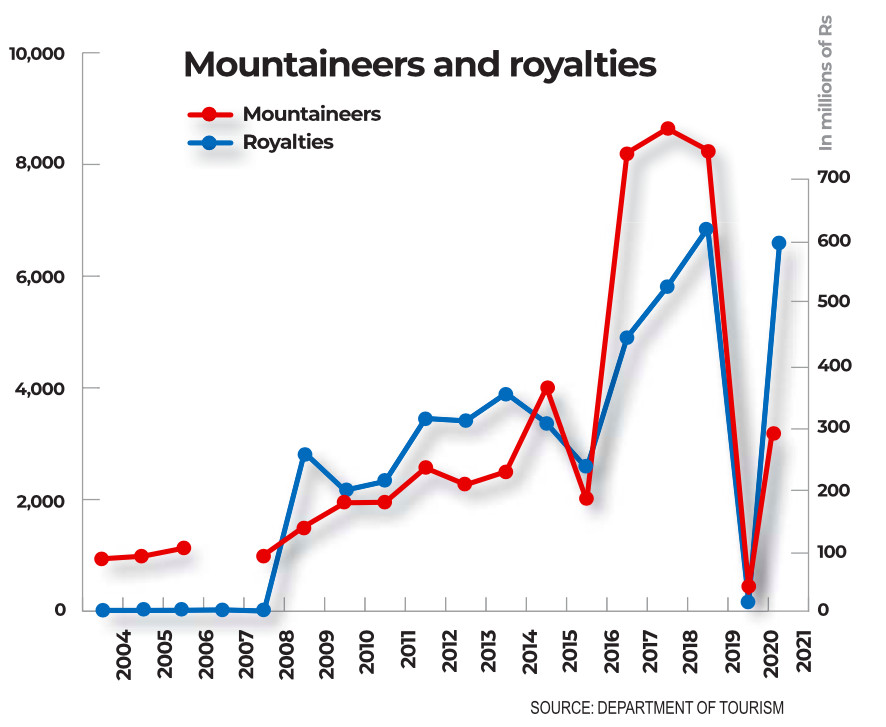
Indeed, the trekking and mountaineering sectors employ more than 18,000 guides, 50,000 porters and other service providers. In 2018, more than 8,000 mountaineers paid over Rs680 million in climbing fees and created jobs for more than 1,700 Nepali high altitude guides, who are now also hired by expeditions on mountains abroad.
Before Covid, tourism was estimated to provide direct jobs for about 1 million Nepalis and indirectly benefit many more. But industry experts say that the potential for economic benefits should have been much higher.
Read also: Peak climbing season in Nepal, Nepali Times