

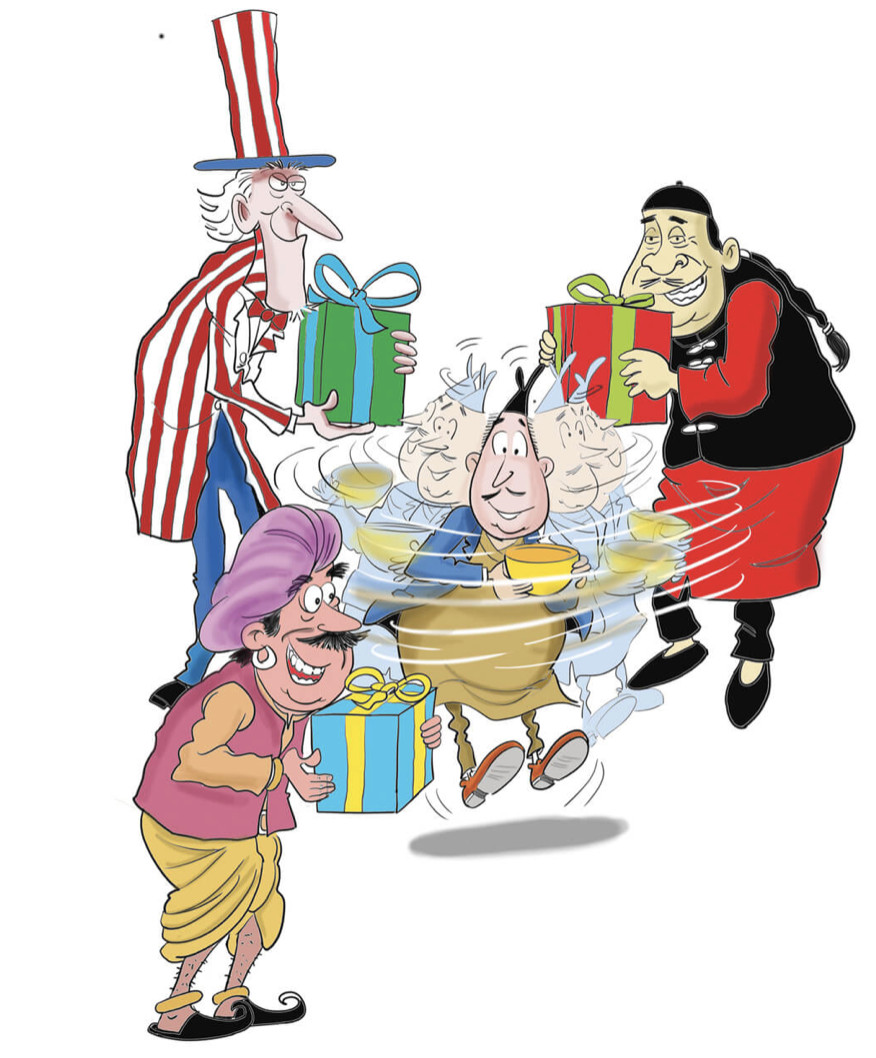
The course of Sino-Nepal relations is likely to enter a new historical phase in the aftermath of the US exit from Afghanistan, and the signing of the ‘Aukus’ security pact this week between Australia, the UK and the US.
The associated decline in the importance of global terrorism is a defining feature of international politics. But there is also a sharper emphasis on great power rivalry, primarily in the context of China’s expanding role globally, specifically in Eurasia.
The United States has now determined the Indo-Pacific as its core area of interest in this new period. How and to what extent the fundamentals of Sino-Nepal relations will be impacted by this structural change in geopolitics is yet to be determined.
Neither the lessons of the Cold War nor the period of globalisation that followed, will serve as an infallible basis upon which to extrapolate about the future contours of bilateral relations between Nepal and China.
What is now emerging as the principal fault line in international politics after the Global War on Terror is the question of hegemony in Asia. Is the US prepared to tolerate a potential peer competitor that gains increasing primacy in Asia, and steadily erodes its options and maneuverability in Asia, including in capitals like Kathmandu?
The vociferous and cacophonous debates in Nepal concerning the MCC, for instance, should be understood within this broader framework instead of deferring to an intellectually convenient position of arguing that bilateral relations (whether Sino-Nepal, Indo-Nepal or US-Nepal) exist in an airtight vacuum.
If there are any lessons to be learnt from the history of the Cold War or the period of globalisation that followed, it is that the bilateral relations between any two countries do not operate in a bubble.
However, history does serve as an indispensable point of departure for any analysis that seeks to prognosticate the nature of Sino-Nepal relations in the coming near future. Some five months prior to the the 9/11 al-Qaeda attacks that prompted the US invasion of Afghanistan, tensions were rising between Washington and Beijing as the George W Bush administration labelled China as a ‘strategic competitor’.
That was, of course, in marked contrast to his predecessor Bill Clinton’s policy of forging a strategic partnership with China, embodied most explicitly in the US Congress passing legislation to grant Permanent Normal Trade Relations with China and the US Senate’s vote to give China permanent most-favoured-nation status, both in 2000. This paved the way for China’s eventual accession to the WTO in 2001.
George W Bush was laser-focused on shifting attention away from what was perceived as Clinton’s flawed and benign approach vis-à-vis Beijing, towards what was deemed as an emerging “near-peer” threat from China.
But after the twin towers in New York were brought down by al-Qaeda operatives, this radically, abruptly, and almost completely, shifted US attention to West Asia. Washington first attacked al-Qaeda bases in Afghanistan to decimate the fulcrum of radical international terrorism. Events in Iraq, Libya and Syria would soon follow.