
Read Also
Patriarchy in the hierarchy, Editorial
In the driving seat, Shreejana Shrestha
Power to women, Bineeta Gurung
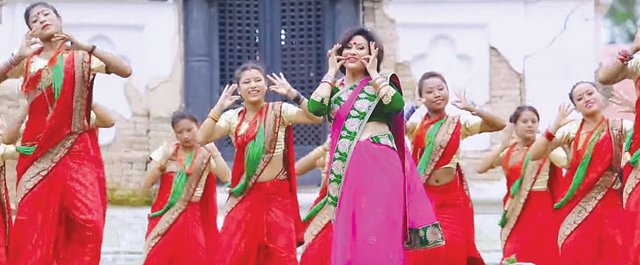
Singer Komal Oli (pictured above, centre) is not new to controversy, in fact the outspoken performer seems to thrive on it. This Tij she has created another furore with her new duet Lastai Choti (For the Last Time) with Pashupati Sharma, which contains rebellious lyrics about how she has decided to end her pursuit of a worthy husband. They say: ‘Naari lai hepne hoina, aadar garna janne, Tyesto keto pae dilma naam lekhai dinthe’ (I want a man who doesn’t scorn women, but respects them, If I find a man like that I would write his name on my heart).
Having not found anyone who has ‘Goji ma gath, ani mann ma aata’ (Cash in his pocket and strength in his heart), Oli concludes her Poi (Husband) song series — which is loved and hated in equal measure — hinting that she might enter politics to help Nepali women fight for equality.
Adorned in red saris and heavy green tilaris, women singing and dancing has been a hallmark of the Tij festival, which this year falls on Sunday. Over the years, the songs have been laced with fatalism: male dominance, neglect, and loneliness. But Tij lyrics are becoming increasingly defiant. “Previously, Tij was the festival when women went to their parents' homes, but it has more and more been used as an opportunity to gather and share their feelings,” said Sabitri Mainali of the Culture Department at Tribhuvan University.
Singers like Oli are no longer taking their secondary role in society as a given. They are voicing their independence and using Tij songs to do it. Their songs ridicule good-for-nothing husbands and taunt wayward ones.
Jyoti Magar’s Dumsi Kade Junga (Porcupine-Like Moustache) is a monologue against her husband’s behaviour and the way she is treated by his family. Having to live with an unkempt, alcoholic and jobless husband, Magar’s songs express the pain of wasted youth: ‘Kapi kalam line haat ma kodali ra kuto' (The hand that was supposed to hold books and pens today holds a hoe).