
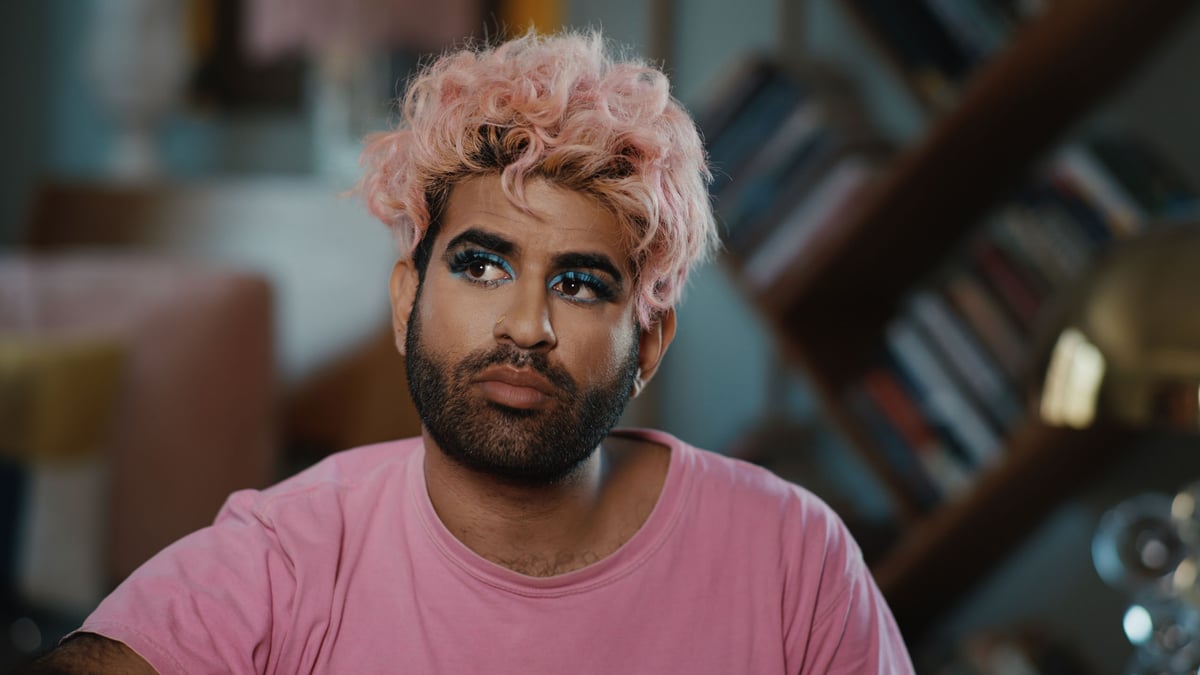
“I’m standing by the post office. You won’t miss me,” promised Alok Vaid-Menon over the phone. Sure enough, there he was.
At the Sundance Film Festival in Utah, where temperatures dip so low even the red carpet is sometimes a parade of cosy sweaters, — the US-based gender non-conforming performer was dressed in cold-defying femme fashion. Indigo pumps, a blue-and-yellow frock ending in a cloud-shaped skirt, swirls of the same colours lining the eyes.
“I want to show that it is possible to look good here,” said Alok cheekily.
Words from one of Alok’s own verses seemed apt for the moment: “They will say that femininity is not powerful, but I have stopped traffic simply by going outside.”
On the day we met, the 32-year-old stopped traffic for another reason too. They were the face of a short documentary ALOK, directed by Alexandra Hedison and produced by Jodie Foster, which had just premiered at the festival.
For over a decade, Alok has combined art and activism. They tour the world with poems about queer and trans experiences, self-acceptance, and love.
Read also: Eleganza Extravaganza, Sahina Shrestha
They will be in Kathmandu presenting a blend of poetry and comedy at the Spoken Fest on 16 February. “I haven’t been to Kathmandu since 2017, so shout out to Nepal,” Alok shared, with a beam.
The film ALOK spent two years in the making, after photographer Hedison chanced upon Alok’s work online and asked if she could trail them — as a “professional groupie” or “consensual stalker”.
The deep dive that followed, she said, “didn’t just inspire me intellectually, it moved me emotionally”. The 18-minute film, Hedison’s first, features Alok’s questioning of the gender binary, their imaginative force, and glimpses of their family and friends.
Quoting Greta Lee, star of the Oscar-nominated Past Lives, Alok said: “For so long I’ve been cast as the best friend but this is my first time as the main character and now I don’t know if I can go back.”
“The mainstream needs to move beyond token diversity. We deserve to have our stories be centered.”
Alok was born into a family of thinkers and academics, with roots in Kerala, Delhi, Malaysia, and the US. Although the Texas milieu they grew up in was conservative, the film shows their home was conducive to queer expression.
Read also: A mother celebrates Pride, Durga Rana Magar
The poet’s aunt Urvashi Vaid, a noted LGBTQ activist in the US, became their protector: “Because of that I was able to articulate myself and be taken seriously from a very young age.”