
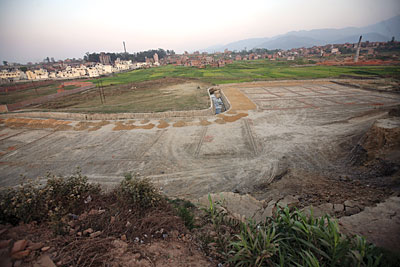
 KIRAN PANDAY IN WITH THE NEW: A plotting development at Hattiban, Lalitpur. |
Rampant real estate development, or plotting, has left giant craters at the base of Mt. Shivapuri, threatening the local ecology and the valley's river network.
The plotting is taking place very close to Shivapuri National Park, which it could damage as it raises the risk of landslides at higher altitudes. "We're very much aware of the problem, but there's little that we can do as the plotting is occuring outside the park boundaries, so is not within our jurisdiction," says Megh Bahadur Pandey of the Department of National Parks and Wildlife Conservation.
The story is the same at other locations on the periphery of the valley floor. If left unchecked, the trend could cause huge environmental problems, like the disruption of river networks and large scale soil erosion, to name a few. "At the rate at which we are disturbing the natural system, we're simply asking for trouble. The damage caused by the heavy soil movement could be disastrous. It's a pity, as the Kathmandu Valley used to be among the most beautiful in the world," says urban planner Bharat Sharma.
The problem isn't plotting per se but its haphazard growth, which is a result of grossly inadequate regulation. Shockingly, there are no land zoning regulations that dictate what can be built where. Such regulations are commonplace in most other parts of the world. "Besides some old, inner city areas, you can build buildings and develop plots anywhere you wish. There are no land zoning policies, but they are in the works," says Keshab Neupane, spokesperson of the Urban Development Committee, which is in the Ministry of Physical Planning and Works.
What regulations do exist are meagre. Real estate developers are first issued a building permit from either the district project implementation committee, if they plan to develop less than 50 ropanis (1.67 hectares) of land, or the urban development committee in Kathmandu, if they plan to develop more than 50 ropanis or any residential areas. At least three per cent of the area in residential developments must be open, and the roads must be at least four metres wide. Kathmandu district alone has issued 102 permits to housing companies. The Urban Development Committee has itself completed 12 projects in the service of organised urbanisation, and has pooled 305 ropanis (just over 10 hectares) of land for the purpose.