
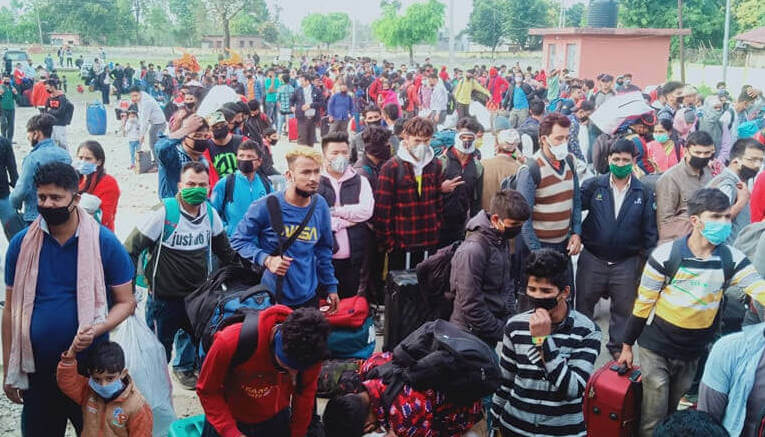
The detection of three new cases of coronavirus in Dhangadi on Sunday has led public health experts to urge more widespread testing and stricter quarantine for people returning from India to their homes in western Nepal.
Nepal closed its border with India nearly two weeks ago leaving thousands of Nepali workers stranded on the Indian side, as both countries went into lockdown. However, many thousands of others returned to their villages through the porous border.
The three new patients bring the total of infected people in Nepal to 9, although an earlier patient recovered. Two of the new detections were men aged 21 and 41 who had recently returned from India.
The third person is a 34-year-old female relative of a man who had flown in from Dubai two weeks ago, and travelled from Kathmandu to Kailali in western Nepal. She is the first community transmission case detected in Nepal, all other eight patients had come to Nepal from Europe, China or India.
A Cabinet meeting on Saturday decided to conduct rapid diagnostic testing in the three districts where new cases have been found: Kailali, Kanchanpur and Baglung. “We are going in for mass-testing in the three districts through contact tracing and of all individuals suspected of being infected,” government spokesman and Finance and Information Minister Yubaraj Khatiwada told a press briefing.
The Cabinet also decided to ban with immediate effect all inter-provincial travel, and people going from one district and local government unit to another. It also decided to enforce more strictly the lockdown.
Public health experts had said in-country infections were inevitable, and they are actually surprised that it has taken so long for it to appear. One reason could be that Nepal has only now expanded its testing to places beyond Kathmandu. This would mean that the country’s case load which had so far been relatively low compared to neighbouring South Asian countries, will go up in the coming week.