“What do people mean by poor governance,” asked Crown Prince Dipendra. “Are they fed up with corruption? Is it that they don’t like how the political parties are behaving? Are they frustrated with the government’s inability to push back the Maoists?”
A barrage of questions followed.
Corruption was obliquely referred to as the “C-word” and was used very sparingly in development literature back then. It was reserved for basket-cases like Zimbabwe, the Republic of Congo, and the like. “Poor governance” was the more elegant euphemism of choice for nascent democracies like Nepal.
Review: Why Nepal is stuck, Kunda Dixit
Over the next ten minutes or so I gave him the low-down on the various “scenarios”, “triggers”, and “resource envelopes” that framed the World Bank strategy.
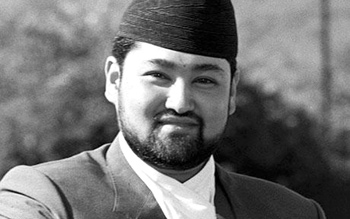
Dipendra listened very patiently.
But just as I finished, to my astonishment, he said, “You know Dai, I doubt that I’ll ever be crowned King. The way I see the palace old guard messing things up, I don’t see my turn ever coming. These guys just don’t get it. And they won’t listen to me. When I try to express my views, they say I’m out of line; they say I’m too political. The thought of what might be coming keeps me up many a-nights.”
I was stunned by Dipendra’s remarks. I could feel his pain and his anger, but I did not know what to say. Moreover, I had no clue who or what the “palace old guard” was; nor did I have the faintest idea where the line was drawn in his world between what was political and what was not.
***
It was high wedding season in Kathmandu. As I stepped into the crowded marquee in the groom’s house, I was surprised to see Prime Minister Sher Bahadur Deuba standing alone in a corner, nursing his drink.
We exchanged friendly banter until Deuba suddenly asked: “Can you get a couple of important donors to issue a statement, essentially to say that the King’s intentions are illegitimate?”
This was the evening of January 20, 2005 and the Kathmandu grapevine was swirling with rumours that King Gyanendra would soon relieve Prime Minister Deuba of his duties to take over executive powers for himself.
“I can’t speak for the other donors, but it’s very unlikely that the World Bank would issue such a statement,” I said, to the best of my knowledge. “Our charter forbids us from commenting on day-to-day domestic politics.”
Little did I know that I had struck a raw nerve.
“You ungrateful fools!” shouted Deuba, to the effect in Nepali. “I’ve put up with donor nuisances for all these years. Now when democracy is in peril, is it too much to ask for reciprocity?”
***
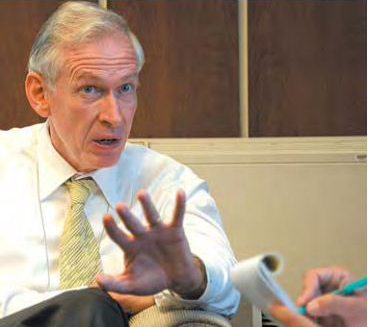
Praful Patel, the World Bank’s Vice President for South Asia in 2005, was star-struck during his meeting with the King. Gyanendra was savvy at coddling the vanities of useful visitors. He made it a point to inform Patel that he specifically ordered the palace guards to open the main gate which was reserved only for “special guests”.
Patel was so enamoured that he shot off an email to his entire staff extolling King Gyanendra’s virtues and arguing why the World Bank should stand ready to do business with his government. But in his haste Patel apparently forgot to encrypt his email, an oversight that would come back later to haunt him.
The King hardly concealed his contempt for the political parties. He also had choice words for the donors and NGOs.
“Terrorists are getting funds from the donors. We have the information,” said the King. “We don’t want to embarrass them. But how can a country accept this? My plea to you is this: you should not do anything that gives the Maoists an impetus to feel stronger.”
On NGOs, the King said he had enough evidence to suggest that some activities had “clearly crossed the line”.
“But all donors are not bad,” the King added, as an afterthought. “There are just a few bad apples in your midst.”
“We want a true democracy,” he said. “Lincoln said: of the people, by the people, for the people— he did not say for a few.”
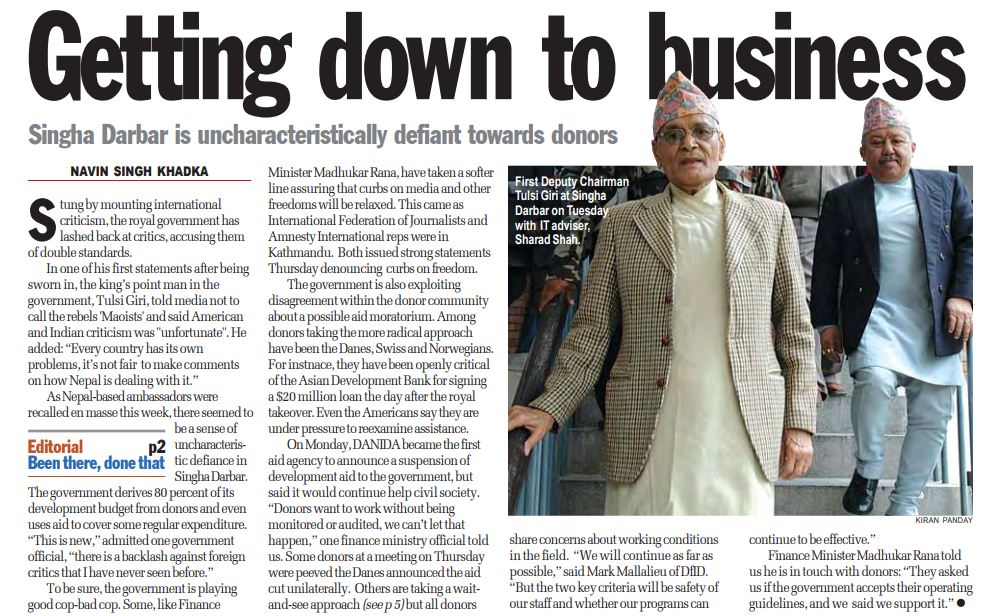
But the world would soon come to see that the royal government had lost the plot. King Gyanendra installed two Panchayat-era octogenarians as vice-chairs to attend to daily administrative business. One vice-chair was losing his eyesight. The other was hard of hearing.
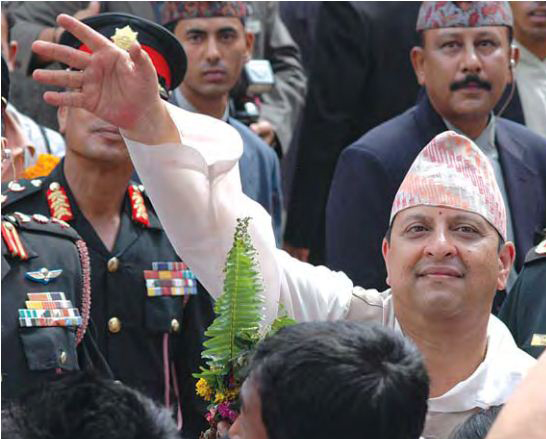
If King Gyanendra believed that self-adulation and official hero-worship would translate constitutional overreach into legitimacy, he was obviously ill-advised by his henchmen. On the contrary, his popularity started to sag. The age of deference was long since over. All the while, regular citizens were still subjected to midnight raids and humiliating body searches at the hands of impervious Royal Nepal Army soldiers. For all that the King painted himself as a redeemer, his government’s actions suggested anything but.
The swiftness with which the tables had turned and the enormity of the royal government’s diplomatic failures came as a shocking revelation to me when I overheard James Moriarty, the US Ambassador to Nepal at the time, publicly say this during a reception: “When you meet Gyanendra for the first time, you are impressed by his intentions. When you meet him a second time, you still give him the benefit of the doubt. When you meet him for a third time, you’re convinced that he’s a con artist.”
***
I first met Prachanda and Baburam Bhattarai in person in late August 2006, Thefog of war had only started to lift and the Maoist leadership had taken a calculated gamble by making itself public in Kathmandu.
I had read somewhere that the greatest duos in history can exist independently of each other but that they really should not. The whole is always greater than the sum of its parts. Bonnie and Clyde, Batman and Robin, Lennon and McCartney, Larry Paige and Sergy Brin, Madan Krishna and Hari Bansha. In my mind Prachanda and Baburam belonged to that same category of iconic dynamic duo.
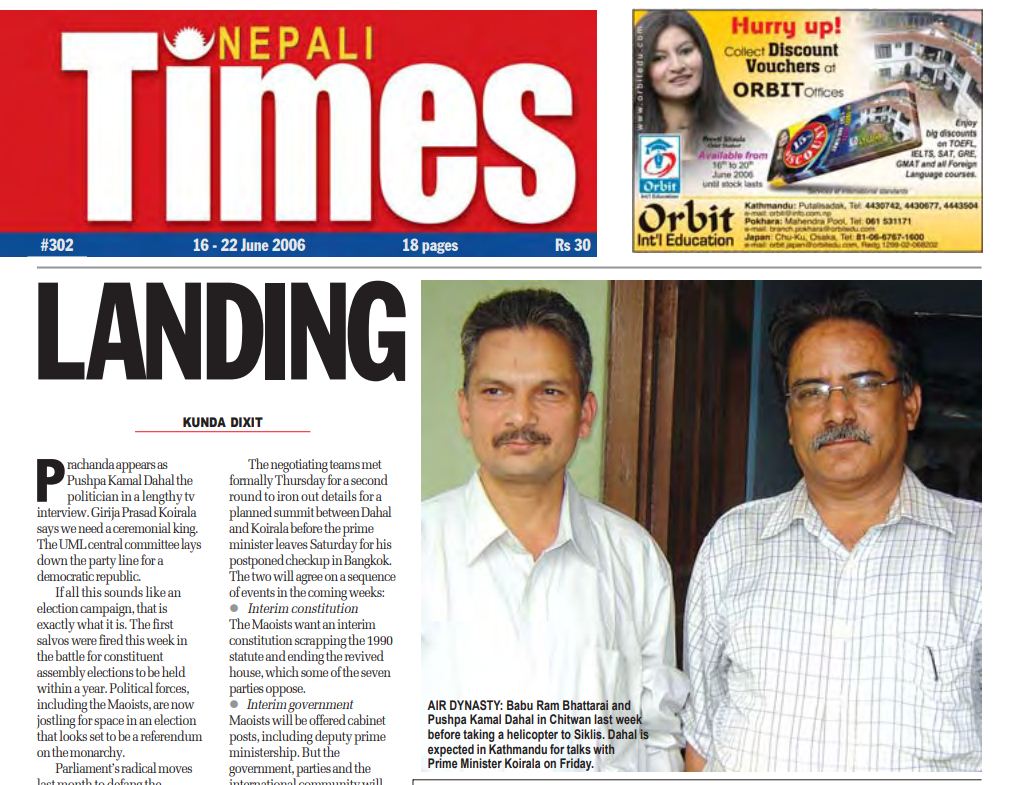
Bhattarai did most of the talking that day. He was all fire and brimstone. No sooner had we settled into our seats, Bhattarai launched into a diatribe against the Seven Party Alliance. He demanded that the World Bank make a clean break from the past and impose a moratorium on aid. The donors should stop “subsidizing the corrupt”. The force of Bhattarai’s contempt for the Seven Party Alliance was quite revealing.
***
“Has the revolution started to eat its babies,” asked Ashraf Ghani, as I pulled up a chair for him in my office one afternoon. He was paraphrasing Mallet du Pan, the late-18th century French political essayist who famously contended that revolution leads to hope, hope to frustration, and frustration to fury.
Before his election as President of Afghanistan in 2014, Ghani frequented Kathmandu at the invitation of the World Bank to help the donors think through the implications of the new political and social order outlined in the 2006 Comprehensive Peace Agreement.
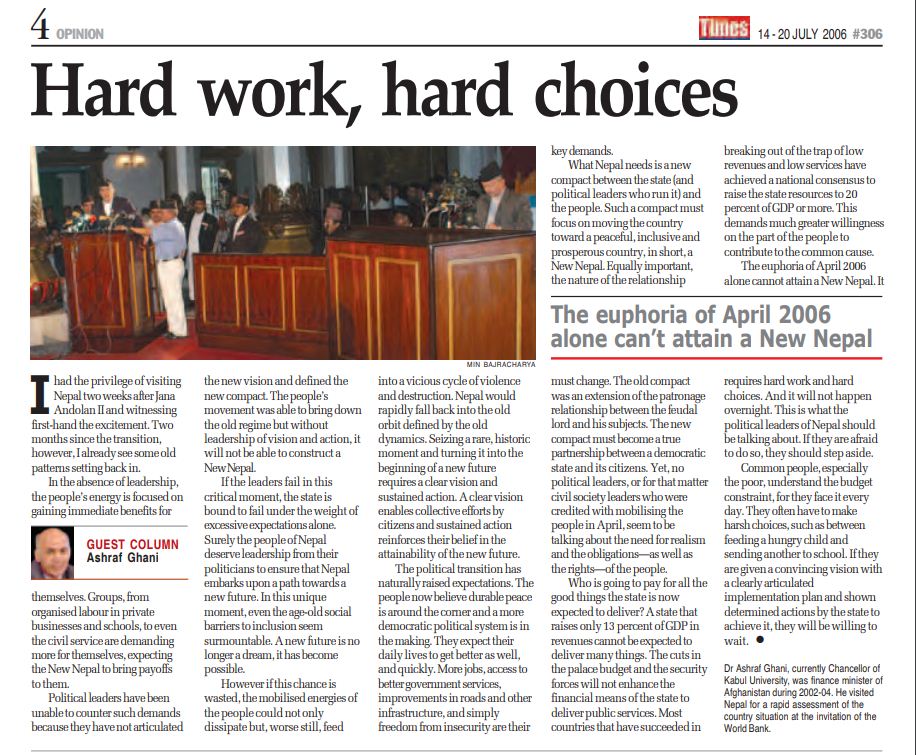
I did not have a ready repartee to Ghani’s question to me in 2007 about the revolution and its babies. If I were to be asked the same question today, I would probably invoke the Lenin Tango to describe the latest shifts and trends in the Nepali transition. I would probably say that while we are still some ways away from the third phase of Mallet du Pan’s postulation about revolutions, developments on the horizon would suggest that we are well into the second.
***
Kathmandu never anticipated the Madhesi uprising. It was inebriated with the false sense of a done peace deal, preoccupied with personalities and agendas driven by the so-called “hill elites” who traditionally walked the hallowed halls of Singha Durbar. It had completely misread a complicated sideshow simmering under the surface in the Tarai.
The World Bank was among those caught by surprise. Embarrassingly, only days prior to the shootout in Lahan, it had released a new study, Unequal Citizens, a multi-year, multi-donor, multi-stakeholder and multi-million-dollar piece of research into gender and social inequalities across Nepali society. But nowhere in the study did it dwell on Madhesi perspectives. A quick addendum was subsequently slapped on to an early second edition.
***
The CPN-Maoist sprung an electoral surprise during the 2008 Constituent Assembly elections and far exceeded its own expectations. Not that the swing voters were suddenly sold on the Maoist ideology. Nor were they beholden to its leaders. And it was not like our hands hovered over the ballot boxes either. Many voters, myself included, decidedly voted for the Maoist party because we had convinced ourselves that our ballot might represent the best hope for a lasting peace. We were totally fed up with the paroxysms and constant political tantrums of the past year and a half since the signing of the Comprehensive Peace Agreement.
To use a crude Americanism, I, for one, believed it would serve Nepal’s interests to have the Maoists “inside the tent pissing out” rather than have them “outside the tent pissing in”.
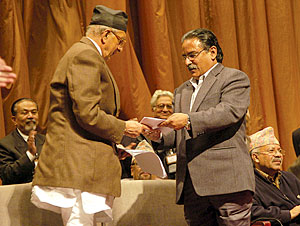
Some months later I tried explaining my rationale (in slightly less graphic terms, of course) to Pampha Bhusal, the Maoist candidate I voted for who went on to serve as a minister in the Prachanda cabinet. She thought I was pulling her leg. She could not for a moment believe that a World Bank staffer, as comprador bourgeoisie as they come, would ever vote for the Maoist party.
***
India’s Foreign Secretary Subrahmanyam Jaishankar (subsequently Minister for External Affairs in the second Modi government) landed in Kathmandu barely 48 hours before Nepal was scheduled to promulgate its new constitution. He read the riot act to Nepal’s political party leaders.
Nepalis were caught by surprise. Our differences are ours to manage, or so we thought. Moreover, it was far too late to entertain India’s anxieties as far as the Nepali politicians were concerned. To slam the brakes now and to appear to buckle this late in the game in deference to India’s concerns, no matter how legitimate, would be politically suicidal.
Nepal’s Constituent Assembly went ahead as scheduled and promulgated the new constitution with a thumping majority of over 90 percent. That evening New Delhi said it “took note” of the fact but it stopped short of welcoming the momentous feat in Kathmandu.
A fresh wave of violence had swept across the Tarai over the summer of 2015 in the build up to the promulgation of the constitution, leaving at least 50 protestors dead in the wake. A week after Nepal announced its new constitution, India responded by imposing an economic blockade.
In Kathmandu’s political circles, the first casualty of Modi’s actions was Prime Minister Sushil Koirala. The bromance he thought he had cultivated with Modi over the previous months cost him dearly. Koirala quietly withdrew, like a jilted lover. He passed away a few months later.
***
History has allegorical modes of transporting us back and forth across time and space. I find it a bleak irony of contemporary Nepali history that K.P. Sharma Oli, an elected Marxist who took his oath of office as Prime Minister swearing by the spirit of a post-monarchy, federal constitution, would soon adopt the same brand of “nationalism” associated with his bête noire, the authoritarian King Mahendra.
To most Nepalis it did not matter that Oli, up until that time, was merely part of the supporting cast; a side hero in the peace process. Nor did rumours matter that he was frequently high on prescription steroids to heal his kidney transplant from some years ago. His loquacious goofiness flummoxed some, but his sardonic wit endeared him with most others. Nepalis, by and large, finally found a messiah in Oli and his anti-Indian rhetoric.
***
Mac Maharaj was a key figure in South Africa’s freedom struggle and among Nelson Mandela’s closest confidants in the African National Congress (ANC). He was also a key ANC negotiator and spokesperson during the peace talks.
Over lunch one day, as we discussed the applicability of South Africa’s experiences in truth and reconciliation to Nepal, Maharaj asked me if I had watched the movie Long Night’s Journey into Day. When I confessed that I had not, he extracted a promise from me that I very soon would. But the tone of his impatience told me he did not believe for once that the South African model would work in Nepal.
Maharaj saw no analogy in Nepal. Rather, he feared that the UN foisted mechanism would allow room for the warlords to hijack the process, absolve themselves with blanket amnesties (without any confession or restitution, critical aspects of the South African approach), deepen disillusionment among the victim groups, and set Nepal up for failure.
Maharaj was spot-on in his prognosis. In the five years since they were established, Nepal’s Truth and Reconciliation Commission (TRC) and Commission on Investigation of Enforced Disappeared Person (CIEDP) have both failed to complete even a single investigation.
***
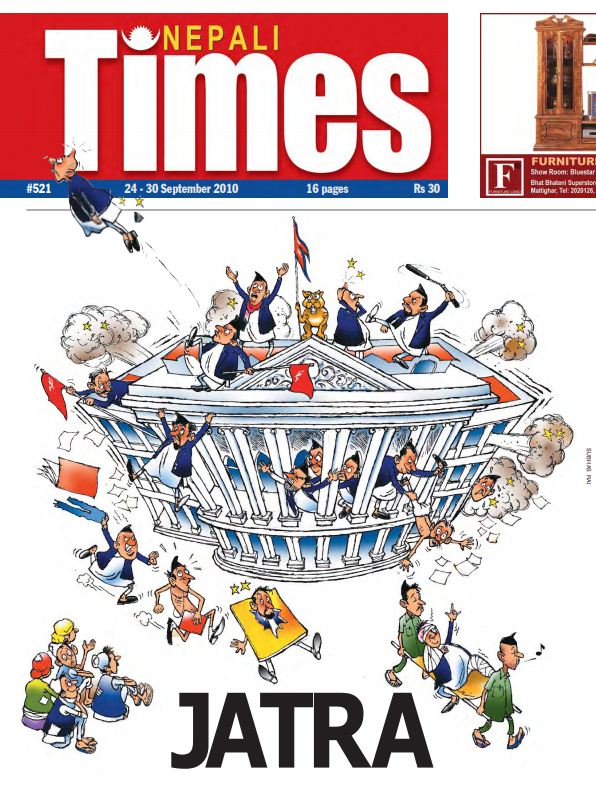
The failures of Nepal’s transitional justice systems are only symptomatic of a wider malaise that has plagued Nepal since the signing of the Comprehensive Peace Agreement (CPA). The popular Nepali term to describe this travesty is bhaagbandaa, or cabal politics.
The origins of bhaagbandaa can be traced to the mid-1990s when, riven with instability, the collusive nature of Nepali democracy was exposed. Every government between 1998 and 2018 – twenty in as many years – was the product of either an unholy alliance, ribald political horse-trading, an obscure “gentlemen’s agreement”, or a coup.
Rather than expunging this legacy, with extra mouths to feed bhaagbandaa became more pronounced after the Maoists entered the political mainstream and proportional representation greatly inflated the size of the legislature. Bhaagbandaa manifested in deviant practices where every political party in the Constituent Assembly (there were 26 in the first CA and 30 in the second CA) deemed it an entitlement to claim their pound of flesh from the Comprehensive Peace Agreement – all in the name of consensus.
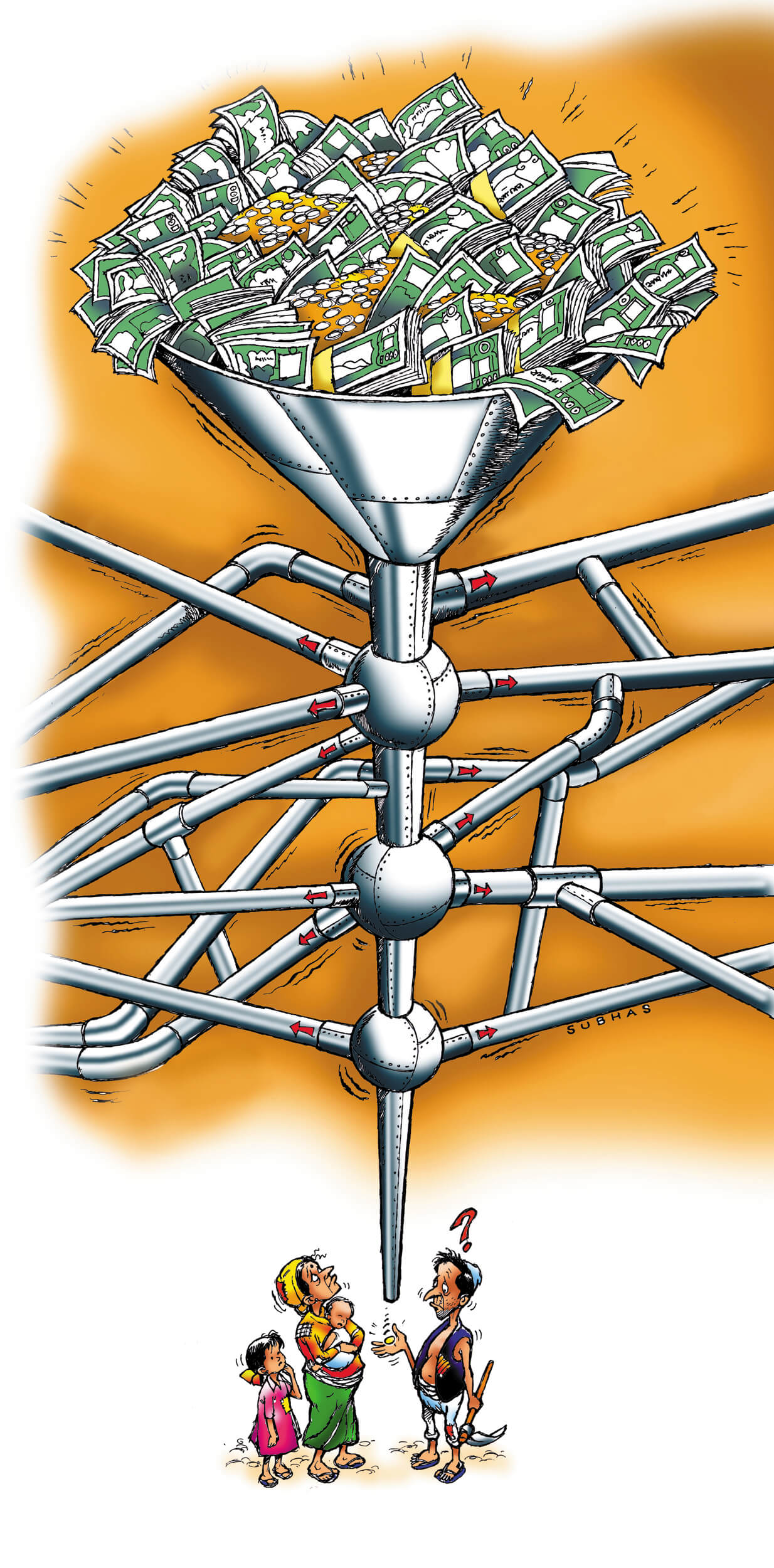
And bhaagbandaa did not stop there. It also involved the buying and selling of plum public offices. From fat contracts out of Singha Durbar to the puniest “small works” at the village “all-party-committee” level, nothing in between was spared in the feeding frenzy.
Bhaagbandaa explains why the so-called “peace-dividend”, a spurt in development and economic activity typically associated with the resolution of conflict, never materialised in the case of Nepal. It was usurped by the cabals.
***
The United Nations Mission to Nepal (UNMIN) descended on Kathmandu in early 2007 with all the flourish and trappings of a liberation force, albeit a civilian one. The sheer size and visibility of its presence dwarfed anything Kathmandu had ever seen before.
But UNMIN soon slid into infamy when its ubiquity was perceived as overreach. For all its grandstanding, in reality the special political mission had arrived with a limited mandate.
Some errors in judgement were to be expected of any multicultural mission on this scale. But it did not help when UNMIN allowed its slip ups to casually pass in the public mind as an inherent bias towards the Maoists. Very soon UNMIN staff were labelled as apologists for the Maoists’ ruthless intimidation of opponents and activities that often bordered on the criminal. Its reputation took a constant pummelling from incorrigible sceptics in the non-Maoist parties. During its latter days, as the mission wound down, UNMIN was even accused of trying to overstay its welcome.
Meanwhile, policy-based aid as a bellwether of economic and institutional change slipped into a deep slumber during most of the decade following the signing of the Comprehensive Peace Agreement. The donors bought into the false dichotomy promoted by the interim-era leadership that development could wait until the peace was settled, as if the two were mutually exclusive. UNMIN’s edict of do no harm was every so often invoked and interpreted as antithetical even to basic development work, let alone politically thorny reforms.
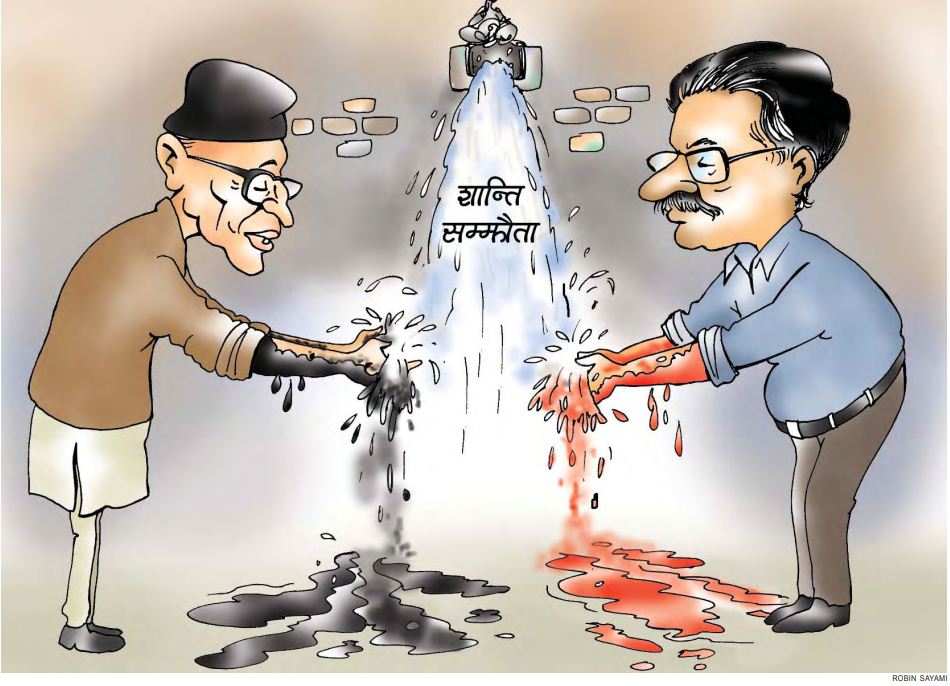
Following the 2008 elections to the first Constituent Assembly, the Speaker Subhash Nemwang told the donors, in no uncertain terms, that constitution writing in Nepal would pursue a unique, “homegrown” approach. While Nemwang managed to evade the pesky donors, he also prompted a certain torpor to set in. Most of the donors took his diktat as an excuse to lie back and think of England, as it were.
***
“A rising tide lifts all boats,” US President John F. Kennedy famously said in a 1963 speech defending the rights of his fishing constituents in New England to federal subsidies. Economists still parrot the expression, somewhat out of the original context, to illustrate the argument that free markets promote upward mobility and the rise of a powerful middleclass. Kennedy’s imagery is so vivid that even recent critics of free market inequality adapt the same phrase: “A rising tide lifts only the yachts”.
In Nepal, there is very little evidence to suggest that free market policies adopted after 1990 contributed to the rise of anything close to a strong middleclass. But yes, we certainly have seen the rise of the “middlemen”.
Joseph Schumpeter, the legendary Austrian-born US political economist, popularised the term “creative destruction” to describe how innovation and growth replace the old with the new. I would like to believe Schumpeter borrowed the termfrom ancient Hindu philosophy and the supreme holy trinity where Lord Shiva figures simultaneously as fearful and auspicious. Lord Shiva also represents creative destruction, his body covered in ashes denoting impermanence and his trident signifying equilibrium.
For a society that worships Shiva and prizes the Temple of Pashupati Nath, one of the Lord’s most revered sanctuaries, I find it quite ironic that Nepalis should tolerate and sometimes even idolise the omnipresence of syndicates and cartels – the antithesis of creative destruction; “conspirators against the public”, to borrow the words of Adam Smith, another legendary economist.