
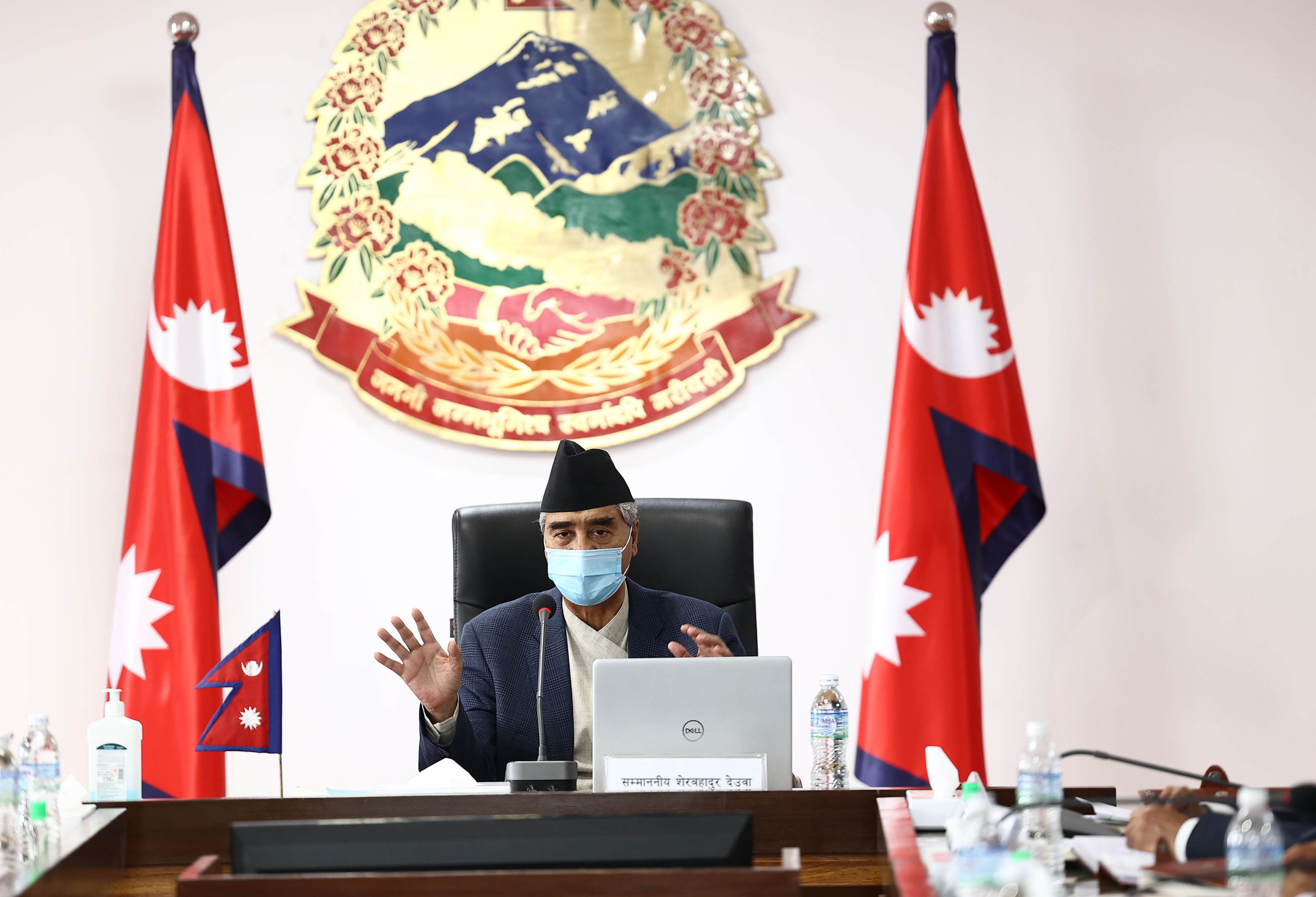
Even as he completes his ‘honeymoon period’ in office, Prime Minister Sher Bahadur Deuba is sending signals that he would like to call early elections.
Already under fire for non-performance and incompetence, his five-party coalition is in disarray, and some in his own Nepali Congress (NC) want elections before the party’s popularity plummets further.
Deuba led his five-party coalition into office on 13 July after the Supreme Court reinstated the Lower House that was dissolved by his predecessor K P Oli. But Deuba and some of his colleagues appear reluctant to allow Parliament to complete its full five-year term.
The next elections are due in December-January 2022, and Parliament’s term is valid till April 2023. Besides his party’s election prospects, Deuba also wants early polls to defuse increasing dissent within his party from those dissatisfied with his leadership. This is the fifth time Deuba has been Nepal’s prime minister in the last 23 years.
Those supporting Deuba’s push for early polls include leaders from all parties who lost in the 2017 polls, as well as coalition leaders who did not get ministerial portfolios in Deuba’s belated Cabinet expansion on 8 October. The opposition UML led by K P Oli has always batted for mid-term polls.
Electoral calculations now even determine relations between the coalition partners and the NC itself. The Maoist Centre (MC), for instance, appears not too unhappy to place all blame for the government’s failures on the prime minister’s lap. In fact, Deuba has become the lightning rod, while none of the criticism seems to rub off on the MC’s Pushpa Kamal Dahal and the party’s ministers in government.
“Voters are disillusioned, so the government must announce some bold initiatives in the public interest,” says the MC’s Giriraj Mani Pokhrel, who has served as education and health minister in previous governments. “The coalition must keep its unity intact till elections.”
When Oli dissolved the House for the first time on 23 December 2020 after facing a mutiny within his Nepal Communist Party from Mahdav Kumar Nepal and Dahal, Deuba who was then the leader of the main opposition party, had supported his call for a fresh electoral mandate. The NCP then split into the MC and UML, and Nepal himself broke away from the UML to form the Unified Socialists (US).