
Prime Minister K P Oli was half way through his one hour delivery to the Upper House on Sunday, defending his move to dissolve the lower chamber of Parliament, when he spat from the rostrum.
The Prime Minister was figuratively spitting at Parliament, but in doing so live on television it became a symbolic demonstration of his attitude towards the Constitution and democracy itself.
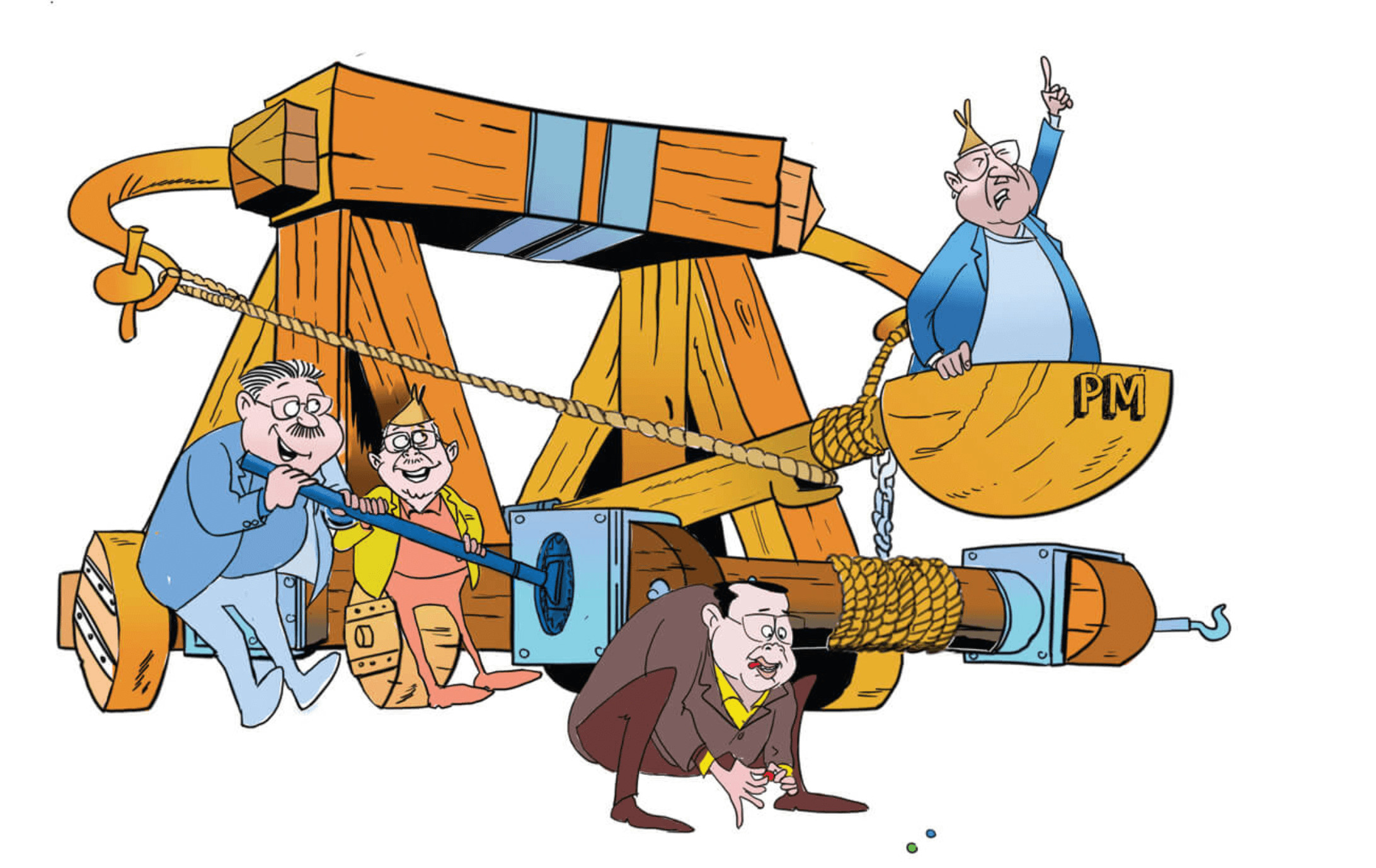
The clip of Oli’s audible spit went viral on YouTube and Facebook, with the prime minister once more coming under blistering attack. Cartoonists had a field day on the front pages of national dailies. But none of this has so far deterred Oli from getting back at his detractors by trying to take his party down with him.
Three weeks after he abruptly dissolved the Lower House and called for elections in five months, Oli has been increasingly on the defensive, mounting spirited attacks on party rivals, and flying to far corners of the country as if he is already out on the campaign trail.
Oli has had a double kidney transplant, and is on heavy medication, but has not let the Covid-19 pandemic deter his movements. His speech to supporters in Dhangadi on Saturday was a vitriolic attacks on those who opposed his move.
Oli is increasingly isolated with only his core allies now standing by their man. The Nepal Communist Party (NCP) faction led by Pushpa Kamal Dahal and Madhav Kumar Nepal have formed a parallel leadership, and claimed the former UML Sun election symbol.
Even as the Supreme Court resumes debate on 13 writ petitions against the House dissolution on Wednesday, former chief justices, lawyers, some civil society members and editors have united against Prime Minister Oli’s move, denouncing it as unconstitutional and anti-democratic.
Street protests have continued nationwide, and the split in the party between the Oli and Dahal-Nepal factions has affected provincial assemblies, permeating right down to the ward level. For all practical purposes the NCP has already split, it just has not been formally announced yet.
The real question is: who benefits? Whichever way the Supreme Court goes, either to reinstate the Lower House or endorse the prime minister’s move, it is the NCP that will be the loser. And what a fall from grace it will be for a unified party that commands a 65% majority in Parliament, and leads six of Nepal’s seven provincial governments.
And all this because the two top comrades in the NCP could not get along. Indeed, the greatest gripe that the Dahal-Nepal faction had against Prime Minister Oli is that he did not listen to them. Dahal waited halfway into Oli’s tenure, and was impatient to be party Chair or Prime Minister, while Nepal just wanted more respect from his erstwhile colleague.
Prime Minister Oli’s biggest political failure is politics. It is the art of give-and-take, but for Oli politics during this two-and-half tenure, became take-and-take. Any other leader would have smoothed out ruffled feathers, accommodated rivals to make his own position more secure. But he chose full confrontation.