
More than 2.5 million Nepalis left the country just in the last three years to study and work abroad. In the past year alone, nearly 900,000 students and migrant workers flew out of Kathmandu airport. These figures do not include those who crossed over to India.
There were, of course, returnees in that period, but it is estimated that up to 16% of Nepal’s population at any given time is outside the country. Most of them are 20-35 years old, which means an estimated quarter of all Nepalis in that age group are abroad.
It is mandatory for students going overseas to get a certificate from the Ministry of Education, and last year alone 112,593 were issued -- nearly double the pre-Covid figure (graph, below).
Before leaving, Nepali students officially exchanged Rs117 billion last year into hard currency to pay for their education costs. The actual figure through unregulated channels is probably higher.
Meanwhile, the 4 million Nepali migrant workers in Malaysia, Qatar, Saudi Arabia, UAE, Kuwait, Korea, Europe and elsewhere sent back through banking channels Rs1.47 trillion in remittances ($11 billion) last year. Actual figures are higher.
“The great irony is that while poorer Nepalis toil in the Gulf and Malaysia to increase our foreign exchange reserves, middle and upper class families are exchanging a part of that money to pay for college fees, travel and medical care abroad,” points out migration researcher Ganesh Gurung.
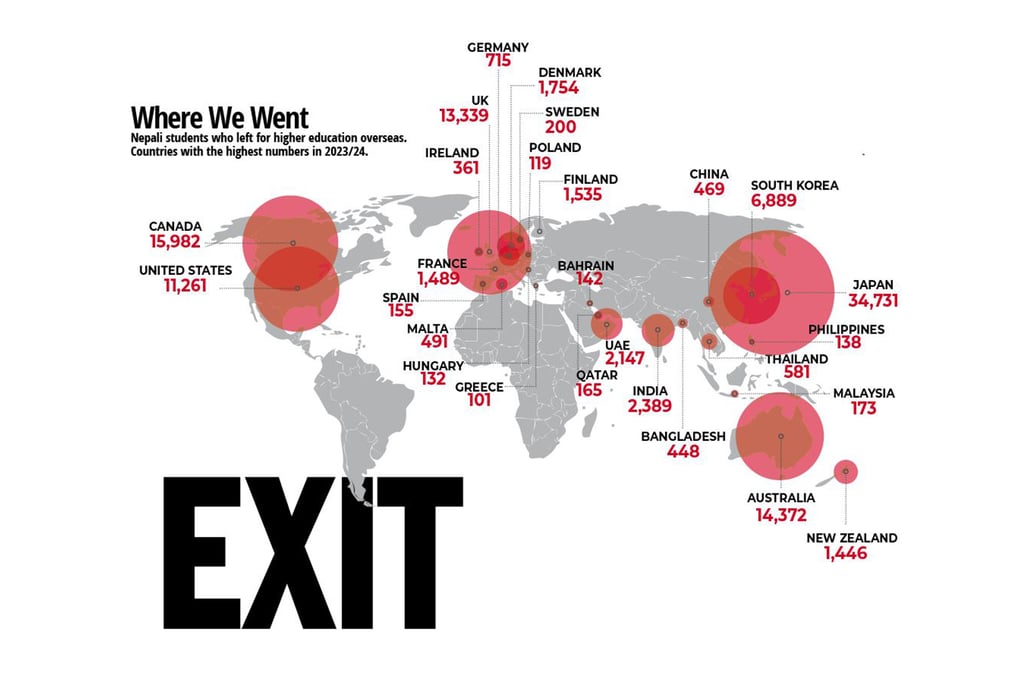
The numbers going to Australia and Canada dropped last year because of visa restrictions. But that has been more than made up by a 30% uptick in Nepali students going to the US (11,261) and UK (13,339) compared to last year.
But by far the largest number of students are going to Japan (34,731) which is also an increase of 30% over the previous year (map, below). Numbers going to South Korea doubled in one year to 6,889.
Nepalis go to 66 countries for higher studies, with Denmark, Finland and France becoming more popular, although the numbers are still much lower than the top six.
Till recently, Nepalis were the third largest number of foreign students in Australia. They were number three also in Canada. Nepalis were among the top ten in the US.
It is no secret that many young Nepalis leaving on student visas intend to emigrate permanently.
Countries in the Global North experiencing declining populations know this, but find it a convenient way to allow controlled entry for much-needed workers in the service or tech sectors.
“Many young Nepalis plan to settle in first-world countries eventually, or to return only after 10-20 years,” affirms migration expert Ganesh Gurung.
“Destination countries benefit too, they are getting a new generation of cheap labour without having spent anything on raising or educating them. What’s more, they also earn university fees. It’s a way for them to allow calibrated migration,” he adds.