
On 25 April 2015 at exactly 11:56, the ground beneath Kathmandu Valley started shaking. Houses built on the soft alluvium of the former lakebed bobbed and swayed like boats in the sea.
Brick and clay monuments and homes collapsed in clouds of dust. Had the duration, intensity and frequency of the earthquake been more severe, reinforced concrete buildings would have also come down.
Because cement houses were spared, the public perception is that reinforced concrete buildings can withstand severe earthquakes.
Read also: Rebuilding resilience 7 years later, Anil Pokhrel
While that is partly true, if the shaking had gone on for more than 1 minute, if it was 8 magnitude or more, or if the frequency of the shock waves was different, many of Kathmandu’s concrete structures would have also come down.
Much of the reconstruction after the 2015 earthquake is now complete, although there are still families waiting for money to rebuild. But we still have to be prepared for the next one. And the way to be ready is to retrofit schools and hospitals, ensure open spaces for shelters, and preposition rescue equipment, water and other essentials.
Teams need training in Collapsed Structure Search and Rescue. Compared to older buildings, search and rescue inside the pancaked ruin of a reinforced concrete high-rise is a whole different exercise.
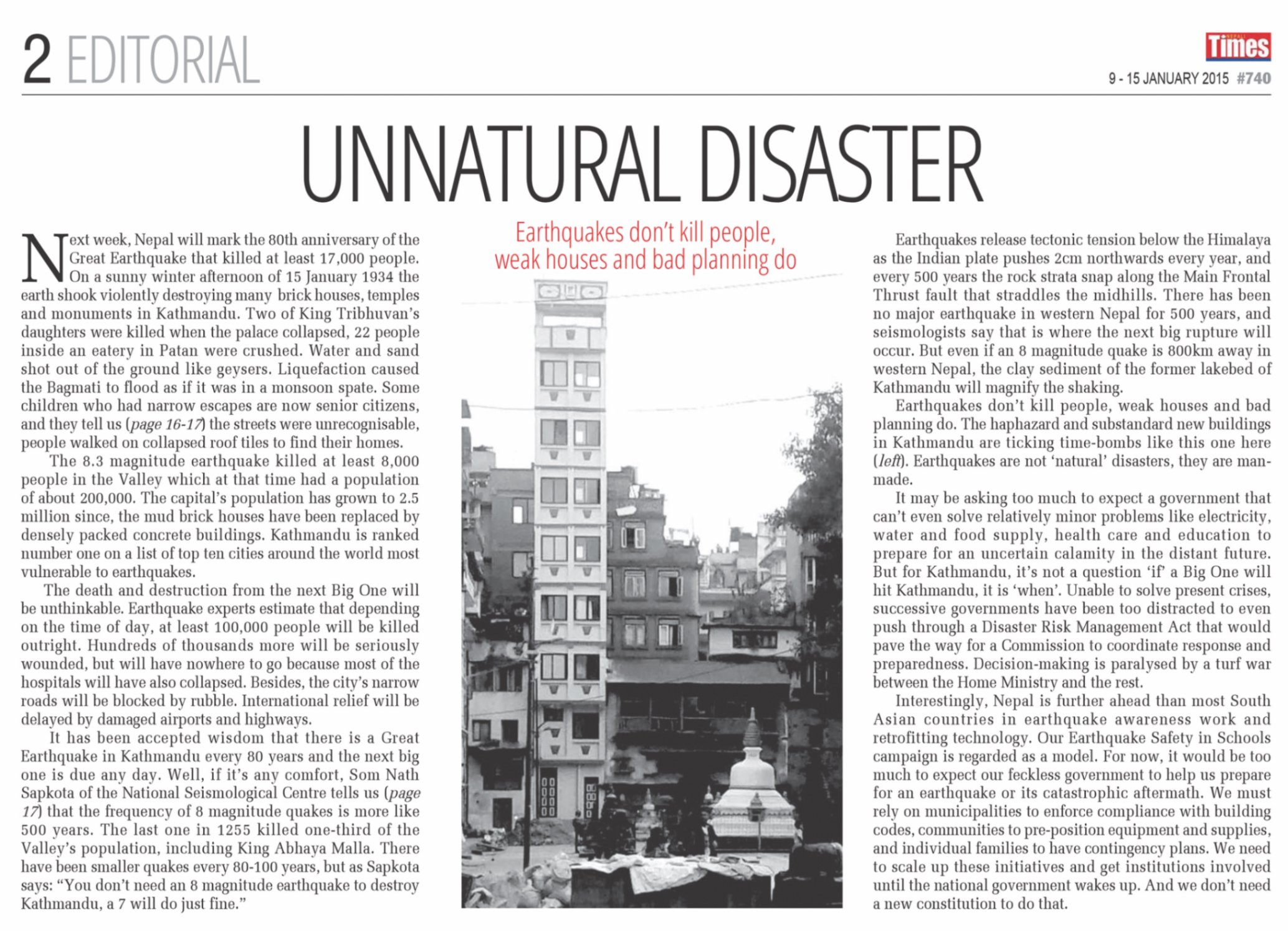
Most of the concrete structures that collapsed in 2015 were illegally built high-rise blocks in Gongabu. Ironically, an eight storey engineering college in Dhapasi was also reduced to rubble. Its building permit was only for three floors.
Read also: Falling through the cracks, Sahina Shrestha
Had the earthquake struck on a weekday, hundreds of students and staff would have been inside the college. Tens of thousands of students across central Nepal were saved because the disaster happened on a weekend.
Concrete structure rescue needs specialised robo-worm cameras, snake-eye acoustic, thermal and motion sensors, and human life detector tools like continuous wave Doppler radar and equipment to measure carbon dioxide levels from survivors.