
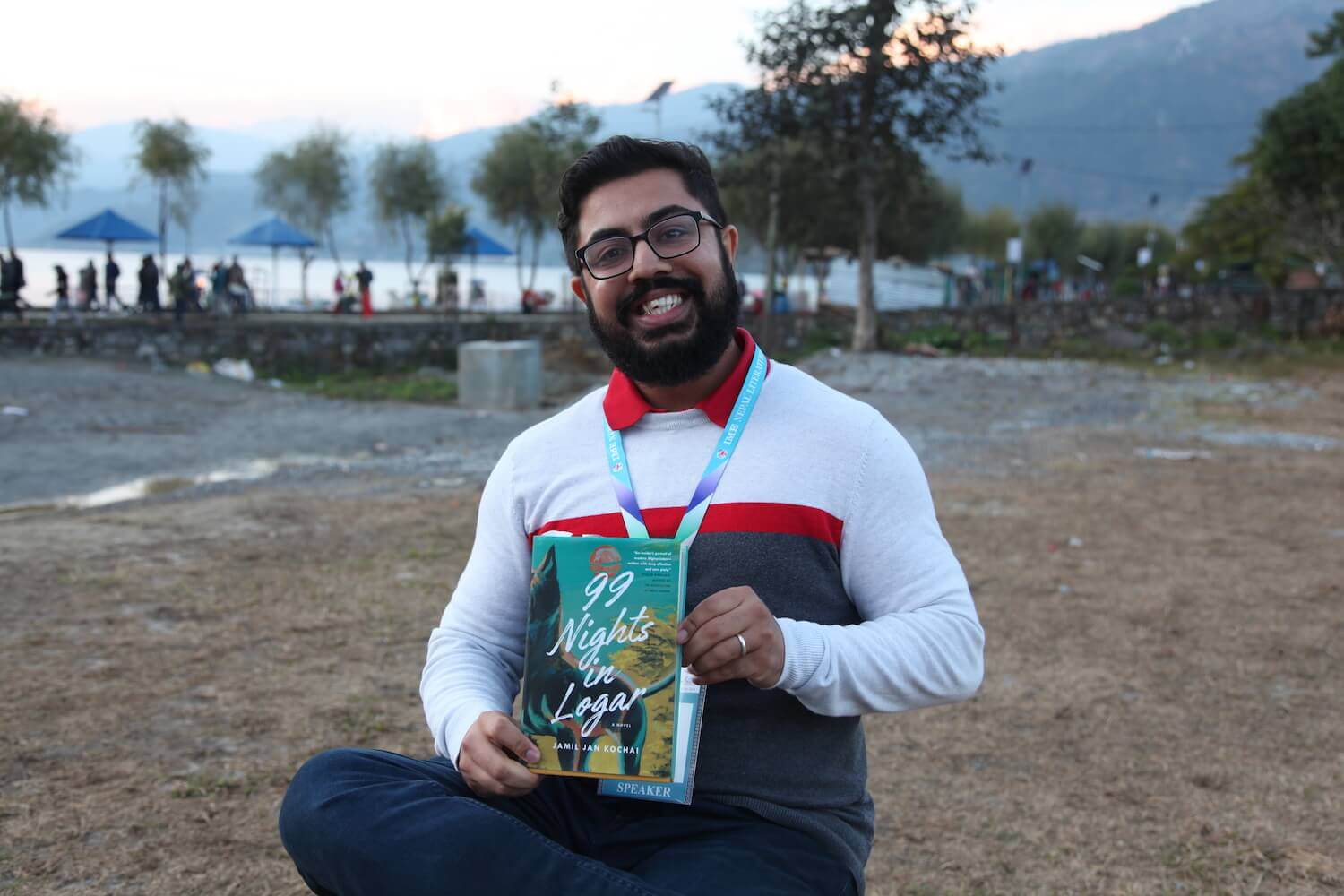
Jamil Jan Kochai is the O Henry Prize-winning author of the novel 99 Nights in Logar, which was shortlisted for the DSC Prize for South Asian Literature. Nepali Times sat down with him at the Nepal Literature Festival in Pokhara on 15 December. Excerpts of interview:
Nepali Times: An entire chapter in your English novel is in Pashto. What was your motivation?
Jamil Jan Kochai: Initially, it started out as a craft issue more than anything else. I had been trying to write that chapter for a long time. The entire novel leads up to that story within the story, and it is a story that is actually based on real life events: this tragedy that occurred in my own family. It is a very sensitive, tender story and it haunted my whole childhood and my entire family. I knew it was going to be very difficult to write, but I did not anticipate that I would not be able to write it. I tried quite a few times and I would get a few sentences in, maybe a page in and it would just fall apart.
Whenever I heard this story, it was always in bits and pieces and it was always in Pashto, because it was only meant for us and it was our story. That chapter ended up being directly from my father. He told the story as he remembered it. It is the story of the murder of his younger brother during the Soviet occupation of Afghanistan. I recorded him telling it. He was very picky about who could write the story down because he wanted it to be told in a very specific way and he wanted it written in a very specific way. We ended up finding someone who met his standards in his village in Logar.
Initially there was some, not necessarily resistance, but certainly questions. My agent had questions about it, my editor had questions about it, other editors had questions about it, but when I discussed the intention of it and how I was having so much trouble telling that story, ultimately, my agent, my editor, my publisher – everyone was very supportive of it.
It did take on its own sort of political ideological message. What happens to stories when they are translated? Who is the book meant for? For me, it is a story that is very precious to our family, told to me over and over again in Pashto. Finally I decided, ‘I am going to allow it to remain in this state instead of translating it and risk ruining it.’
You also have all these non-English words in the novel.
There is this sad thing where our entire second generation of immigrants in America that is coming up right now, we are losing touch with our language, but at the same time it still has a way of almost infecting our English and that is the way we talk. I always wanted to write in a voice that was true to the voice that belongs to my household. I think there are also certain words that are untranslatable.
Could we talk a little bit about how you insert oral narratives and traditional stories in the novel?
It became a central element of the novel, but just like the chapter in Pashto it initially had just been a craft issue. I had got to a point in the novel where, like 100 pages in, I had been writing a very traditional ‘boy’s adventure’ tale based on Huckleberry Finn and Rudyard Kipling’s Kim and all these novels I grew up reading. I did not know what the characters were going to do next.
Up until then, I was watching the characters, seeing what choices they were going to make, seeing how they were interacting with each other, interacting with the land. Then the group split apart. Two of the characters were underneath a tree and they were stuck there and did not know how to leave because they did not know how to get back and they did not want to leave – I was like “What do I do here?”
I ended up putting the novel away and going to my bookshelf and picking up a copy of The Arabian Nights, which I had purchased a long time ago, but it had been just sitting on my shelf for years and years. I opened up and I started reading it and I was just blown away by the beauty of these tales, the magic and also the radical form, almost experimental by today’s standards. I read the stories within the stories and I was looking at the way that the book was handling time and was able to play with tension and danger through the storytelling itself: it just felt so true to the way that we tell stories in our own house ... often lead into other stories, end halfway through, for whatever reason.