
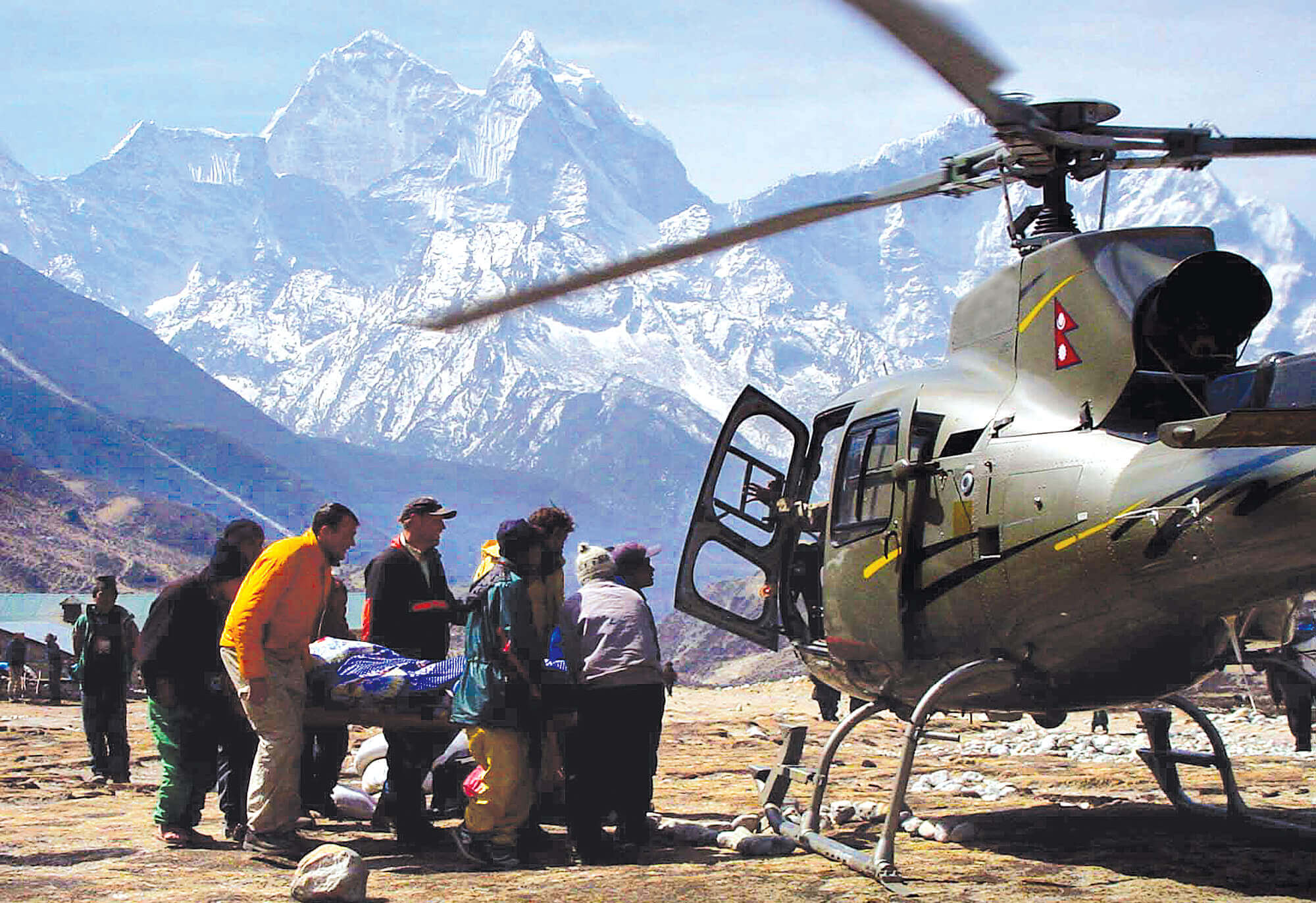
Kathmandu is hosting the XII World Congress on Mountain Medicine 21-24 November, and the location is indeed appropriate considering that it was in the Nepal Himalaya that modern mountain medicine made great advances in altitude illness.
Acute altitude illness requires two things in order to happen: 1) a person not adjusted to high altitude, and 2) going high quickly, faster than the body has time to adjust. Before the advent of modern transportation, no one could travel high enough fast enough to get into much trouble. Altitude illness is therefore mainly a problem of modern times. The largest experience with altitude illness prior to the advent of trekking in Nepal was when the Indian Army, in the Sino-Indian war of 1962, was airlifted rapidly to over 5,000 m.
Read also:
Trekkers with the trots, David R Shlim
Although foreigners started walking around Nepal in the early 1950’s, larger scale trekking only began in the late 1960’s. Trekkers, unaware of the risks of ascending rapidly, began to die on their treks. The number of evacuations and deaths became alarming to the fledgling trekking industry and the few agencies in operation at that time banded together to start the Himalayan Rescue Association (HRA) in 1973, organised by a former Peace Corps Volunteer named John Skow.
John Dickinson, who began work at the old Shanta Bhawan Hospital in Patan in 1969, became the receiving physician for severe cases of altitude illness. He and Dr Bond, the pathologist, published the first series of autopsy findings in trekkers dying from altitude illness. This work brought the world’s attention to the problem of altitude illness in Nepal, a rather mysterious condition that stuck down perfectly healthy young people venturing into thin air. Dickinson became the first medical advisor to the HRA.
Under the leadership of Tek Chandra Pokharel, Mike Cheney, Dawa Norbu Sherpa and Robert Reiffel in the early 1970’s, the HRA staffed an aid post in the village of Pheriche, at 4,300 m on the path to Everest. When I first passed through Pheriche in 1974, the post was staffed by an American nurse and a famous climbing Sherpa, Tashi. Wanting to stay in Nepal, I volunteered for the next season, and many seasons after that. I became the medical director of the HRA until 1983 when David Shlim (see his contribution alongside) became the medical director after he moved to Nepal to run the CIWEC Clinic.