The oil paintings hang in sharp relief against the white walls at Siddhartha Art Gallery, and have a distinct sepia tint reminiscent of historical images from the early days of photography.
And just like the sepia tone protects prints and keeps them from ageing, artist Mann Gurung uses the warm monochrome tint to preserve the history and identity of his indigenous community in the mountains of central Nepal.
Gurung’s collection of 24 burnt umber paintings titled Lost in Translation II is a continuation of his 2019 exhibition of the same name. His art depicts real men, women and children from up country villages in his native Gorkha district, and are as much an act of cultural conservation as a homage.
Born in Gorkha’s Khorla village, Gurung grew up away from home to attend school in the neighbouring towns. As a child, he would draw pictures of gods and goddesses and create his own comic strips, which eventually gained the attention of an INGO worker who suggested he study art in Kathmandu.
For a long time after he left home, Gurung took comfort in the memory of his village where people still wore their customary jama, bhoto, lungi and cholo, sang dohori during Dasain, and were self-reliant in agriculture and trade.
But when he returned after completing his Master’s in the United States, Gorkha had changed. The district was just getting over the trauma of conflict, and traditional attire and customs had given way to new influences. T-shirts had replaced bhoto, film songs on mobile phones had taken the place of dohori and ghatu. Just like he had, many young men had left the village, and only the elderly, women and children remained.
Read also: At the edge of tomorrow, Mark Turin
“Our identity was being wiped out in front of our very eyes with no visual reference point and archive,” explains Gurung. “I knew that if we did not document our history and culture, they would become a mere memory.”
The artist travelled through 13 villages in Gorkha documenting what he saw for his Lost in Transition exhibition in 2019. And in 2021, he started work once again to create a second collection.
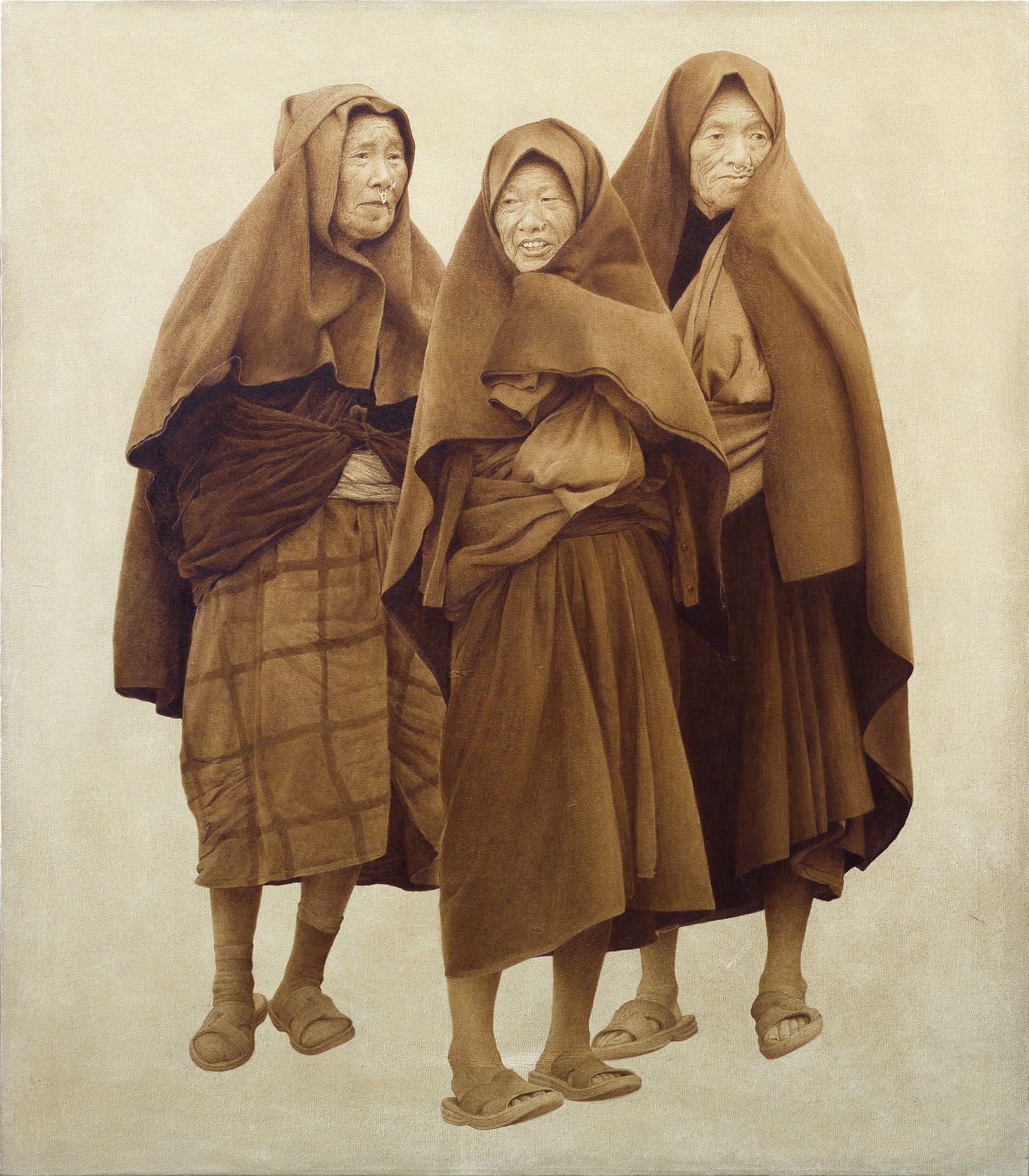
Gurung paints his subjects as if they are posing in front of a camera, a calculated choice to reflect the indigenous community’s unfamiliarity with modern devices even as they move towards modernity.
Their smiles are careful, stances self-conscious. An elderly woman looks out at visitors, clad in lungi, cholo, ghalek, and patuki. Her head is covered with a pachyeuri, and she wears gumboots. Another man has a tungna strapped to his jacket, and a patuki around his sweater, and smiles beatifically as he glances away.
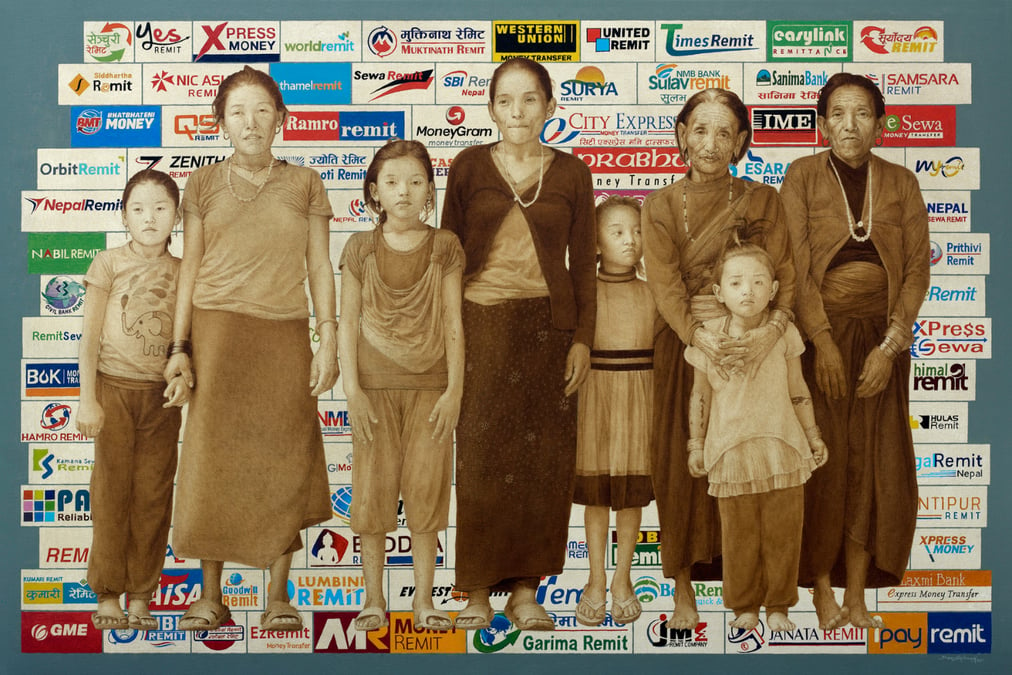
But the most striking work in the collection is the only one in which Gurung deviates from his monochromatic style. A single family of eight women and children are standing as if to get a family portrait taken at a photo studio. The men are present only in the background, in colourful signages of remittance companies.