
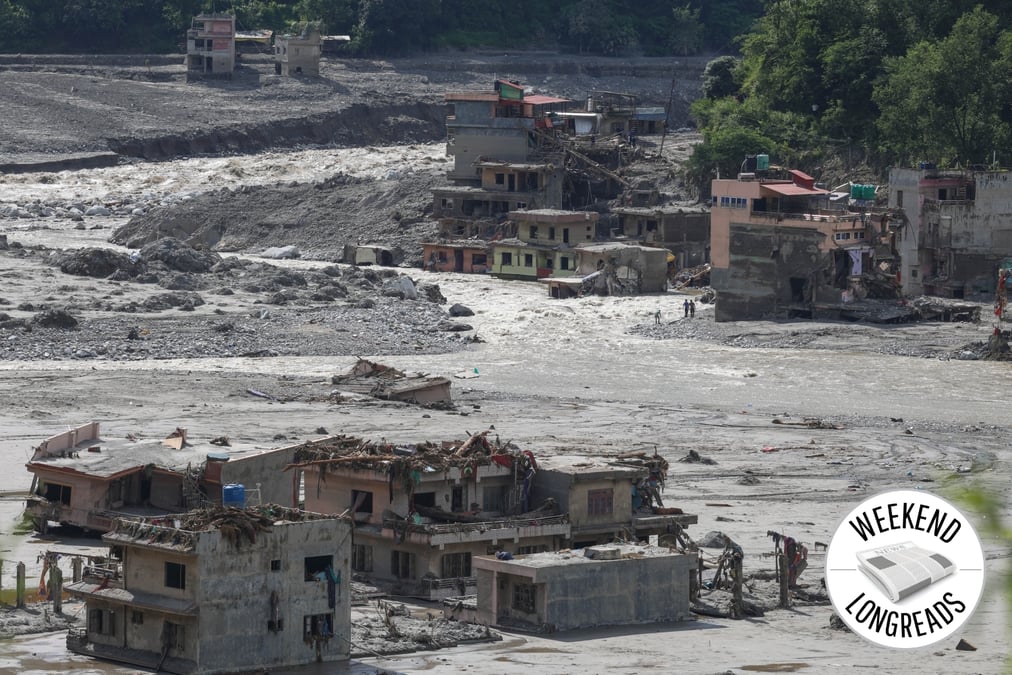
At 17, while backpacking through Nepal and teaching English in remote Himalayan communities, I saw the impacts of climate change firsthand. Soon after, a climate lawyer took me under his wing and introduced me to the foundations of climate finance and law. Over the past decade, I have worked at the intersection of climate activism and finance.
In 2016, just after the Paris Agreement, I attended a bankers’ conference in Sydney. I had grown up believing that the central obstacle to climate action was a lack of money. Yet the bankers were describing a different problem: a shortage of high-quality climate projects that could also generate a return.
That encounter complicated my activist view that the problem was simply wealthy countries refusing to pay. Finance existed, but the structures for moving it into viable projects often did not.
Ten years later, the conversation has changed remarkably little. Developed countries are reducing public development finance even as developing countries bear the brunt of climate impacts. Oil and gas companies invoke energy security and poverty. Financiers complain about a lack of bankable projects, while local developers complain that they cannot reach international investors. Scientists struggle to translate risk into language markets can use, while governments are overwhelmed by competing priorities.
Caught between these failures are communities losing lives and livelihoods. That puts Nepalis living in Himalayan valleys in a difficult position.
Yet, inaction is not an option. As Nepal’s leadership takes centre stage in the coming weeks, it should use that moment not only to champion the mountain agenda and climate reparations, but also to ask a harder question at home: how do we climate-proof our own communities and infrastructure against disasters that will keep coming?
RISK PRICING
At the centre of this conversation is how we understand and price climate risk -- the chance that climate change will cause harm, damage, or money losses. Once the risk is understood, that needs to be quantified and a monetary value needs to be placed. To simplify, if there is a 20% chance of a severe risk for crop failure next year and that can lead to a loss of Rs100,000 to a farmer, the climate risk for next year is Rs20,000. Understanding this can help the farmer create solutions, for example with insurance.
“A lot of people think of insurance as a band-aid solution that only kicks in after disasters. But it doesn't have to be,” says Hannah Melville Rea, a PhD candidate at Stanford University and a co-founder of the Himalayan Water Project. “At its best, it can work to incentivise resilience projects. Reduce the risk, and the industry rewards you for it. That said, you have to be able to measure the risk that you reduce.”
But measuring risk is easier said than done. Suman Ghimire of the climate-insurtech startup PlantSat has insured more than 14,000 farmers with $2.3 million in coverage over the past four years. This year, when extreme heat triggered our maize parametric insurance in western Nepal, 1,352 farmers received Rs2.63 million in payouts within seven days, fast enough to replant in the same season.
“For most smallholder farmers in Nepal, traditional crop insurance is too slow and costly,” Ghimire says. “Farmers can wait months for claims to be verified, often missing the opportunity to replant, which is why we use weather data to trigger automatic payouts without inspections or paperwork.”
The very same week Nepal got hit by the mountain tsunami, Lao PDR, the country I currently work in, received a $1.14m payout from the Southeast Asia Disaster Risk Insurance Facility (SEADRIF) following severe flooding that triggered both the country’s two-year parametric sovereign policy and the World Food Program’s (WFP) disaster resilience policy.
“Speed is the whole point of parametric insurance. There's no assessor, no claims process. A pre-set payout triggers the moment a certain flood height is reached. But someone or something still has to prove, quickly and transparently, that the threshold was hit,” notes Melville-Rea.
Understanding these risks is critical to shaping any conversations around insurance in Nepal, particularly as coverage will be expensive and reliance on private insurance as the backstop of these disasters will not be possible.
RISK MANAGEMENT
In Nepal, domestic sources combining revenue and borrowing finance over 85% of Nepal's total annual budget expenditure. The remaining 12% comes from foreign loans, such as through the multilateral development banks (MDBs) and bilateral lending, and 3% from foreign grants.
While international and development finance is critical to fund Nepal's actual capital and development expenditure, foreign grant aid is drying up, and as the country graduates from Least Developed Country (LDC) status, access to ultra-cheap concessional MDB loans is narrowing.
The Nepal Rastra Bank has adopted the Environmental and Risk Management (ESRM) guidelines alongside issuing the Green Finance Taxonomy to push commercial banks to promote green lending, without disrupting the economy and risking capital flight, while there are ongoing conversations on green diaspora bonds, promoting agriculture insurance, and introducing a nationwide property insurance scheme.
Commercial banks in Nepal are at the center of this. As of mid-2026, Class A commercial banks hold a total outstanding loan portfolio of approximately Rs5.32 trillion ($39.5 billion) which is roughly 4.2 times more credit to the Nepali economy than international MDBs. While large-scale infrastructure projects rely on international financing, domestic homes in climate-vulnerable floodplains, construction projects fueled by rampant sand mining, and the purchase of fossil-fuel-based automobiles are funded, often by commercial loans.
“Almost 10 percent of the banking sector’s portfolio is already exposed to the energy sector, and banks have already made a commitment to finance an even larger pipeline of energy projects,” says Dinesh Dulal, Chief of Sustainable Energy Finance at NMB Bank. “But the critical question is: how do we manage the growing climate-related risks and ensure that these investments remain operational and financially sustainable?”
Nepal is already taking significant strides to pivot its economy towards a low-carbon economy. This needs to continue and be scaled up to ensure entities promoting climate action and incorporating climate risks and resilience are provided with financial incentives to continue the transition -- either lowered interest rates to install early-warning systems, buy subsidised insurance, or simply to get a loan rejected for a property that is clearly in a climate hazard zone.
“We cannot look at climate resilience as an additional feature of an energy project, it has to become a core part of project design, financing and commercial viability, says Dulal. “That means creating the right financial incentives, including viability gap funding, concessional financing, appropriate tariff mechanisms and insurance solutions for climate risks. If we want banks to continue financing Nepal’s energy ambitions, we must ensure that these projects are not only bankable today but also resilient to the climate risks of tomorrow.”
BLENDED FINANCE
As domestic revenue is entirely eaten up by recurrent expenditures such as salaries and pensions, Nepal cannot afford to rebuild out of its pocket every time, and the landscape for international grants is shrinking. But the cost of inaction is equally high, and if Nepal does not build a domestic ecosystem for climate insurance and risk pricing, it will face a sovereign credit downgrade as climate disasters worsen, making international borrowing even more expensive.
Nepal therefore is presented with an inherent question of securing financing to undertake massive shifts, first to rebuild the existing loss & damage, but also to secure additional critical infrastructure from impending disasters. The first choice is reparations, but Nepal is joining in the queue of the SIDS (Small Island Developing States) who have for decades fought inaction and ignorance to acknowledge loss & damage by the polluters while climate change is threatening the whole existence of their countries.
Unless Nepal manages to pull off a major historical achievement in international climate negotiations, there is not much precedent.
Nepal is and needs to continue using its scarce domestic resources to crowd in more private and development capital in the energy and industrial sectors, while pulling internal levers to transition the economy. This means a stronger focus on de-risking and the use of guarantees and blends in different forms of capital.
It also means a strategic vision for the use of carbon markets. Despite the criticisms, carbon finance remains one of the few debt-free forms of capital that is seeing a positive momentum in the climate finance landscape with the potential to ease fiscal space for countries such as Nepal. Such revenue mobilisation from carbon markets can be earmarked for climate adaptation and livelihood protection of local communities.
If loans will be sought for building resilient infrastructure, it is important to ensure strong covenants that have future potential for debt restructuring and climate swaps triggered in the case of disasters, so risks are better understood and safeguarded. But this also means careful focus on project types.
There are inherent risks with the large hydro sector, not to mention the harm to the environment and biodiversity. Energy diversification, decentralisation and focus on alternative energy solutions are therefore critical. Adaptation intervention needs to be integrated and mainstreamed in existing infrastructure and mitigation projects so it’s not treated as stand-alone projects, as they can never raise the return on investment to turn projects bankable. The climate vulnerability urges Nepal to focus on smaller, decentralised energy solutions over large-scale projects in the face of impending disasters.
Focusing on solutions such as pumped hydro storage, which can help address the seasonal variability of hydropower generation with deficits in winter months and prevent Nepal from buying expensive electricity imports from India, can prove handy. In addition, pumped hydro has less risk as it can be built completely ‘off-river’ away from dangerous floodplains, and also offers significant climate adaptation benefits, particularly through improved water management, flood mitigation, and regional drought resilience. Reservoirs associated with pumped hydro projects can capture and hold heavy runoff during extreme precipitation events, helping to regulate peak river flows and protect downstream communities.
Nepal has also identified green hydrogen, which can act as a seasonal battery, as a priority. Its massive monsoon hydro surplus can be converted into stored hydrogen or green methane, saving it to generate electricity or supply heavy industries during the dry winter months. Butwal Power Company has established Nepal’s first private-sector 50kW Green Hydrogen Commercial Pilot Project in Pyuthan, adjacent to its 12MW Jhimruk Hydroelectric Project, while government plans advance for a larger 2.5 MW plant in Hetauda.
The real question now is how mitigation and infrastructure projects are reflecting climate risks in their operating models, and how the existing ecosystem can be leveraged to maximise the flow of international finance. That is exactly why the work of people like Suman Ghimire and Dinesh Dulal on insurance, risk-pricing and green lending is a macroeconomic necessity, not just an entrepreneurial and commercial gimmick.
MOUNTAIN TSUNAMI
The force of nature that unleashed the mountain tsunami on the morning of 26 August was too big to contain. But that should not stop Nepal from ideating solutions, as disasters are not new to Nepal, and they are here to stay, if not increase, in both frequency and severity. A whole-of-economy systemic rethinking is needed with:
· Understand climate finance and how interactions with climate funds and development partners are done, how year-round climate diplomacy can be done to demand and receive reparations.
· Tap into overseas Nepalis through a structured financial vehicle such as diaspora green bonds.
· Translate climate science into domestic risk pricing, integrate climate resilience into domestic lending alongside infrastructure design and fund the grassroots so lived communities also have a voice on how climate adaptation can be done.
The mountain tsunami was a stark reminder that climate disasters are no longer future scenarios discussed in international conferences. They are real events causing real economic losses today. The question facing Nepal is no longer whether climate impacts will arrive. The question is how we will pay for them.
If climate risk can be measured, it can also be incorporated into lending decisions, infrastructure planning and investment strategies. This makes Nepal's banking sector one of the most important actors in climate resilience.
Domestic sources already finance the overwhelming majority of Nepal's public expenditure. At the same time, foreign grants are declining, and access to highly concessional financing is expected to narrow as Nepal graduates from Least Developed Country status. As a result, Nepal's transition will increasingly depend on how effectively domestic capital is mobilised.
Nepal will continue to need international climate finance. It should continue demanding greater global accountability from those most responsible for the climate crisis. But waiting for others to solve our problems is not a strategy.
What could Nepal have done differently to prevent or reduce the impacts of the recent mountain tsunami? Perhaps, in this case, the forces involved were too large to fully contain.
But that should not stop us from preparing for the next disaster, because there will be more.
The lesson from this year's tragedy is not that Nepal is vulnerable. We already knew that. Climate resilience can no longer be treated as a peripheral environmental concern. It is now a question of economic stability, fiscal planning, financial regulation and national security.
Rastraraj Bhandari is a climate economist with the Himalayan Water Project.