
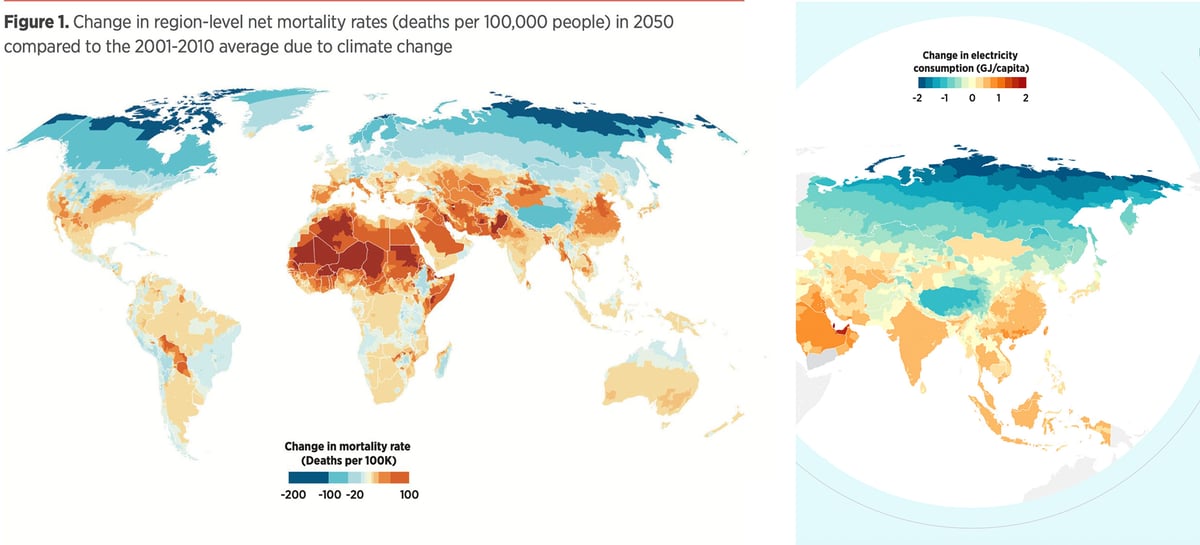
Heat-related deaths in Nepal due to global warming is projected to rise by 24 deaths per 100,000 people, according to a new global study from Chicago-based Climate Impact Lab (CIL) released this week. Most at risk are people in the Tarai districts of Dhanusa, Rupandehi, and Kailali.
Nepal is among the 18 countries the report identifies as caught in a ‘Mortality Cooling Trap (MCT)’ due to lower electricity availability for fans and air conditioner to cope with the heat.
The most vulnerable to MCT is Pakistan due to its power shortage and extreme heat stress. Bangladesh and Burma are also vulnerable.
“The Mortality Cooling Trap identifies areas that are projected to see both large increases in temperature-related mortality and small changes in electricity consumption due to climate change,” explained co-author Emily Grover-Kopec. “Areas at greatest risk will not be able to adapt to heat through electric cooling.”
The CIL report covers 24,378 regions globally and measured how rising temperatures will change energy consumption worldwide, and where that will leave communities unable to adapt. They found that climate-driven temperature change would cause about 430,000 more deaths a year by 2050, with poorer countries reporting 10 times more deaths than wealthy ones.
More than 676 million people live in these trapped regions including Nepal, and the study projects about 377,000 lives lost each year from 2050 onward across these countries as a result.
POWER DOWN
In Nepal, electricity consumption could decline by 0.01 GJ per capita due to climate impact, reducing ability of 32% of the population to cope with heat stress. Load-shedding and expensive electricity would deprive many families from cooling devices.
This despite Nepal’s power generation capacity reaching 4,300MW. The government plans to generate 30,000MW by 2035, and export 10,000-15,000MW to India and Bangladesh.
Co-author Ashwin Rode of the Energy Policy Institute in Chicago notes that the projected decline in power consumption in Nepal is due to climate change, and does not look into other parameters.
“Nepal's expansion of power generation would be good news toward the goal of increasing consumption to support cooling,” Rode told Nepali Times. “But this figure was calculated based on estimated relationships between daily temperatures and energy consumption at different income levels and climatic zones.”
The report ranks the 18 Mortality Cooling Trap countries by the share of the population with electricity access. Nepal has the second-highest overall access among the 18, after Bangladesh.
CLIMATE MIGRATION
Despite being listed as one of the countries in the ‘Mortality Cooling Trap’, Nepal’s average elevation makes it relatively cooler. Besides trans-boundary migration to the mountains, within Nepal people will start moving back up to the mountains from the plains.
Preparedness for possible mass migration is lacking, and policies haven’t kept pace with mitigation and adaptation, let alone climate migration.
Warns Rode: “While migration offers a way to avoid the harms of a warming climate, it is also a costly adaptation strategy that will be particularly burdensome to the poorest, most vulnerable populations.”
URBAN HEAT ISLAND
Cooling with fans and air conditioners add to the urban heat island (UHI) effect, making core city centres up to 5°C hotter than less crowded suburbs. Heat-trapping concrete, dark asphalt surfaces, lack of vegetation and waste heat from air conditioning and vehicles add to UHI (page 9).
Already, the city core within the Ring Road in Kathmandu is up to 4°C hotter during the daytime and up to 3°C hotter in the evening than the outskirts. Green-blue spaces can lower temperatures by up to 1.2°C.
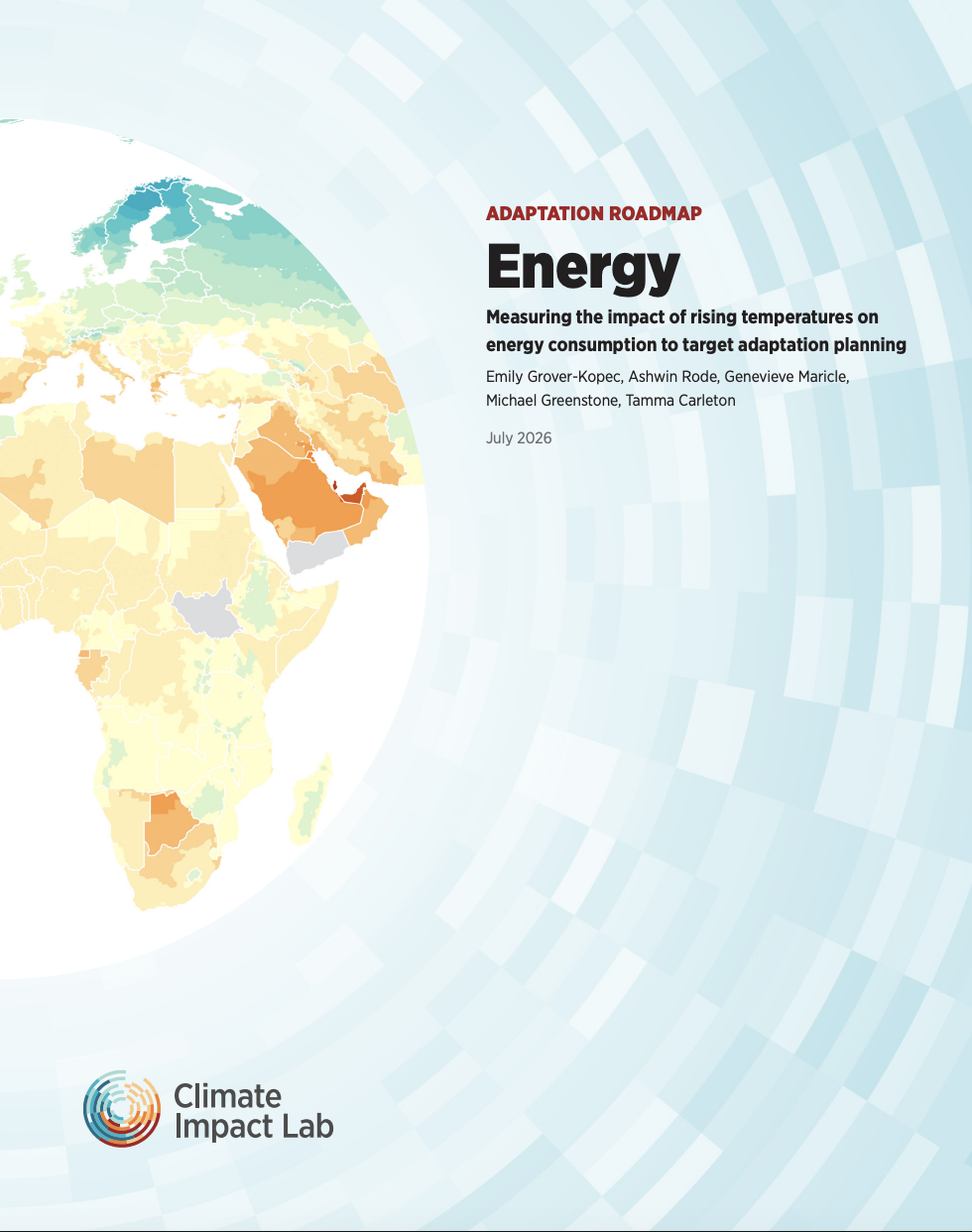
Interestingly, while 72% of the population is projected to see relatively small changes in electricity consumption due to climate change, many of those regions are not projected to see significant increases in mortality due to climate change as many are in the more mountainous areas where declines in cold-related deaths will offset any increase in heat-related deaths, notes co-author Emily Grover-Kopec of the Rhodium Group.
Energy: Measuring the imp
act of rising temperatures on mortality to target adaptation planning
Emily Grover-Kopec, Ashwin Rode, Genevieve Miracle, Michael Greenstone, Tamma Careton
July 2026
MIGRATION IS A HOT TOPIC

Gaia Vince’s 2022 book Nomad Century estimated that up to 3.5 billion people will be affected by unsurvivable heat and will be on the move. Mass migration is inevitable so governments might as well get used to the idea.
Julian Hattem’s Shelter from the Storm: How Climate Change Is Creating a New Era of Migration (2026) notes that mass human displacement due to heat is already happening and plots trends into the future.
Migration and Displacement in a Changing Climate by Kelsea Best, Kayly Ober, and Robert A. McLeman (2025) examines how climate shifts interact with human societies, infrastructure, and regional adaptation measures.
Move: The Forces Uprooting Us by Parag Khanna looks at which countries people will move from and where to escape the impacts of climate change. The future will be messy.
Science fiction writer Kim Stanley Robinson’s 2019 novel The Ministry for the Future begins with the mass death of 20 million people due to a heat wave in northern India. But world governments come together to finance adaptation.