
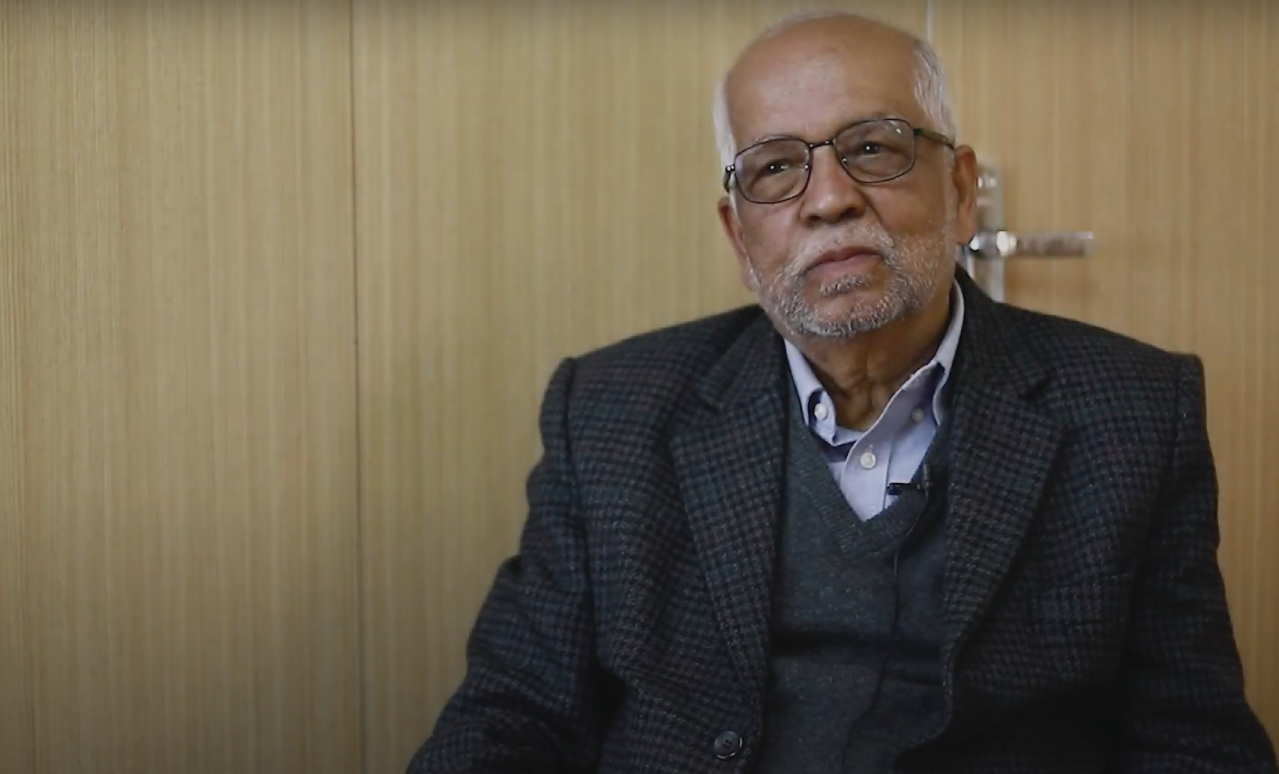
Till he was recalled last month by Prime Minister Sher Bahadur Deuba, Nilambar Acharya was Nepal’s ambassador to India since 2019. Acharya had previously served as Law Minister, as well as the Chairman of the Constitutional Committee. He spoke to Santa Gaha Magar about Indo-Nepal relations, and the country’s domestic politics:
Nepali Times: As someone who was posted to New Delhi during a rocky period in bilateral relations please give some insight into the current state of India-Nepal ties.
Nilamber Acharya: The relationship between Nepal and India is vast and nuanced. There are problems as well as positives, and they cannot be understood if we look at them in a one-dimensional framework. We need to be careful that the problems do not overshadow the positive aspects of our relationship. The Indian people have a lot of goodwill towards Nepalis.
Like any other relationship, our bilateral ties need to evolve in the context of the times. And that has been the biggest challenge. Both governments and their political leadership need to be especially mindful of this fact.
What could be the reasons why India has not formally received the report prepared by the bilateral Eminent Persons' Group (EPG) on Nepal-India relations?
I am not sure why India has been reluctant to receive the EPG report. The document, which is integral to strengthening the foundations of our bilateral relationship, was finalised in consensus with four members from both countries. If India delays acknowledging and receiving the report any longer, it will be that much more difficult to move forward to review our diplomatic relations.
Could it be that Nepal has not taken a more active initiative to implement the report?
We have consistently engaged with our Indian counterparts to follow up on the EPG. There was not a single meeting during my term as ambassador when this report wasn’t discussed.
In fact, then-Foreign Minister Sushma Swaraj at one stage before the 2019 Indian elections had assured us that India would receive the report. Prime Minister Narendra Modi said the same thing during the inauguration of the Nepal-India Petroleum Pipeline. Ultimately, it did not work out.
After that, was there not enough pressure from Nepal, or did the Indians change their mind?
Initially, both sides had agreed to submit the report first to the Prime Minister of India, then to the Prime Minister of Nepal, following which it would be made public via a press conference. However, there has been a roadblock from the Indian side.
As I said, Nepal has repeatedly reminded and urged our counterparts to move forward with the report, but to no avail. Once the report is received, it would then be up to both the governments to decide whether to implement the its provisions and to what extent. One thing is for sure. Our bilateral relationships cannot move forward on the basis of the 1950 treaty.
Could India’s perceptions on Nepal vis-à-vis China be one of the reasons?
Our relations with India and China are mutually exclusive to one another. Establishing diplomatic ties with another country does not mean that our relations with India have weakened. Diplomatic relations with countries have different contexts, and must therefore be understood separately. Diplomatic ties with one nation do not and should not have a negative effect on relations with another.
Let us turn to Nepal. As a former law minister, what are your views on the Supreme Court row?
The current controversy surrounding the Supreme Court is not limited to whether the Chief Justice should resign or not. This issue is emblematic of a widespread disease that has for long plagued the very foundation of Nepal’s judiciary, which needs to be addressed properly. It is the responsibility of the Chief Justice, the judges of the court, and the government to address and solve those problems immediately.
However, instances of judges boycotting the court and refusing to hear and try cases are not representative of the principles of the judiciary. The problems within the court must under no circumstances impact the judicial process or hinder Nepalis’ right to justice.
Who is responsible?
The government, political leadership, and experts in the field must come together to identify the problem through research and investigation.
What is happening to Nepal’s Supreme Court?, Santa Gaha Magar
Many have linked the Constitutional Council, the Judicial Council, and even the Constitution of Nepal to the problems surrounding the Supreme Court. Do you see any flaws in the constitution?
Seeing as the Constitution maintains objectivity over all things, debates about flaws in the Constitution do not come into play in this matter. What needs to be thoroughly examined is whether there are irregularities in institutional appointments and if the concerned authorities have been doing the work that they were assigned to do. Corruption must be investigated and the corrupt punished, but baseless public indictment must not be entertained. That is how this disease can be treated.